Department of Cell and Molecular Biology, Uppsala University, Uppsala, Sweden.
PLoS One. 2012;7(2):e31756. doi: 10.1371/journal.pone.0031756. Epub 2012 Feb 27.
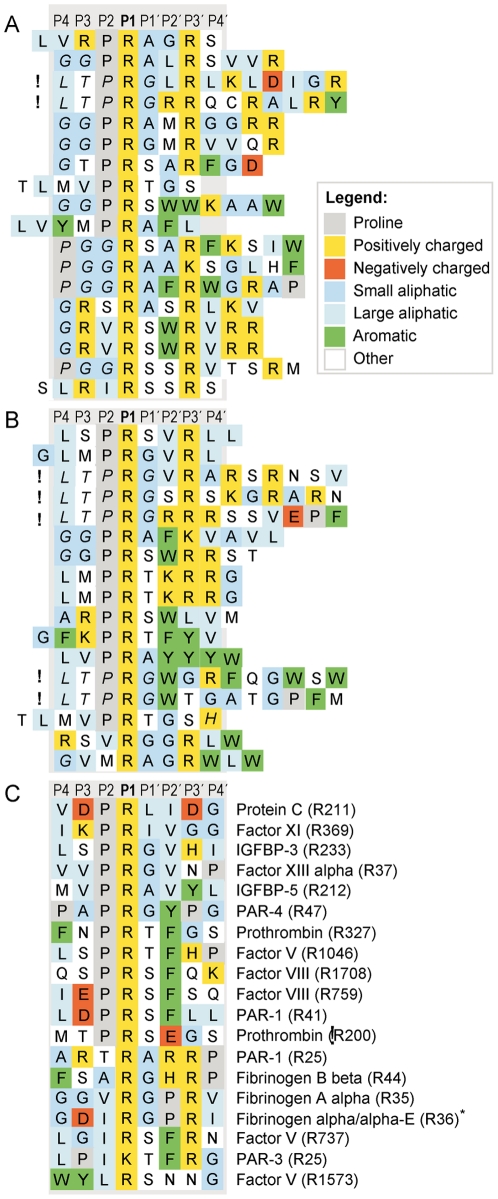
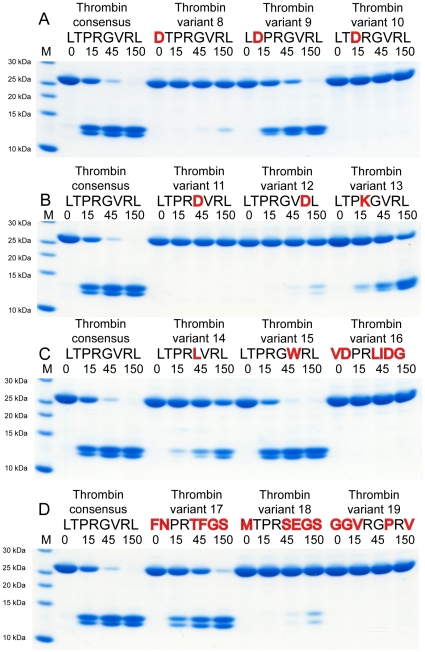
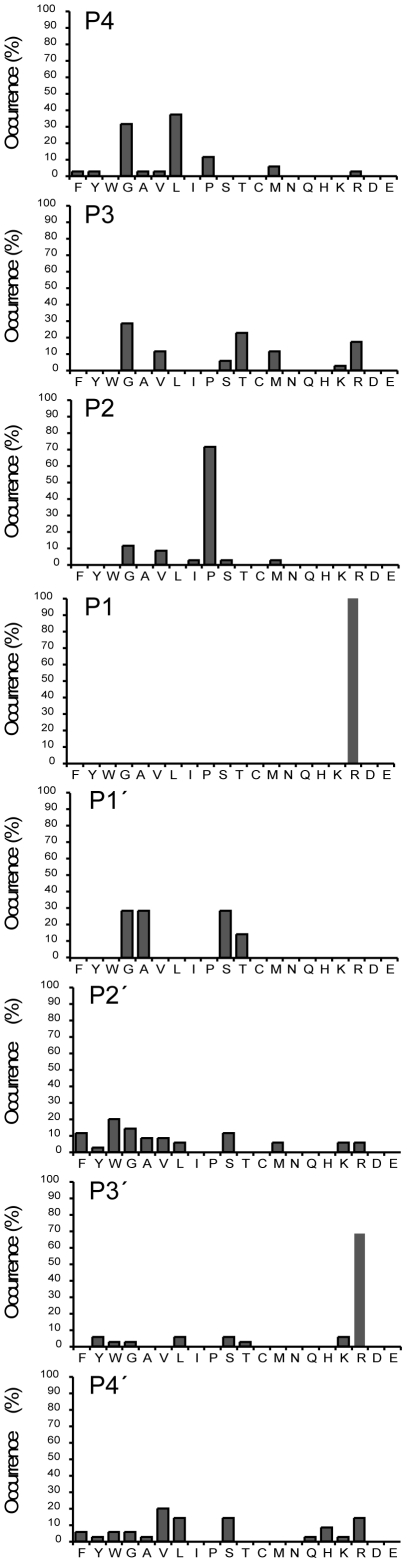
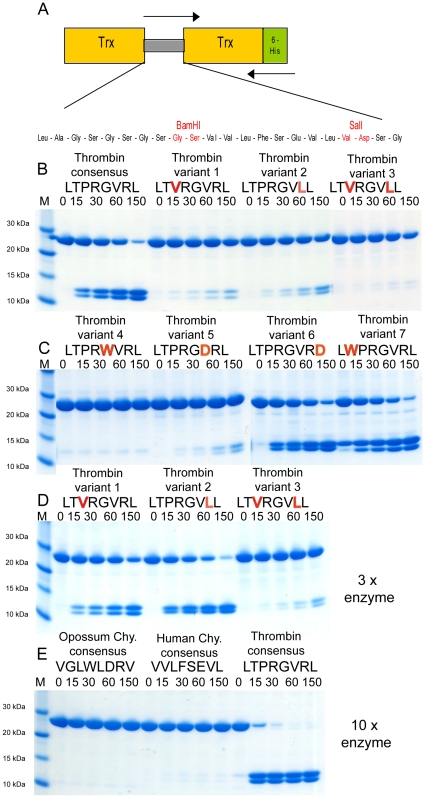
Thrombin is one of the most extensively studied of all proteases. Its central role in the coagulation cascade as well as several other areas has been thoroughly documented. Despite this, its consensus cleavage site has never been determined in detail. Here we have determined its extended substrate recognition profile using phage-display technology. The consensus recognition sequence was identified as, P2-Pro, P1-Arg, P1'-Ser/Ala/Gly/Thr, P2'-not acidic and P3'-Arg. Our analysis also identifies an important role for a P3'-arginine in thrombin substrates lacking a P2-proline. In order to study kinetics of this cooperative or additive effect we developed a system for insertion of various pre-selected cleavable sequences in a linker region between two thioredoxin molecules. Using this system we show that mutations of P2-Pro and P3'-Arg lead to an approximate 20-fold and 14-fold reduction, respectively in the rate of cleavage. Mutating both Pro and Arg results in a drop in cleavage of 200-400 times, which highlights the importance of these two positions for maximal substrate cleavage. Interestingly, no natural substrates display the obtained consensus sequence but represent sequences that show only 1-30% of the optimal cleavage rate for thrombin. This clearly indicates that maximal cleavage, excluding the help of exosite interactions, is not always desired, which may instead cause problems with dysregulated coagulation. It is likely exosite cooperativity has a central role in determining the specificity and rate of cleavage of many of these in vivo substrates. Major effects on cleavage efficiency were also observed for residues as far away as 4 amino acids from the cleavage site. Insertion of an aspartic acid in position P4 resulted in a drop in cleavage by a factor of almost 20 times.
凝血酶是研究最多的蛋白酶之一。其在凝血级联反应中的核心作用以及在其他几个领域的作用已经得到了充分的证明。尽管如此,其公认的裂解位点从未被详细确定过。在这里,我们使用噬菌体展示技术确定了其扩展的底物识别谱。共识识别序列被确定为 P2-Pro、P1-Arg、P1'-Ser/Ala/Gly/Thr、P2'-非酸性和 P3'-Arg。我们的分析还确定了 P3'-精氨酸在缺乏 P2-脯氨酸的凝血酶底物中的重要作用。为了研究这种协同或加性效应的动力学,我们开发了一种在两个硫氧还蛋白分子之间的连接区插入各种预选可切割序列的系统。使用该系统,我们表明 P2-Pro 和 P3'-Arg 的突变分别导致切割速率降低约 20 倍和 14 倍。同时突变 Pro 和 Arg 导致切割下降 200-400 倍,这突出了这两个位置对最大底物切割的重要性。有趣的是,没有天然底物显示出获得的共识序列,但代表仅显示凝血酶最佳切割率 1-30%的序列。这清楚地表明,最大切割(不包括外位点相互作用的帮助)并不总是需要的,这可能会导致失调的凝血问题。外位点协同作用很可能在确定许多这些体内底物的特异性和切割速率方面起着核心作用。即使远离切割位点 4 个氨基酸的残基也观察到对切割效率的重大影响。在位置 P4 插入天冬氨酸导致切割下降近 20 倍。