Burnett School of Biomedical Sciences, College of Medicine, University of Central Florida, Orlando, Florida, United States of America.
PLoS One. 2012;7(2):e32262. doi: 10.1371/journal.pone.0032262. Epub 2012 Feb 23.
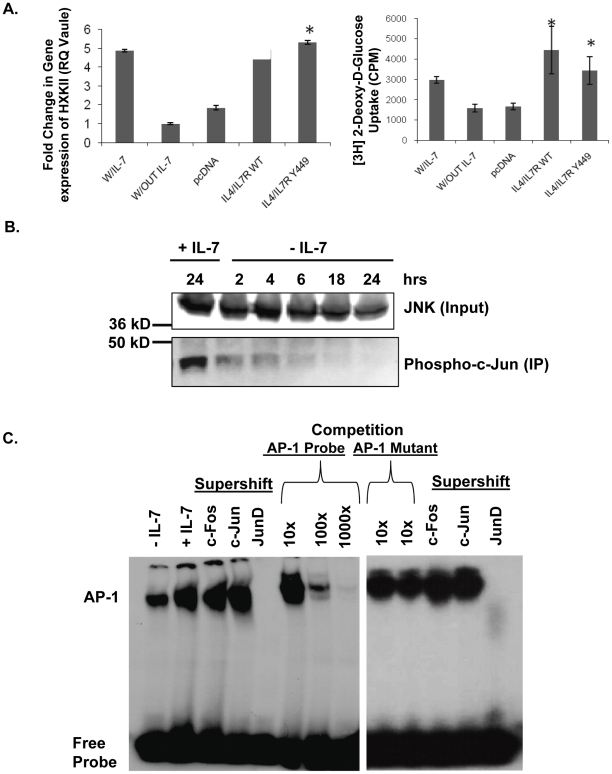
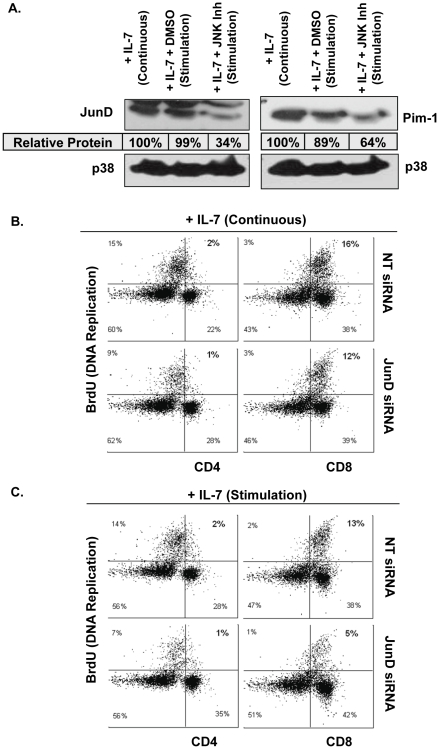
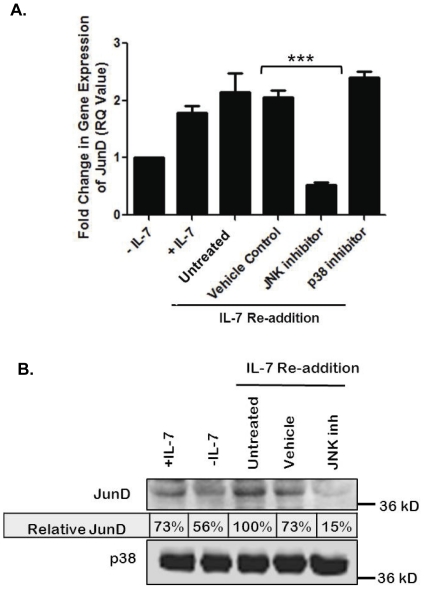
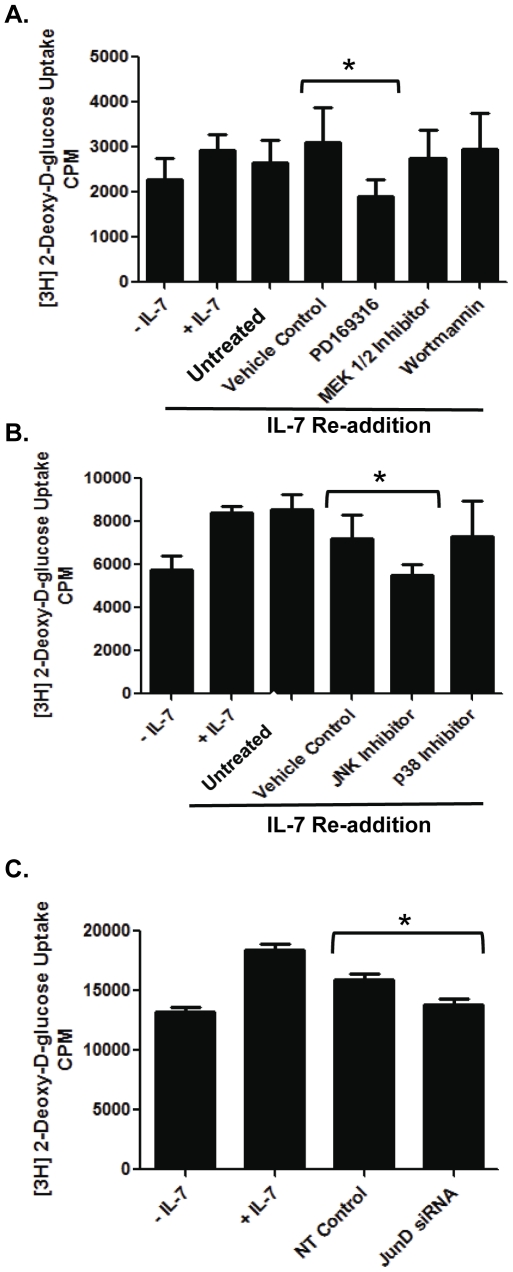
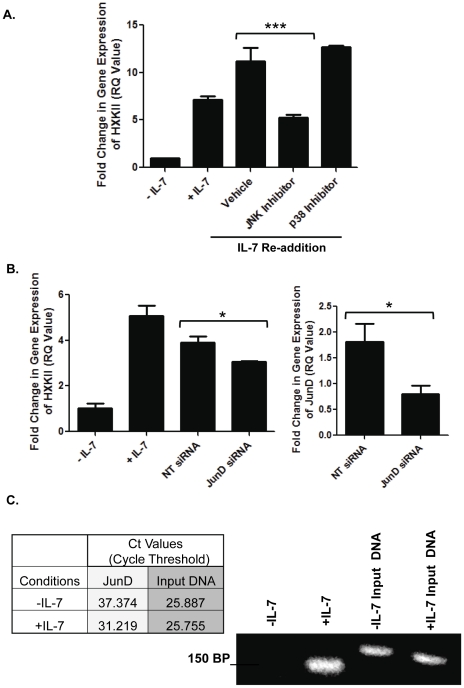
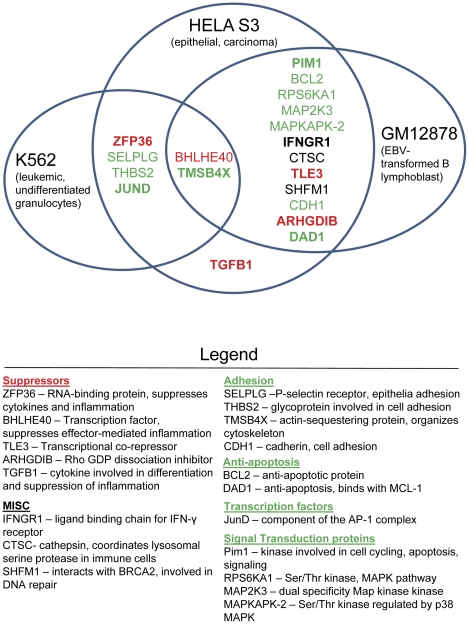
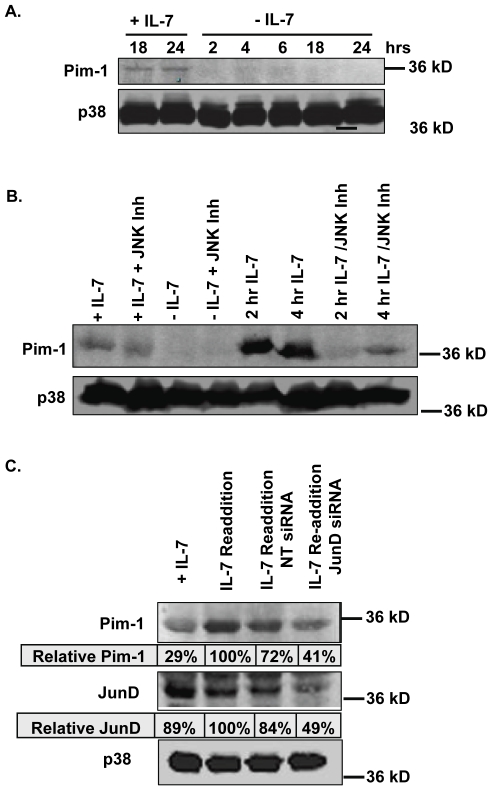
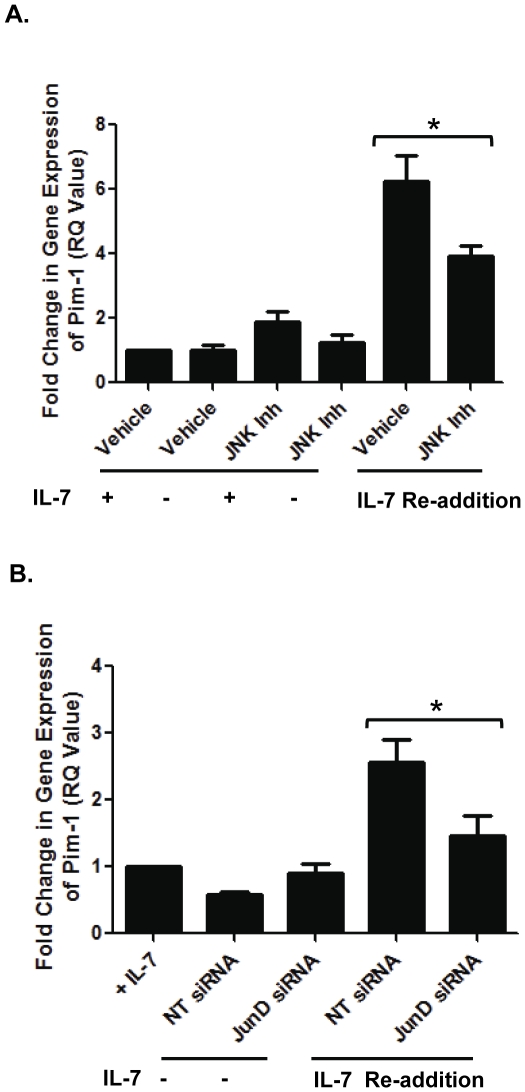
Interleukin-7 (IL-7) is an essential cytokine for lymphocyte growth that has the potential for promoting immune reconstitution. This feature makes IL-7 an ideal candidate for therapeutic development. As with other cytokines, signaling through the IL-7 receptor induces the JAK/STAT pathway. However, the broad scope of IL-7 regulatory targets likely necessitates the use of other signaling components whose identities remain poorly defined. To this end, we used an IL-7 dependent T-cell line to examine how expression of the glycolytic enzyme, Hexokinase II (HXKII) was regulated by IL-7 in a STAT5-independent manner. Our studies revealed that IL-7 promoted the activity of JNK (Jun N-terminal Kinase), and that JNK, in turn, drove the expression of JunD, a component of the Activating Protein 1 (AP-1) transcription factors. Gel shifts showed that the AP-1 complex induced by IL-7 contained JunD but not c-Fos or c-Jun. Inhibition of JNK/JunD blocked glucose uptake and HXKII gene expression, indicating that this pathway was responsible for promoting HXKII expression. Because others had shown that JunD was a negative regulator of cell growth, we performed a bioinformatics analysis to uncover possible JunD-regulated gene targets. Our search revealed that JunD could control the expression of proteins involved in signal transduction, cell survival and metabolism. One of these growth promoters was the oncogene, Pim-1. Pim-1 is an IL-7-induced protein that was inhibited when the activities of JNK or JunD were blocked, showing that in IL-7 dependent T-cells JunD can promote positive signals transduced through Pim-1. This was confirmed when the IL-7-induced proliferation of CD8 T-cells was impaired upon JunD inhibition. These results show that engagement of the IL-7 receptor drives a signal that is more complex than the JAK/STAT pathway, activating JNK and JunD to induce rapid growth stimulation through the expression of metabolic and signaling factors like HXKII and Pim-1.
白细胞介素-7 (IL-7) 是一种对淋巴细胞生长至关重要的细胞因子,具有促进免疫重建的潜力。这一特性使 IL-7 成为治疗开发的理想候选物。与其他细胞因子一样,通过 IL-7 受体的信号传导会诱导 JAK/STAT 途径。然而,IL-7 调节靶标的广泛范围可能需要使用其他信号成分,其身份仍未得到很好的定义。为此,我们使用依赖于 IL-7 的 T 细胞系来研究 IL-7 如何以 STAT5 非依赖性方式调节糖酵解酶己糖激酶 II (HXKII) 的表达。我们的研究表明,IL-7 促进了 JNK(Jun N-末端激酶)的活性,而 JNK 反过来又驱动了激活蛋白 1 (AP-1) 转录因子的 JunD 成分的表达。凝胶迁移显示,IL-7 诱导的 AP-1 复合物包含 JunD,但不包含 c-Fos 或 c-Jun。JNK/JunD 的抑制阻断了葡萄糖摄取和 HXKII 基因表达,表明该途径负责促进 HXKII 表达。由于其他人已经表明 JunD 是细胞生长的负调节剂,我们进行了生物信息学分析以揭示可能的 JunD 调节的基因靶标。我们的搜索结果表明,JunD 可以控制参与信号转导、细胞存活和代谢的蛋白质的表达。其中一个生长促进剂是癌基因 Pim-1。Pim-1 是一种由 IL-7 诱导的蛋白质,当 JNK 或 JunD 的活性被阻断时,其表达受到抑制,这表明在依赖于 IL-7 的 T 细胞中,JunD 可以促进通过 Pim-1 转导的阳性信号。当 JunD 抑制时,IL-7 诱导的 CD8 T 细胞增殖受损,这一结果得到了证实。这些结果表明,IL-7 受体的结合驱动的信号比 JAK/STAT 途径更复杂,通过表达代谢和信号因子(如 HXKII 和 Pim-1)激活 JNK 和 JunD 以诱导快速生长刺激。