Department of Anatomy and Neurobiology, Kinki University School of Medicine, Osaka-Sayama, Osaka, Japan.
PLoS One. 2012;7(2):e32342. doi: 10.1371/journal.pone.0032342. Epub 2012 Feb 23.
There is an increasing need for animal disease models for pathophysiological research and efficient drug screening. However, one of the technical barriers to the effective use of the models is the difficulty of non-invasive and sequential monitoring of the same animals. Micro-CT is a powerful tool for serial diagnostic imaging of animal models. However, soft tissue contrast resolution, particularly in the brain, is insufficient for detailed analysis, unlike the current applications of CT in the clinical arena. We address the soft tissue contrast resolution issue in this report.
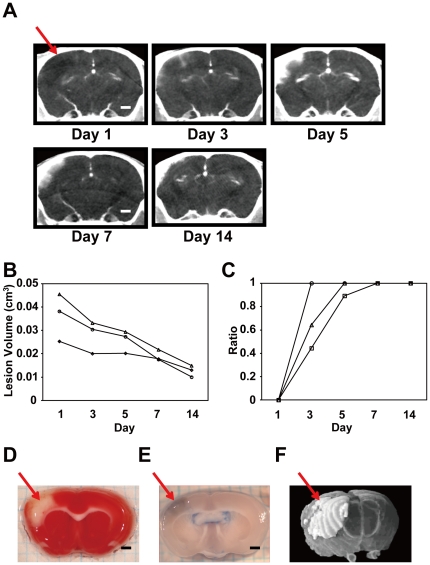
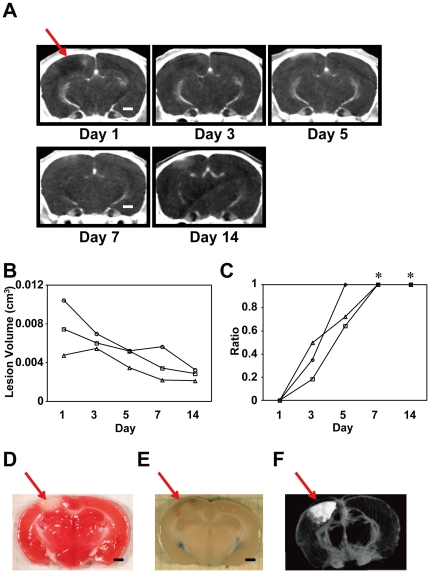
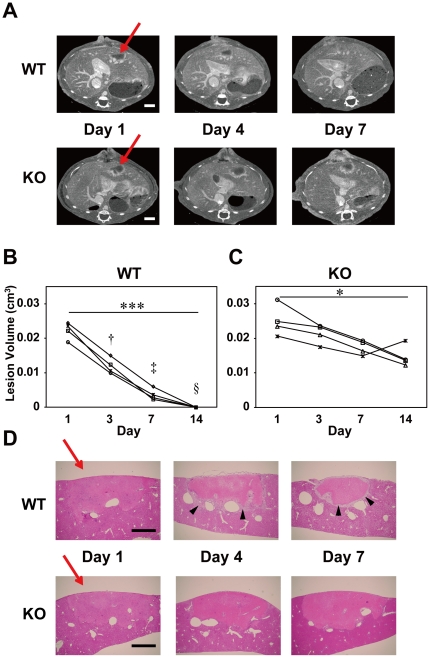
We performed contrast-enhanced CT (CECT) on mouse models of experimental cerebral infarction and hepatic ischemia. Pathological changes in each lesion were quantified for two weeks by measuring the lesion volume or the ratio of high attenuation area (%HAA), indicative of increased vascular permeability. We also compared brain images of stroke rats and ischemic mice acquired with micro-CT to those acquired with 11.7-T micro-MRI. Histopathological analysis was performed to confirm the diagnosis by CECT.
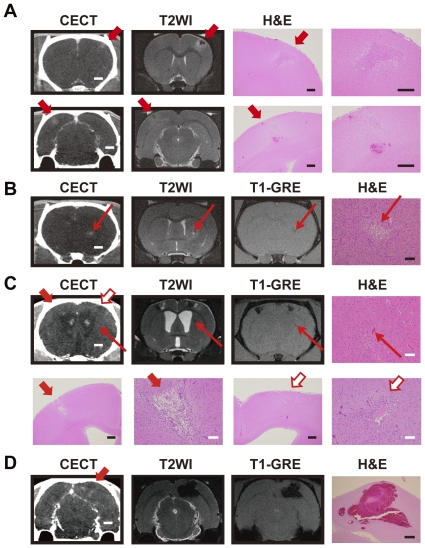
In the models of cerebral infarction, vascular permeability was increased from three days through one week after surgical initiation, which was also confirmed by Evans blue dye leakage. Measurement of volume and %HAA of the liver lesions demonstrated differences in the recovery process between mice with distinct genetic backgrounds. Comparison of CT and MR images acquired from the same stroke rats or ischemic mice indicated that accuracy of volumetric measurement, as well as spatial and contrast resolutions of CT images, was comparable to that obtained with MRI. The imaging results were also consistent with the histological data.
This study demonstrates that the CECT scanning method is useful in rodents for both quantitative and qualitative evaluations of pathologic lesions in tissues/organs including the brain, and is also suitable for longitudinal observation of the same animals.
对于病理生理学研究和高效药物筛选,动物疾病模型的需求日益增加。然而,有效使用这些模型的技术障碍之一是难以对同一动物进行非侵入性和连续监测。微计算机断层扫描(micro-CT)是对动物模型进行连续诊断成像的有力工具。然而,软组织对比分辨率,特别是在大脑中,对于详细分析来说还不够,这与 CT 在临床领域的当前应用不同。我们在本报告中解决了软组织对比分辨率问题。
我们对实验性脑梗死和肝缺血的小鼠模型进行了对比增强 CT(CECT)检查。通过测量病变体积或高衰减区比例(%HAA),我们对每个病变的病理变化进行了两周的定量分析,这表明血管通透性增加。我们还比较了微 CT 采集的中风大鼠和缺血小鼠的脑图像与 11.7-T 微 MRI 采集的脑图像。通过 CECT 进行组织病理学分析以确认诊断。
在脑梗死模型中,手术开始后三天至一周,血管通透性增加,伊文思蓝染料漏出也证实了这一点。肝病变的体积和%HAA 的测量表明,具有不同遗传背景的小鼠的恢复过程存在差异。来自同一中风大鼠或缺血小鼠的 CT 和 MR 图像的比较表明,体积测量的准确性以及 CT 图像的空间和对比分辨率与 MRI 相当。成像结果也与组织学数据一致。
本研究表明,CECT 扫描方法在啮齿动物中对于包括大脑在内的组织/器官的病理病变的定量和定性评估都很有用,也适合对同一动物进行纵向观察。