Molecular Biology Unit, Hospital Universitario de la Princesa, Instituto de Investigación Sanitaria Princesa and Red Española de Investigación en Patología Infecciosa, Madrid, Spain.
PLoS One. 2012;7(2):e32451. doi: 10.1371/journal.pone.0032451. Epub 2012 Feb 27.
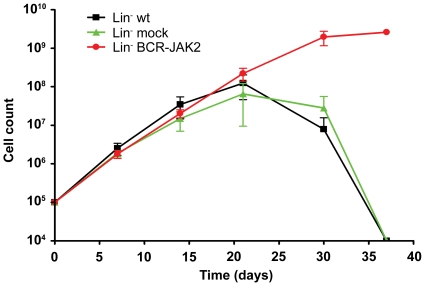
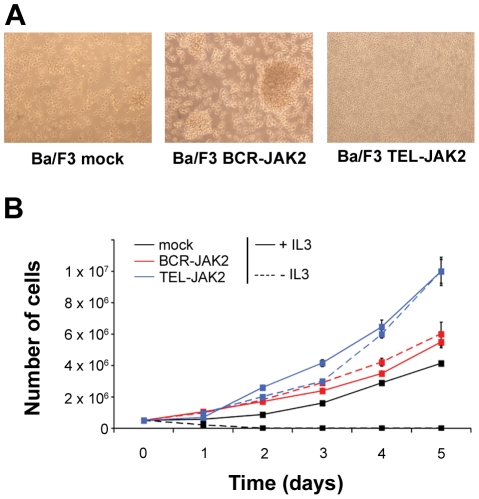
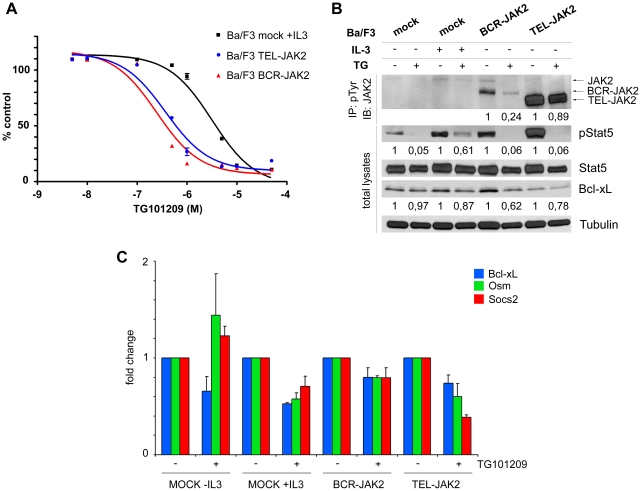
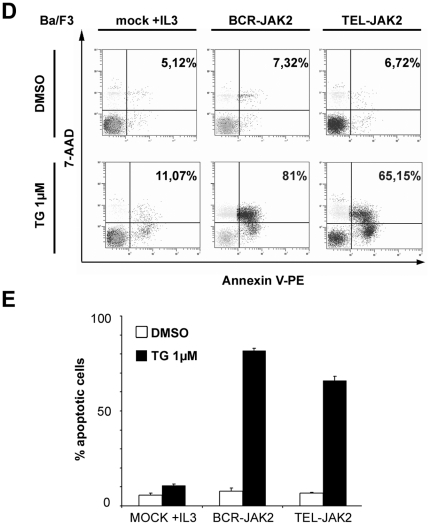
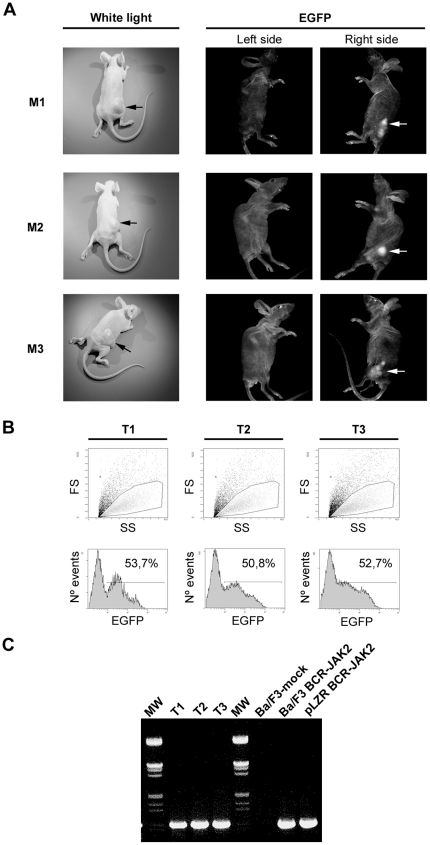
Chromosomal translocations in tumors frequently produce fusion genes coding for chimeric proteins with a key role in oncogenesis. Recent reports described a BCR-JAK2 fusion gene in fatal chronic and acute myeloid leukemia, but the functional behavior of the chimeric protein remains uncharacterized. We used fluorescence in situ hybridization and reverse transcription polymerase chain reaction (RT-PCR) assays to describe a BCR-JAK2 fusion gene from a patient with acute lymphoblastic leukemia. The patient has been in complete remission for six years following treatment and autologous transplantation, and minimal residual disease was monitored by real-time RT-PCR. BCR-JAK2 codes for a protein containing the BCR oligomerization domain fused to the JAK2 tyrosine-kinase domain. In vitro analysis of transfected cells showed that BCR-JAK2 is located in the cytoplasm. Transduction of hematopoietic Ba/F3 cells with retroviral vectors carrying BCR-JAK2 induced IL-3-independent cell growth, constitutive activation of the chimeric protein as well as STAT5 phosphorylation and translocation to the nuclei, where Bcl-xL gene expression was elicited. Primary mouse progenitor cells transduced with BCR-JAK2 also showed increased proliferation and survival. Treatment with the JAK2 inhibitor TG101209 abrogated BCR-JAK2 and STAT5 phosphorylation, decreased Bcl-xL expression and triggered apoptosis of transformed Ba/F3 cells. Therefore, BCR-JAK2 is a novel tyrosine-kinase with transforming activity. It deregulates growth factor-dependent proliferation and cell survival, which can be abrogated by the TG101209 inhibitor. Moreover, transformed Ba/F3 cells developed tumors when injected subcutaneously into nude mice, thus proving the tumorigenic capacity of BCR-JAK2 in vivo. Together these findings suggest that adult and pediatric patients with BCR-ABL-negative leukemia and JAK2 overexpression may benefit from targeted therapies.
肿瘤中的染色体易位经常产生融合基因,这些基因编码嵌合蛋白,在肿瘤发生中起着关键作用。最近的报告描述了在致命性慢性和急性髓性白血病中存在 BCR-JAK2 融合基因,但嵌合蛋白的功能行为仍未被阐明。我们使用荧光原位杂交和逆转录聚合酶链反应 (RT-PCR) 检测方法来描述一位急性淋巴细胞白血病患者的 BCR-JAK2 融合基因。该患者在接受治疗和自体移植后六年完全缓解,通过实时 RT-PCR 监测微小残留病。BCR-JAK2 编码的蛋白包含 BCR 寡聚化结构域融合到 JAK2 酪氨酸激酶结构域。转染细胞的体外分析表明,BCR-JAK2 位于细胞质中。携带 BCR-JAK2 的逆转录病毒载体转导造血 Ba/F3 细胞可诱导 IL-3 非依赖性细胞生长、嵌合蛋白的组成性激活以及 STAT5 磷酸化和转位到核内,从而诱导 Bcl-xL 基因表达。用 BCR-JAK2 转导的原代小鼠祖细胞也表现出增殖和存活增加。用 JAK2 抑制剂 TG101209 处理可阻断 BCR-JAK2 和 STAT5 磷酸化、降低 Bcl-xL 表达并触发转化的 Ba/F3 细胞凋亡。因此,BCR-JAK2 是一种具有转化活性的新型酪氨酸激酶。它使生长因子依赖性增殖和细胞存活失调,这种失调可被 TG101209 抑制剂阻断。此外,转化的 Ba/F3 细胞在皮下注射到裸鼠中时会形成肿瘤,从而证明了 BCR-JAK2 在体内的致瘤能力。这些发现表明,BCR-ABL 阴性白血病和 JAK2 过表达的成人和儿科患者可能受益于靶向治疗。