
疟疾合并坏疽:病例报告与文献综述
Malaria complicated by gangrene: a case presentation and review.
作者信息
Alkizim Faraj Omar, Matheka Duncan, Mwanda Otieno Walter
机构信息
School of Medicine, University of Nairobi, PO Box 30197-00100, Nairobi, Kenya.
出版信息
Pan Afr Med J. 2011;10:46. Epub 2011 Nov 25.
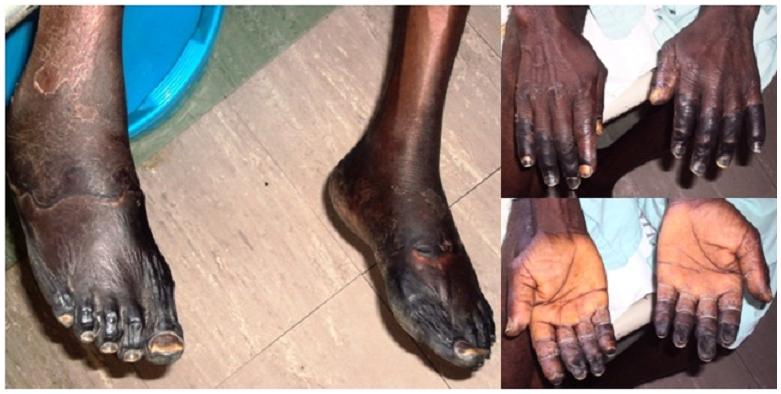
Symmetrical peripheral gangrene (SPG) is an extremely rare complication of malaria. It occurs acutely and progresses rapidly to cause irreversible necrosis of tissue following which debridement or amputation is inevitable. We present a case of malaria complicated by SPG. A 54-year old male developed SPG two days after he was diagnosed with severe malaria and treated with intravenous quinine. Despite intervention quad-amputation was necessary as the gangrene had involved all four limbs. SPG secondary to malaria is caused by obstruction of arterioles following sequestration of parasite infected erythrocytes. This is extremely rare, hence almost never anticipated during management of malaria patients. Furthermore due to its rapid progression, it is almost always detected at an advanced irreversible stage. Physicians managing malaria should therefore be vigilant, and look out for SPG, as its prognosis is dependent on correct and timely intervention.
对称性外周坏疽(SPG)是疟疾一种极其罕见的并发症。它急性发作且进展迅速,会导致组织发生不可逆坏死,之后清创或截肢不可避免。我们报告一例并发SPG的疟疾病例。一名54岁男性在被诊断为重症疟疾并接受静脉注射奎宁治疗两天后出现SPG。尽管进行了干预,但由于坏疽已累及四肢,四部位截肢仍有必要。疟疾继发的SPG是由于寄生虫感染的红细胞隔离后小动脉阻塞所致。这极为罕见,因此在疟疾患者的治疗过程中几乎从未被预料到。此外,由于其进展迅速,几乎总是在晚期不可逆阶段才被发现。因此,治疗疟疾的医生应保持警惕,留意SPG,因为其预后取决于正确及时的干预。
 Zotero 插件