Department of Virology 1, National Institute of Infectious Diseases, Tokyo, Japan.
PLoS Negl Trop Dis. 2012;6(2):e1536. doi: 10.1371/journal.pntd.0001536. Epub 2012 Feb 28.
Progress in dengue vaccine development has been hampered by limited understanding of protective immunity against dengue virus infection. Conventional neutralizing antibody titration assays that use FcγR-negative cells do not consider possible infection-enhancement activity. We reasoned that as FcγR-expressing cells are the major target cells of dengue virus, neutralizing antibody titration assays using FcγR-expressing cells that determine the sum of neutralizing and infection-enhancing activity, may better reflect the biological properties of antibodies in vivo.
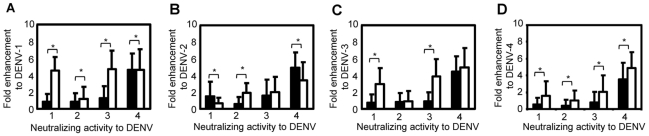
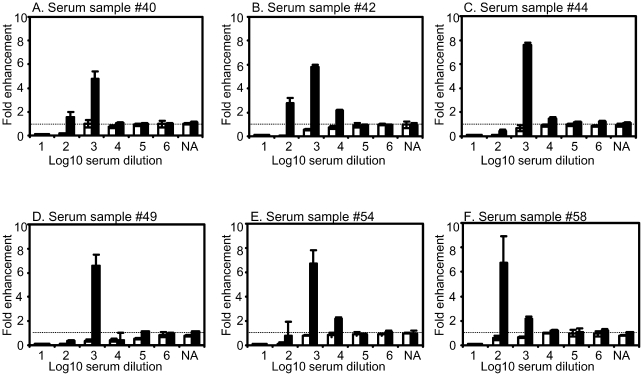
We evaluated serum samples from 80 residents of a dengue endemic country, Malaysia, for neutralizing activity, and infection-enhancing activity at 1∶10 serum dilution by using FcγR-negative BHK cells and FcγR-expressing BHK cells. The serum samples consisted of a panel of patients with acute DENV infection (31%, 25/80) and a panel of donors without acute DENV infection (69%, 55/80). A high proportion of the tested serum samples (75%, 60/80) demonstrated DENV neutralizing activity (PRNT(50)≥10) and infection-enhancing activity. Eleven of 18 serum samples from patients with acute secondary DENV infection demonstrated neutralizing activity to the infecting serotype determined by using FcγR-negative BHK cells (PRNT(50)≥10), but not when determined by using FcγR-expressing cells.
Human serum samples with low neutralizing activity determined by using FcγR-negative cells showed DENV infection-enhancing activity using FcγR-expressing cells, whereas those with high neutralizing activity determined by using FcγR-negative cells demonstrate low or no infection-enhancing activity using FcγR-expressing cells. The results suggest an inverse relationship between neutralizing antibody titer and infection-enhancing activity, and that neutralizing activity determined by using FcγR-expressing cells, and not the activity determined by using FcγR-negative cells, may better reflect protection to DENV infection in vivo.
登革热疫苗的研发进展一直受到对登革病毒感染保护性免疫认识有限的阻碍。使用 FcγR 阴性细胞的常规中和抗体滴度测定不能考虑可能的感染增强活性。我们推断,由于 FcγR 表达细胞是登革病毒的主要靶细胞,使用 FcγR 表达细胞测定中和和感染增强活性之和的中和抗体滴度测定,可能更好地反映体内抗体的生物学特性。
我们使用 FcγR 阴性 BHK 细胞和 FcγR 表达 BHK 细胞,在血清稀释度为 1∶10 时,评估了来自登革热流行国家马来西亚的 80 名居民的血清样本的中和活性和感染增强活性。血清样本包括一组急性 DENV 感染患者(31%,25/80)和一组无急性 DENV 感染的供体(69%,55/80)。检测的血清样本中有很大比例(75%,60/80)表现出 DENV 中和活性(PRNT(50)≥10)和感染增强活性。18 份来自急性二次 DENV 感染患者的血清样本中有 11 份在使用 FcγR 阴性 BHK 细胞测定时对感染血清型表现出中和活性(PRNT(50)≥10),但在使用 FcγR 表达细胞测定时则没有。
使用 FcγR 阴性细胞测定的中和活性低的人血清样本在使用 FcγR 表达细胞时显示出 DENV 感染增强活性,而在使用 FcγR 阴性细胞测定时具有高中和活性的样本在使用 FcγR 表达细胞时显示出低或无感染增强活性。结果表明中和抗体滴度与感染增强活性之间存在反比关系,并且使用 FcγR 表达细胞测定的中和活性而不是使用 FcγR 阴性细胞测定的活性可能更好地反映体内对 DENV 感染的保护作用。