Ecol Evol. 2011 Dec;1(4):517-28. doi: 10.1002/ece3.45.
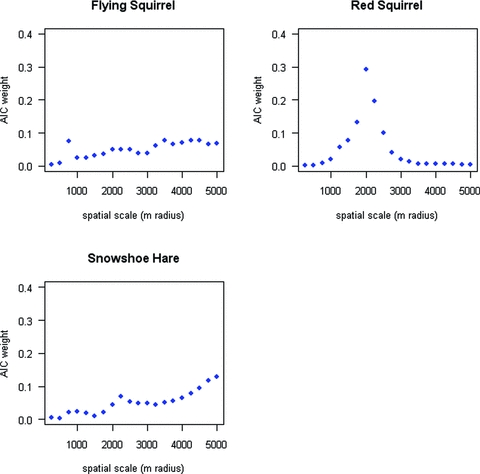
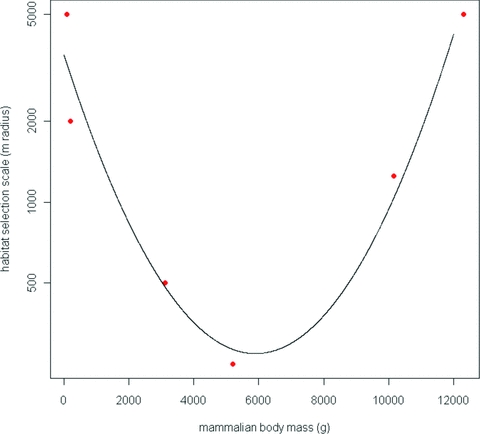
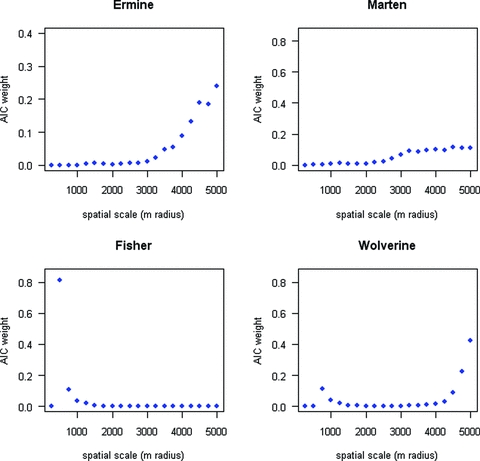
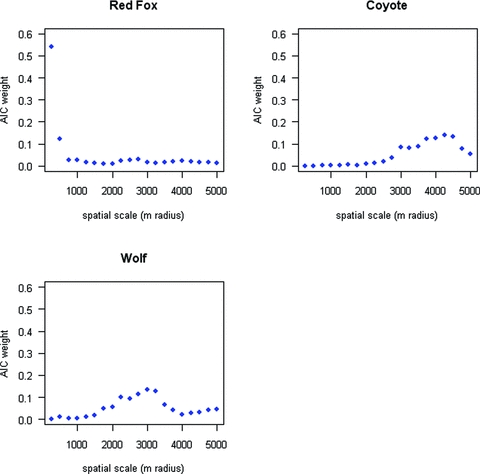
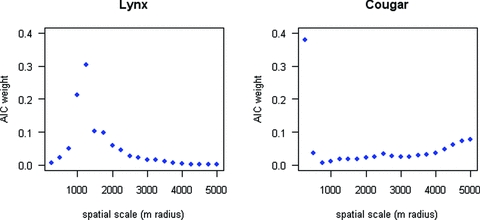
Niche theory in its various forms is based on those environmental factors that permit species persistence, but less work has focused on defining the extent, or size, of a species' environment: the area that explains a species' presence at a point in space. We proposed that this habitat extent is identifiable from a characteristic scale of habitat selection, the spatial scale at which habitat best explains species' occurrence. We hypothesized that this scale is predicted by body size. We tested this hypothesis on 12 sympatric terrestrial mammal species in the Canadian Rocky Mountains. For each species, habitat models varied across the 20 spatial scales tested. For six species, we found a characteristic scale; this scale was explained by species' body mass in a quadratic relationship. Habitat measured at large scales best-predicted habitat selection in both large and small species, and small scales predict habitat extent in medium-sized species. The relationship between body size and habitat selection scale implies evolutionary adaptation to landscape heterogeneity as the driver of scale-dependent habitat selection.
生态位理论的各种形式都是基于那些允许物种持续存在的环境因素,但较少的工作集中在定义物种环境的范围或大小上:即解释物种在空间中存在的区域。我们提出,这种生境范围可以从特征性的生境选择尺度中识别出来,即生境最佳解释物种出现的空间尺度。我们假设该尺度可以由体型预测。我们在加拿大落基山脉的 12 种同域陆生哺乳动物物种上检验了这个假说。对于每个物种,生境模型在测试的 20 个空间尺度上都有所不同。对于六个物种,我们发现了一个特征尺度;该尺度与物种的体重呈二次关系。在大尺度上测量的生境最能预测大、小物种的生境选择,而小尺度则能预测中体型物种的生境范围。体型与生境选择尺度之间的关系意味着,作为尺度依赖生境选择的驱动因素,对景观异质性的进化适应。