Unidad Académica de Sistemas Arrecifales, Instituto de Ciencias del Mar y Limnología, Universidad Nacional Autónoma de México, Puerto Morelos, Quintana Roo, México.
PLoS One. 2012;7(3):e32859. doi: 10.1371/journal.pone.0032859. Epub 2012 Mar 1.
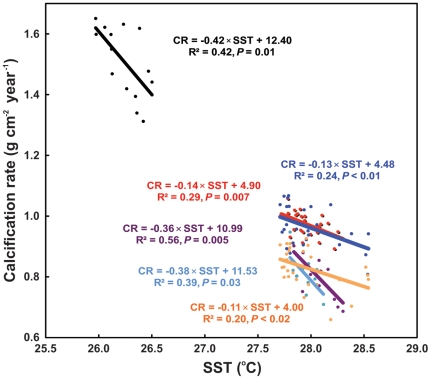
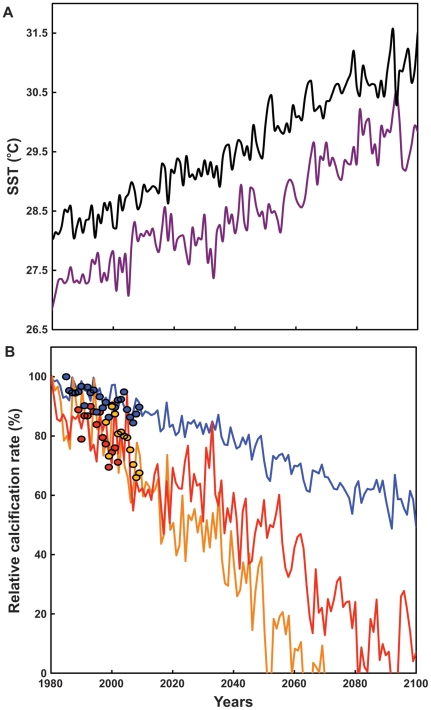
Reductions in calcification in reef-building corals occur when thermal conditions are suboptimal, but it is unclear how they vary between genera in response to the same thermal stress event. Using densitometry techniques, we investigate reductions in the calcification rate of massive Porites spp. from the Great Barrier Reef (GBR), and P. astreoides, Montastraea faveolata, and M. franksi from the Mesoamerican Barrier Reef (MBR), and correlate them to thermal stress associated with ocean warming. Results show that Porites spp. are more sensitive to increasing temperature than Montastraea, with calcification rates decreasing by 0.40 g cm(-2) year(-1) in Porites spp. and 0.12 g cm(-2) year(-1) in Montastraea spp. for each 1°C increase. Under similar warming trends, the predicted calcification rates at 2100 are close to zero in Porites spp. and reduced by 40% in Montastraea spp. However, these predictions do not account for ocean acidification. Although yearly mean aragonite saturation (Ω(ar)) at MBR sites has recently decreased, only P. astreoides at Chinchorro showed a reduction in calcification. In corals at the other sites calcification did not change, indicating there was no widespread effect of Ω(ar) changes on coral calcification rate in the MBR. Even in the absence of ocean acidification, differential reductions in calcification between Porites spp. and Montastraea spp. associated with warming might be expected to have significant ecological repercussions. For instance, Porites spp. invest increased calcification in extension, and under warming scenarios it may reduce their ability to compete for space. As a consequence, shifts in taxonomic composition would be expected in Indo-Pacific reefs with uncertain repercussions for biodiversity. By contrast, Montastraea spp. use their increased calcification resources to construct denser skeletons. Reductions in calcification would therefore make them more susceptible to both physical and biological breakdown, seriously affecting ecosystem function in Atlantic reefs.
当热条件不理想时,造礁珊瑚的钙化作用会减少,但尚不清楚它们在应对相同的热胁迫事件时,在不同属之间的变化情况。我们使用密度测定技术,研究了大堡礁(GBR)的块状 Porites spp. 和中美洲堡礁(MBR)的 P. astreoides、Montastraea faveolata 和 M. franksi 的钙化率降低情况,并将其与与海洋变暖相关的热胁迫相关联。结果表明,Porites spp. 对温度升高比 Montastraea 更敏感,Porites spp. 的钙化率每升高 1°C 就会降低 0.40 g cm(-2) year(-1),而 Montastraea spp. 的钙化率则降低 0.12 g cm(-2) year(-1)。在类似的变暖趋势下,到 2100 年,Porites spp. 的预测钙化率接近零,而 Montastraea spp. 的钙化率则降低了 40%。然而,这些预测并未考虑到海洋酸化。尽管 MBR 站点的年平均霰石饱和度(Ω(ar))最近有所下降,但只有 Chinchorro 的 P. astreoides 显示出钙化减少。在其他地点的珊瑚中,钙化没有变化,这表明 Ω(ar) 变化对 MBR 中珊瑚钙化率没有普遍影响。即使没有海洋酸化,与变暖相关的 Porites spp. 和 Montastraea spp. 之间钙化作用的差异减少,也可能对珊瑚礁生态系统产生重大影响。例如,Porites spp. 会增加在延伸过程中的钙化作用,而在变暖的情况下,它可能会降低其竞争空间的能力。因此,预计在印度-太平洋珊瑚礁中会出现分类组成的变化,这对生物多样性可能会产生不确定的影响。相比之下,Montastraea spp. 会利用其增加的钙化资源来构建更密集的骨骼。因此,钙化作用的减少会使它们更容易受到物理和生物破坏的影响,严重影响大西洋珊瑚礁的生态系统功能。