Department of Molecular Oncology, John Wayne Cancer Institute at Saint John's Health Center, Santa Monica, California 90404, USA.
J Invest Dermatol. 2012 Jun;132(6):1689-97. doi: 10.1038/jid.2012.36. Epub 2012 Mar 8.
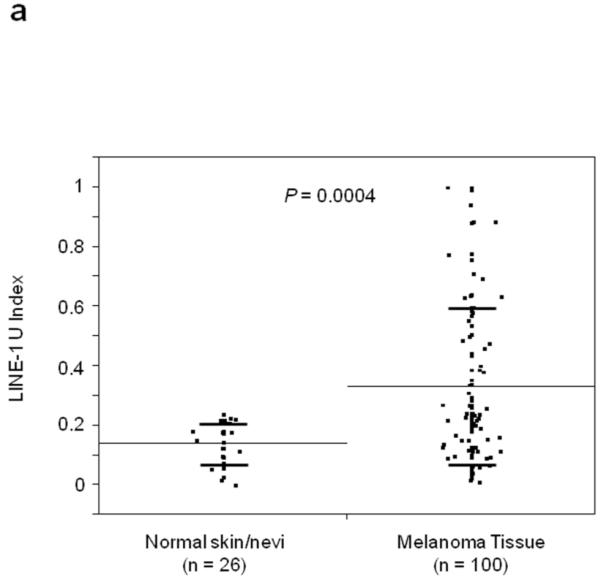
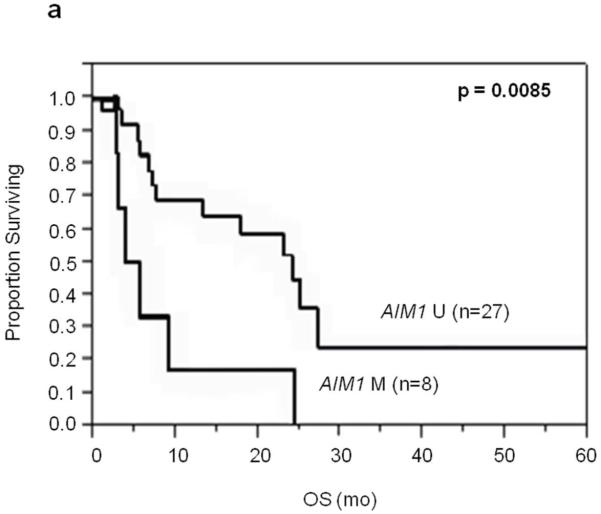
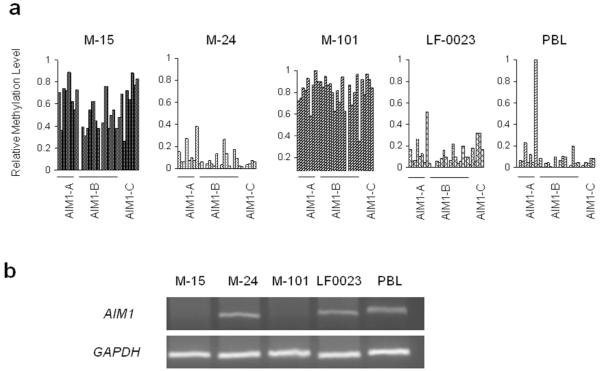
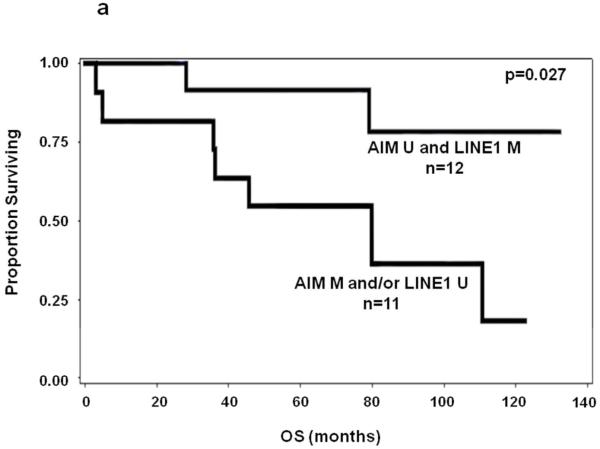
Aberrations in the methylation status of noncoding genomic repeat DNA sequences and specific gene promoter region are important epigenetic events in melanoma progression. Promoter methylation status in long interspersed nucleotide element-1 (LINE-1) and absent in melanoma-1 (AIM1; 6q21) associated with melanoma progression and disease outcome was assessed. LINE-1 and AIM1 methylation status was assessed in paraffin-embedded archival tissue (PEAT; n = 133) and in melanoma patients' serum (n = 56). LINE-1 U-Index (hypomethylation) and AIM1 were analyzed in microdissected melanoma PEAT sections. The LINE-1 U-Index of melanoma (n = 100) was significantly higher than that of normal skin (n = 14) and nevi (n = 12; P = 0.0004). LINE-1 U-Index level was elevated with increasing American Joint Committee on Cancer (AJCC) stage (P<0.0001). AIM1 promoter hypermethylation was found in higher frequency (P = 0.005) in metastatic melanoma (65%) than in primary melanomas (38%). When analyzed, high LINE-1 U-Index and/or AIM1 methylation in melanomas were associated with disease-free survival (DFS) and overall survival (OS) in stage I/II patients (P = 0.017 and 0.027, respectively). In multivariate analysis, melanoma AIM1 methylation status was a significant prognostic factor of OS (P = 0.032). Furthermore, serum unmethylated LINE-1 was at higher levels in both stage III (n = 20) and stage IV (n = 36) patients compared with healthy donors (n = 14; P = 0.022). Circulating methylated AIM1 was detected in patients' serum and was predictive of OS in stage IV patients (P = 0.009). LINE-1 hypomethylation and AIM1 hypermethylation have prognostic utility in both melanoma patients' tumors and serum.
非编码基因组重复 DNA 序列和特定基因启动子区域的甲基化状态异常是黑色素瘤进展中的重要表观遗传事件。评估了与黑色素瘤进展和疾病结果相关的长散布核元件-1(LINE-1)和黑色素瘤缺失 1(AIM1;6q21)的启动子甲基化状态。评估了石蜡包埋存档组织(PEAT;n=133)和黑色素瘤患者血清(n=56)中的 LINE-1 和 AIM1 甲基化状态。分析了微切割黑色素瘤 PEAT 切片中的 LINE-1 U-Index(低甲基化)和 AIM1。黑色素瘤的 LINE-1 U-Index(n=100)明显高于正常皮肤(n=14)和痣(n=12;P=0.0004)。LINE-1 U-Index 水平随着美国癌症联合委员会(AJCC)分期的增加而升高(P<0.0001)。在转移性黑色素瘤(65%)中发现 AIM1 启动子超甲基化的频率更高(P=0.005)比原发性黑色素瘤(38%)。当进行分析时,黑色素瘤中高 LINE-1 U-Index 和/或 AIM1 甲基化与 I/II 期患者的无病生存率(DFS)和总生存率(OS)相关(P=0.017 和 0.027)。在多变量分析中,黑色素瘤 AIM1 甲基化状态是 OS 的显著预后因素(P=0.032)。此外,与健康供体(n=14)相比,III 期(n=20)和 IV 期(n=36)患者的血清未甲基化 LINE-1 水平更高(P=0.022)。在患者血清中检测到循环甲基化的 AIM1,并且对 IV 期患者的 OS 具有预测性(P=0.009)。LINE-1 低甲基化和 AIM1 高甲基化在黑色素瘤患者的肿瘤和血清中均具有预后价值。