Department of Molecular Microbiology and Immunology, Oregon Health & Science University, Portland, OR 97239, USA.
Stroke. 2012 May;43(5):1383-9. doi: 10.1161/STROKEAHA.111.641522. Epub 2012 Mar 8.
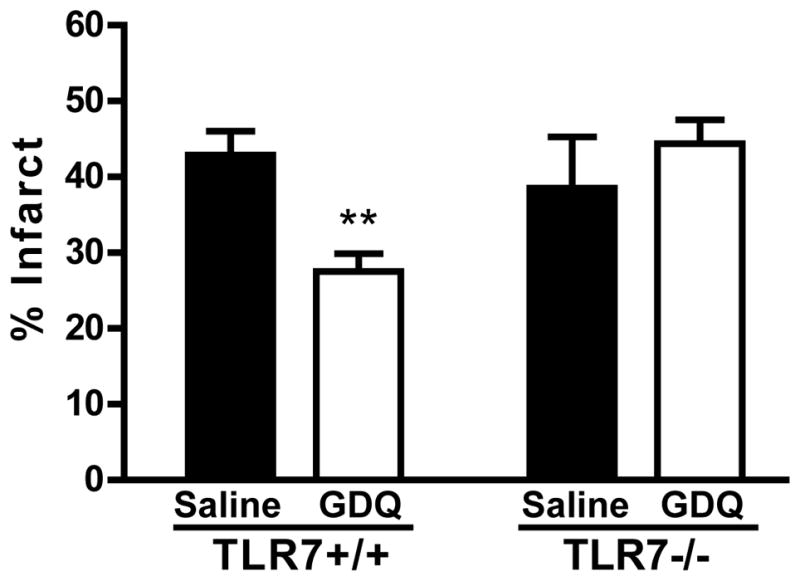
Systemic administration of Toll-like receptor (TLR) 4 and TLR9 agonists before cerebral ischemia have been shown to reduce ischemic injury by reprogramming the response of the brain to stroke. Our goal was to explore the mechanism of TLR-induced neuroprotection by determining whether a TLR7 agonist also protects against stroke injury.
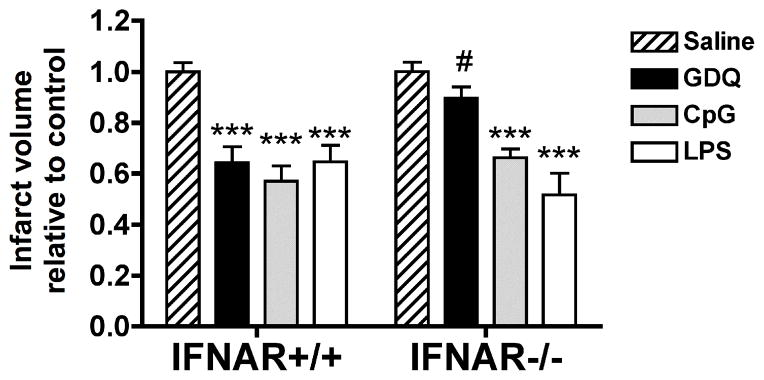
C57Bl/6, TNF(-/-), interferon (IFN) regulatory factor 7(-/-), or type I IFN receptor (IFNAR)(-/-) mice were subcutaneously administered the TLR7 agonist Gardiquimod (GDQ) 72 hours before middle cerebral artery occlusion. Infarct volume and functional outcome were determined after reperfusion. Plasma cytokine responses and induction of mRNA for IFN-related genes in the brain were measured. IFNAR(-/-) mice also were treated with the TLR4 agonist (lipopolysaccharide) or the TLR9 agonist before middle cerebral artery occlusion and infarct volumes measured.
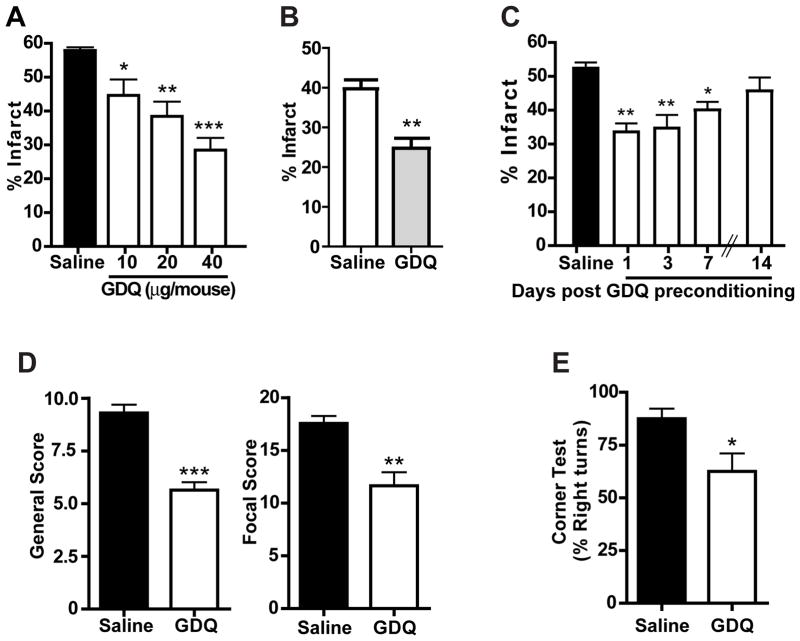
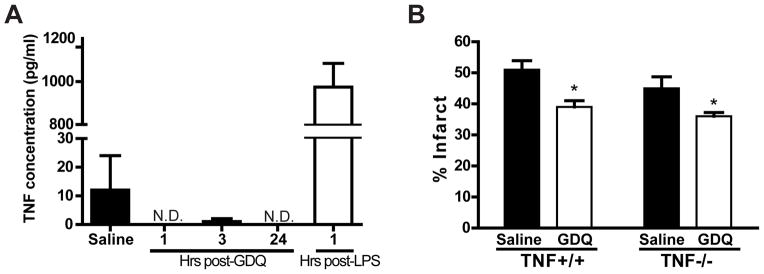
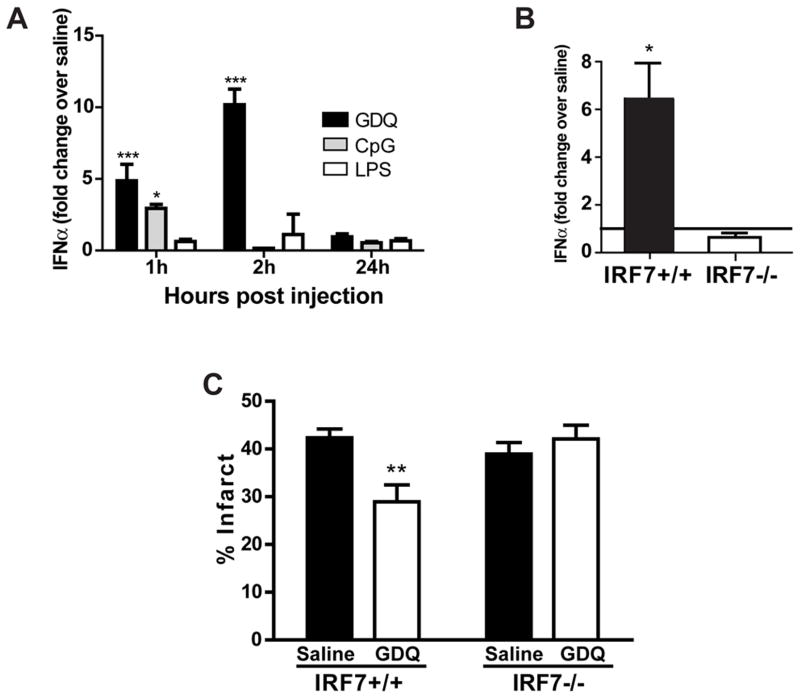
The results show that GDQ reduces infarct volume as well as functional deficits in mice. GDQ pretreatment provided robust neuroprotection in TNF(-/-) mice, indicating that TNF was not essential. GDQ induced a significant increase in plasma IFNα levels and both IRF7(-/-) and IFNAR(-/-) mice failed to be protected, implicating a role for IFN signaling in TLR7-mediated protection.
Our studies provide the first evidence that TLR7 preconditioning can mediate neuroprotection against ischemic injury. Moreover, we show that the mechanism of protection is unique from other TLR preconditioning ligands in that it is independent of TNF and dependent on IFNAR.
在脑缺血前全身性给予 Toll 样受体(TLR)4 和 TLR9 激动剂已被证明通过重新编程大脑对中风的反应来减少缺血性损伤。我们的目标是通过确定 TLR7 激动剂是否也能保护免受中风损伤来探索 TLR 诱导的神经保护机制。
C57Bl/6、TNF(-/-)、干扰素(IFN)调节因子 7(-/-)或 I 型 IFN 受体(IFNAR)(-/-)小鼠在大脑中动脉闭塞前 72 小时皮下给予 TLR7 激动剂 Gardiquimod(GDQ)。再灌注后确定梗死体积和功能结果。测量血浆细胞因子反应和脑中 IFN 相关基因的 mRNA 诱导。IFNAR(-/-)小鼠也在大脑中动脉闭塞前用 TLR4 激动剂(脂多糖)或 TLR9 激动剂治疗,并测量梗死体积。
结果表明,GDQ 可减少小鼠的梗死体积和功能缺陷。GDQ 预处理为 TNF(-/-)小鼠提供了强大的神经保护作用,表明 TNF 不是必需的。GDQ 诱导血浆 IFNα 水平显著增加,IRF7(-/-)和 IFNAR(-/-)小鼠均未得到保护,表明 IFN 信号转导在 TLR7 介导的保护中起作用。
我们的研究首次提供了证据,表明 TLR7 预处理可以介导对缺血性损伤的神经保护。此外,我们表明,保护机制与其他 TLR 预处理配体不同,它独立于 TNF 并依赖于 IFNAR。