Department of Nephrology, Clinical Sciences, Lund University, Lund, Sweden.
PLoS One. 2012;7(3):e32439. doi: 10.1371/journal.pone.0032439. Epub 2012 Mar 5.
ANCA-Associated Systemic Vasculitis (AASV) is characterized by leukocytoclasis, accumulation of unscavenged apoptotic and necrotic neutrophils in perivascular tissues. Dysregulation of neutrophil cell death may contribute directly to the pathogenesis of AASV.
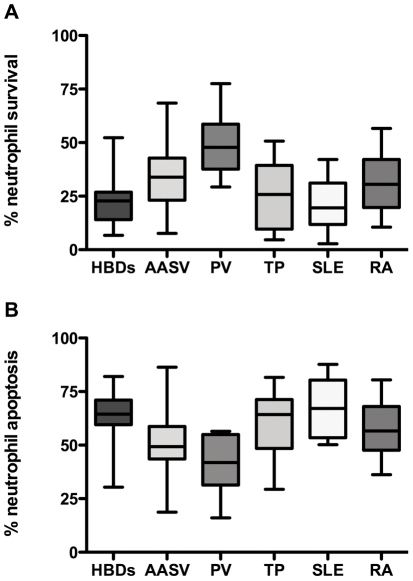
Neutrophils from Healthy Blood Donors (HBD), patients with AASV most in complete remission, Polycythemia Vera (PV), Systemic Lupus Erythematosus (SLE), Rheumatoid Arthritis (RA) and renal transplant recipients (TP) were incubated in vitro, and the rate of spontaneous apoptosis was measured by FACS. Plasma levels of cytokines and sFAS were measured with cytometric bead array and ELISA. Expression of pro/anti-apoptotic factors, transcription factors C/EBP-α, C/EBP-β and PU.1 and inhibitors of survival/JAK2-pathway were measured by real-time-PCR.
AASV, PV and RA neutrophils had a significantly lower rate of apoptosis compared to HBD neutrophils (AASV 50 ± 14% vs. HBD 64 ± 11%, p<0.0001). In RA but not in AASV and PV, low apoptosis rate correlated with increased plasma levels of GM-CSF and high mRNA levels of anti-apoptotic factors Bcl-2A1 and Mcl-1. AASV patients had normal levels of G-CSF, GM-CSF and IL-3. Both C/EBP-α, C/EBP-β were significantly higher in neutrophils from AASV patients than HBD. Levels of sFAS were significantly higher in AASV compared to HBD.
Neutrophil apoptosis rates in vitro are decreased in AASV, RA and PV but mechanisms seem to differ. Increased mRNA levels of granulopoiesis-associated transcription factors and increased levels of sFAS in plasma were observed in AASV. Additional studies are required to define the mechanisms behind the decreased apoptosis rates, and possible connections with accumulation of dying neutrophils in regions of vascular lesions in AASV patients.
抗中性粒细胞胞浆抗体(ANCA)相关性系统性血管炎(AASV)的特征是白细胞碎裂,血管周围组织中未被清除的凋亡和坏死中性粒细胞的积累。中性粒细胞细胞死亡的失调可能直接导致 AASV 的发病机制。
从健康献血者(HBD)、处于完全缓解期的 AASV 患者、真性红细胞增多症(PV)、系统性红斑狼疮(SLE)、类风湿关节炎(RA)和肾移植受者(TP)中体外孵育中性粒细胞,并通过流式细胞术测量自发性凋亡率。用细胞因子和 sFAS 的流式细胞术微珠阵列和 ELISA 测量血浆水平。通过实时-PCR 测量促凋亡/抗凋亡因子、转录因子 C/EBP-α、C/EBP-β 和 PU.1 以及生存/JAK2 途径抑制剂的表达。
与 HBD 中性粒细胞相比,AASV、PV 和 RA 中性粒细胞的凋亡率显著降低(AASV 50 ± 14% vs. HBD 64 ± 11%,p<0.0001)。在 RA 中,但不在 AASV 和 PV 中,低凋亡率与 GM-CSF 血浆水平升高和抗凋亡因子 Bcl-2A1 和 Mcl-1 的 mRNA 水平升高相关。AASV 患者的 G-CSF、GM-CSF 和 IL-3 水平正常。AASV 患者的中性粒细胞中 C/EBP-α 和 C/EBP-β 水平均显著高于 HBD。AASV 中 sFAS 的水平明显高于 HBD。
AASV、RA 和 PV 患者体外中性粒细胞凋亡率降低,但机制似乎不同。在 AASV 中观察到与粒细胞生成相关的转录因子的 mRNA 水平升高和血浆中 sFAS 水平升高。需要进一步研究以确定降低凋亡率的机制,以及与 AASV 患者血管病变区域死亡中性粒细胞积累的可能联系。