Department of Ecology and Evolutionary Biology, Cornell University, Ithaca, New York, United States of America.
PLoS One. 2012;7(3):e32713. doi: 10.1371/journal.pone.0032713. Epub 2012 Mar 6.
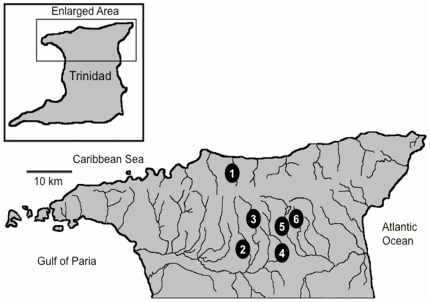
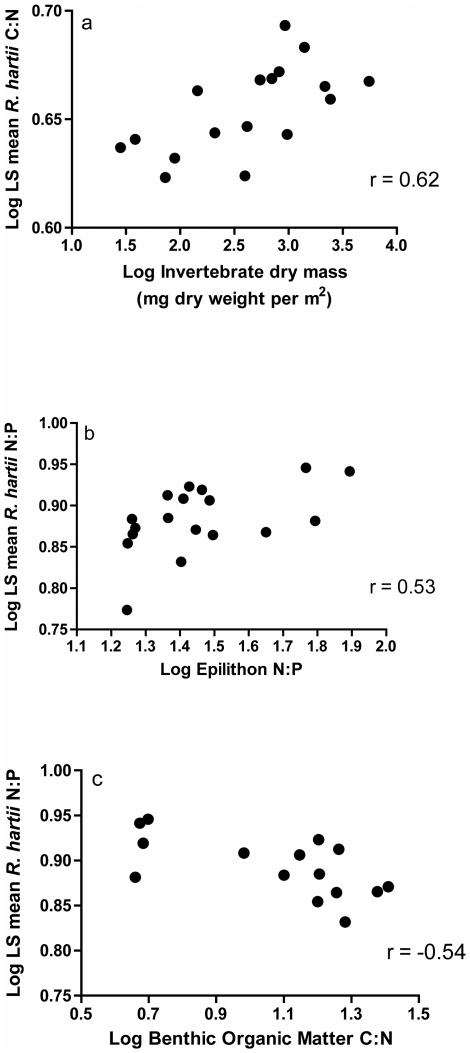
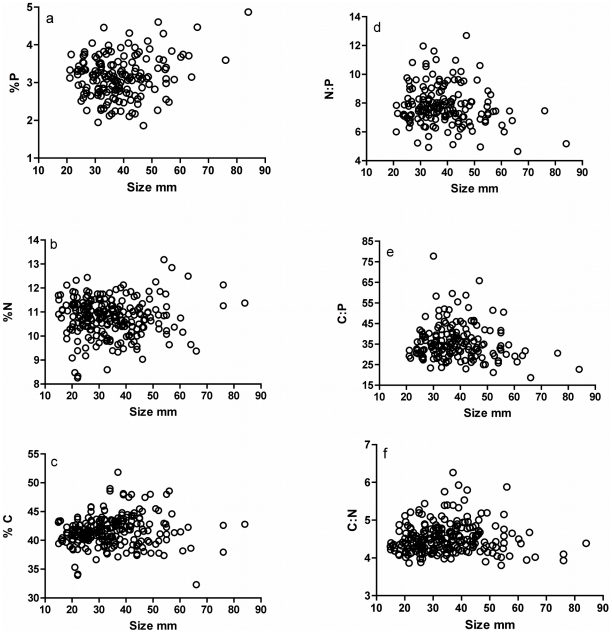
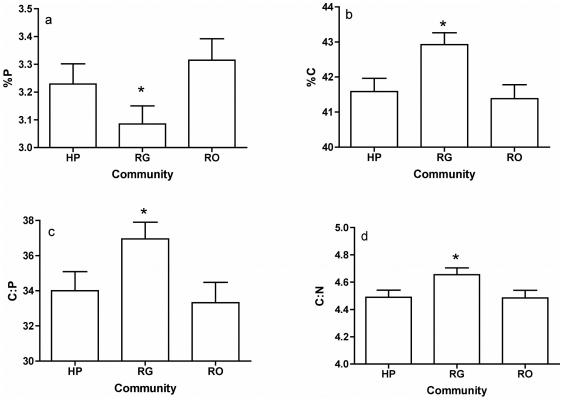
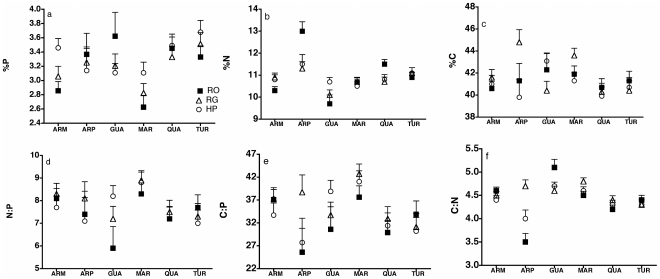
The elemental composition of animals, or their organismal stoichiometry, is thought to constrain their contribution to nutrient recycling, their interactions with other animals, and their demographic rates. Factors that affect organismal stoichiometry are generally poorly understood, but likely reflect elemental investments in morphological features and life history traits, acting in concert with the environmental availability of elements. We assessed the relative contribution of organismal traits and environmental variability to the stoichiometry of an insectivorous Neotropical stream fish, Rivulus hartii. We characterized the influence of body size, life history phenotype, stage of maturity, and environmental variability on organismal stoichiometry in 6 streams that differ in a broad suite of environmental variables. The elemental composition of R. hartii was variable, and overlapped with the wide range of elemental composition documented across freshwater fish taxa. Average %P composition was ∼3.2%(±0.6), average %N∼10.7%(±0.9), and average %C∼41.7%(±3.1). Streams were the strongest predictor of organismal stoichiometry, and explained up to 18% of the overall variance. This effect appeared to be largely explained by variability in quality of basal resources such as epilithon N:P and benthic organic matter C:N, along with variability in invertebrate standing stocks, an important food source for R. hartii. Organismal traits were weak predictors of organismal stoichiometry in this species, explaining when combined up to 7% of the overall variance in stoichiometry. Body size was significantly and positively correlated with %P, and negatively with N:P, and C:P, and life history phenotype was significantly correlated with %C, %P, C:P and C:N. Our study suggests that spatial variability in elemental availability is more strongly correlated with organismal stoichiometry than organismal traits, and suggests that the stoichiometry of carnivores may not be completely buffered from environmental variability. We discuss the relevance of these findings to ecological stoichiometry theory.
动物的元素组成,或它们的机体化学计量,被认为限制了它们对营养物质循环的贡献、它们与其他动物的相互作用以及它们的种群增长率。影响机体化学计量的因素通常理解得很差,但可能反映了元素在形态特征和生活史特征上的投资,与元素的环境可用性协同作用。我们评估了机体特征和环境变异性对食虫新热带溪流鱼类里氏鱼(Rivulus hartii)化学计量的相对贡献。我们描述了体型、生活史表型、成熟阶段和环境变异性对 6 条溪流中机体化学计量的影响,这 6 条溪流在广泛的环境变量中存在差异。里氏鱼的元素组成是可变的,与淡水鱼类分类群中记录的广泛的元素组成范围重叠。平均%P 组成约为 3.2%(±0.6),平均%N∼10.7%(±0.9),平均%C∼41.7%(±3.1)。溪流是机体化学计量的最强预测因子,解释了总方差的 18%。这种影响似乎主要是由基岩资源质量的变异性(如附生藻类 N:P 和底栖有机物质 C:N)以及无脊椎动物现存量的变异性解释的,而无脊椎动物现存量是里氏鱼的重要食物来源。在该物种中,机体特征是机体化学计量的弱预测因子,当与总方差的 7%结合解释时。体型与%P 呈显著正相关,与 N:P 和 C:P 呈显著负相关,生活史表型与%C、%P、C:P 和 C:N 呈显著相关。我们的研究表明,元素可用性的空间变异性与机体化学计量的相关性强于机体特征,这表明肉食动物的化学计量可能不能完全免受环境变异性的影响。我们讨论了这些发现对生态化学计量学理论的相关性。