Department of Anesthesiology, University of North Carolina at Chapel Hill, Chapel Hill, North Carolina 27599-7010, USA.
Anesthesiology. 2012 Apr;116(4):896-902. doi: 10.1097/ALN.0b013e31824b96a1.
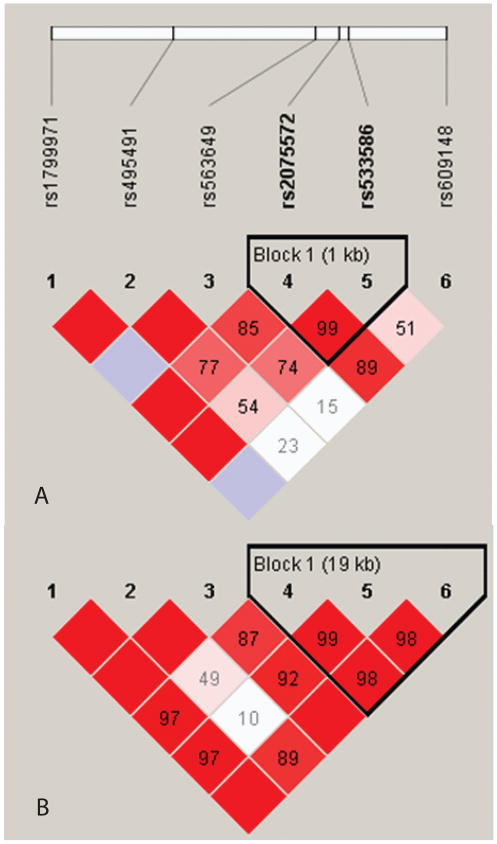
Preclinical studies suggest that opioids may promote tumor growth. Genetic polymorphisms have been shown to affect opioid receptor function and to modify the clinical effects of morphine. In this study we assessed the association between six common polymorphisms in the μ-opioid receptor gene, including the well known A118G polymorphism, and breast cancer survival.
A total of 2,039 women ages 23-74 yr (38% African-American, 62% European-American, 55% postmenopausal) diagnosed with breast cancer between 1993-2001 were followed through 2006. Genotyping was performed using the TaqMan platform (Applied Biosystems Inc., Foster City, CA). Kaplan-Meier curves, log-rank tests, and Cox proportional hazard models were used to examine the association between each genotype and survival.
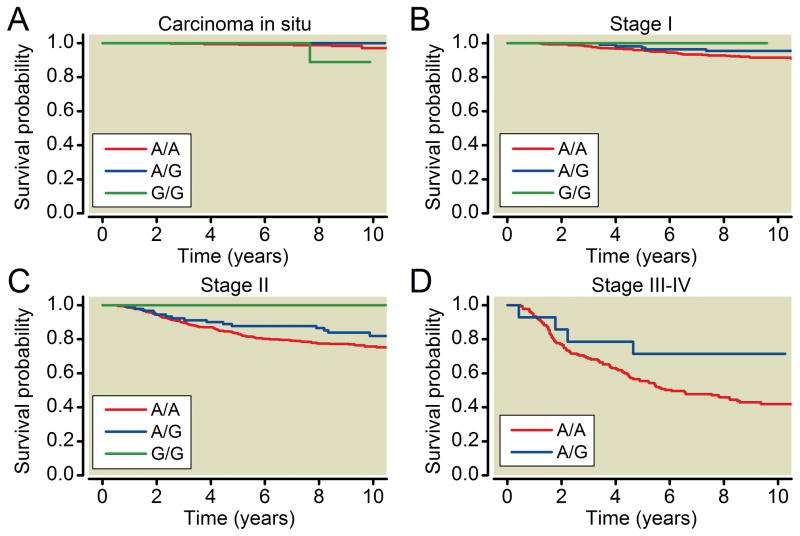
After Bonferroni correction for multiple testing, patient genotype at A118G was associated with breast cancer-specific mortality at 10 yr. Women with one or more copies of the G allele had decreased breast cancer-specific mortality (P < 0.001). This association was limited to invasive cases only; effect size appeared to increase with clinical stage. Cox regression model adjusted for age and ethnicity also showed decreased mortality in A/G and G/G genotypes compared with A/A genotype (hazard ratio = 0.57 [0.38, 0.85] and 0.32 [0.22, 0.49], respectively; P = 0.006).
These results suggest that opioid pathways may be involved in tumor growth. Further studies examining the association between genetic variants influencing opioid system function and cancer survival are warranted.
临床前研究表明阿片类药物可能促进肿瘤生长。遗传多态性已被证明影响阿片受体功能,并改变吗啡的临床效果。在这项研究中,我们评估了μ-阿片受体基因中 6 个常见多态性(包括众所周知的 A118G 多态性)与乳腺癌生存之间的关系。
共纳入 2039 名年龄在 23-74 岁之间(38%为非裔美国人,62%为欧裔美国人,55%为绝经后)的乳腺癌患者,于 1993-2001 年确诊,随访至 2006 年。采用 TaqMan 平台(Applied Biosystems Inc.,Foster City,CA)进行基因分型。Kaplan-Meier 曲线、对数秩检验和 Cox 比例风险模型用于检验每种基因型与生存之间的关系。
经过多次检验的 Bonferroni 校正后,患者 A118G 基因型与 10 年乳腺癌特异性死亡率相关。携带 G 等位基因的女性乳腺癌特异性死亡率降低(P < 0.001)。这种相关性仅局限于浸润性病例;效应大小似乎随临床分期而增加。调整年龄和种族的 Cox 回归模型也显示 A/G 和 G/G 基因型与 A/A 基因型相比,死亡率降低(危险比=0.57 [0.38, 0.85] 和 0.32 [0.22, 0.49],P = 0.006)。
这些结果表明阿片类药物途径可能参与肿瘤生长。进一步研究检查影响阿片系统功能的遗传变异与癌症生存之间的关系是必要的。