Remote Sensing Lab., Dept. Signal Theory and Communications, Universitat Politècnica de Catalunya (UPC) Campus Nord, Bldg D3, E-08034 Barcelona, Spain; E-Mails:
Sensors (Basel). 2009;9(8):6131-49. doi: 10.3390/s90806131. Epub 2009 Aug 3.
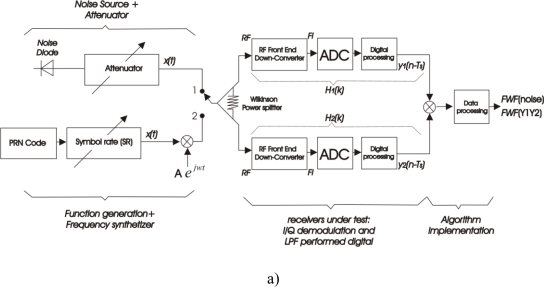
The calibration of correlation radiometers, and particularly aperture synthesis interferometric radiometers, is a critical issue to ensure their performance. Current calibration techniques are based on the measurement of the cross-correlation of receivers' outputs when injecting noise from a common noise source requiring a very stable distribution network. For large interferometric radiometers this centralized noise injection approach is very complex from the point of view of mass, volume and phase/amplitude equalization. Distributed noise injection techniques have been proposed as a feasible alternative, but are unable to correct for the so-called "baseline errors" associated with the particular pair of receivers forming the baseline. In this work it is proposed the use of centralized Pseudo-Random Noise (PRN) signals to calibrate correlation radiometers. PRNs are sequences of symbols with a long repetition period that have a flat spectrum over a bandwidth which is determined by the symbol rate. Since their spectrum resembles that of thermal noise, they can be used to calibrate correlation radiometers. At the same time, since these sequences are deterministic, new calibration schemes can be envisaged, such as the correlation of each receiver's output with a baseband local replica of the PRN sequence, as well as new distribution schemes of calibration signals. This work analyzes the general requirements and performance of using PRN sequences for the calibration of microwave correlation radiometers, and particularizes the study to a potential implementation in a large aperture synthesis radiometer using an optical distribution network.
相关辐射计,特别是孔径综合干涉辐射计的校准是确保其性能的关键问题。目前的校准技术基于从公共噪声源注入噪声时测量接收器输出的互相关,这需要非常稳定的分配网络。对于大型干涉辐射计,从质量、体积和相位/幅度均衡的角度来看,这种集中式噪声注入方法非常复杂。已经提出了分布式噪声注入技术作为一种可行的替代方案,但无法校正与形成基线的特定接收器对相关的所谓“基线误差”。在这项工作中,提出使用集中式伪随机噪声 (PRN) 信号来校准相关辐射计。PRN 是具有长重复周期的符号序列,其频谱在由符号率确定的带宽内具有平坦的频谱。由于它们的频谱类似于热噪声,因此可以用于校准相关辐射计。同时,由于这些序列是确定性的,因此可以设想新的校准方案,例如将每个接收器的输出与 PRN 序列的基带本地副本相关联,以及校准信号的新分配方案。这项工作分析了使用 PRN 序列校准微波相关辐射计的一般要求和性能,并将研究特别针对使用光学分配网络的大型孔径综合辐射计中的潜在实现。