Osman Magda
Biological and Experimental Psychology Centre, School of Biological and Chemical Sciences, Queen Mary College, University of London London, UK.
Front Neurosci. 2012 Mar 20;6:35. doi: 10.3389/fnins.2012.00035. eCollection 2012.
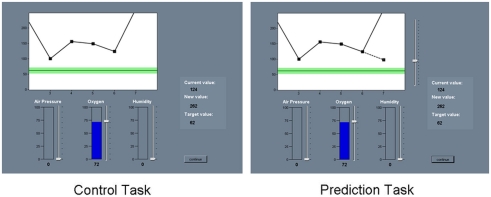
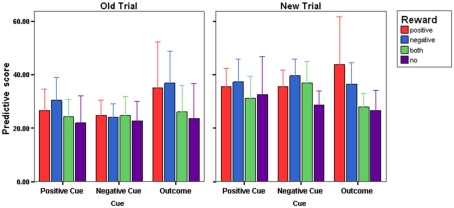
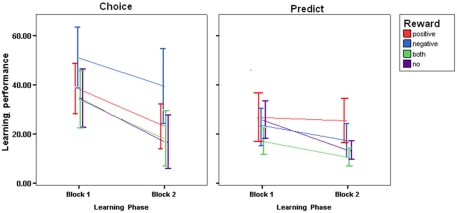
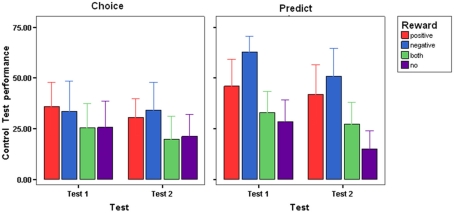
The present study investigates two aspects of decision making that have yet to be explored within a dynamic environment, (1) comparing the accuracy of cue-outcome knowledge under conditions in which knowledge acquisition is either through Prediction or Choice, and (2) examining the effects of reward on both Prediction and Choice. In the present study participants either learnt about the cue-outcome relations in the environment by choosing cue values in order to maintain an outcome to criterion (Choice-based decision making), or learnt to predict the outcome from seeing changes to the cue values (Prediction-based decision making). During training participants received outcome feedback and one of four types of reward manipulations: Positive Reward, Negative Reward, Both Positive + Negative Reward, No Reward. After training both groups of learners were tested on prediction and choice-based tasks. In the main, the findings revealed that cue-outcome knowledge was more accurate when knowledge acquisition was Choice-based rather than Prediction-based. During learning Negative Reward adversely affected Choice-based decision making while Positive Reward adversely affected predictive-based decision making. During the test phase only performance on tests of choice was adversely affected by having received Positive Reward or Negative Reward during training. This article proposes that the adverse effects of reward may reflect the additional demands placed on processing rewards which compete for cognitive resources required to perform the main goal of the task. This in turn implies that, rather than facilitate decision making, the presentation of rewards can interfere with Choice-based and Prediction-based decisions.
(1)比较在通过预测或选择获取知识的条件下线索-结果知识的准确性;(2)检验奖励对预测和选择的影响。在本研究中,参与者要么通过选择线索值以维持结果达到标准来了解环境中的线索-结果关系(基于选择的决策),要么通过观察线索值的变化来学习预测结果(基于预测的决策)。在训练期间,参与者会收到结果反馈以及四种奖励操纵之一:正奖励、负奖励、正负奖励都有、无奖励。训练后,两组学习者都要接受基于预测和选择的任务测试。总体而言,研究结果表明,当基于选择获取知识而非基于预测时,线索-结果知识更准确。在学习过程中,负奖励对基于选择的决策有不利影响,而正奖励对基于预测的决策有不利影响。在测试阶段,只有选择测试的表现会受到训练期间接受正奖励或负奖励的不利影响。本文提出,奖励的不利影响可能反映了处理奖励所带来的额外需求,这些需求与执行任务主要目标所需的认知资源相竞争。这反过来意味着,奖励的呈现非但促进决策,反而会干扰基于选择和基于预测的决策。