Department of Orthopedics, Warren Alpert Medical School of Brown University, Providence, RI 02903, USA.
Osteoarthritis Cartilage. 2012 Jul;20(7):755-63. doi: 10.1016/j.joca.2012.03.010. Epub 2012 Mar 30.
The objectives of this study were to (1) determine the correlation between osteoarthritis (OA) and Indian hedgehog (Ihh) expression, and (2) establish the effects of Ihh on expression of markers of chondrocyte hypertrophy and matrix metalloprotease (MMP)-13 in human OA cartilage.
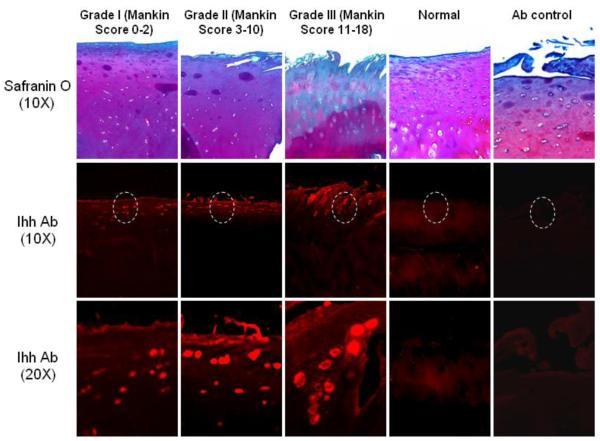
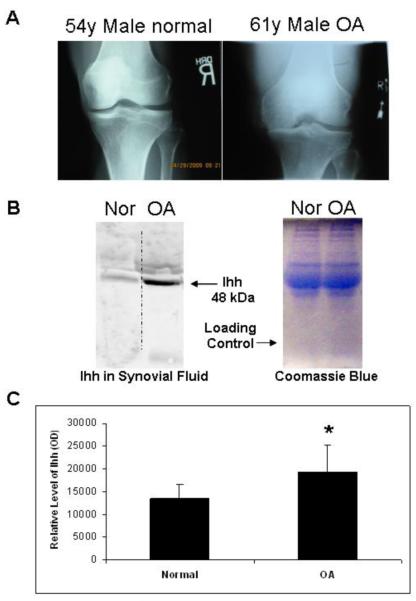
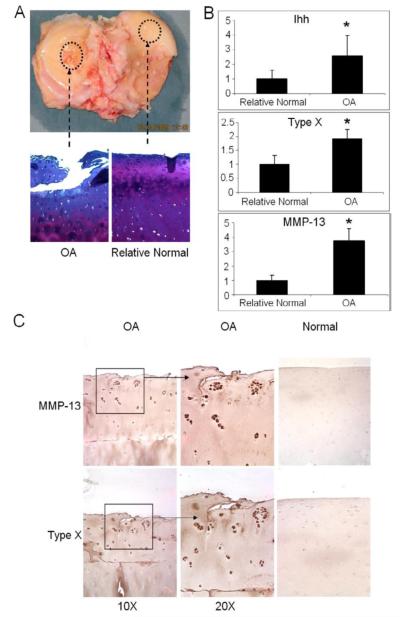
OA cartilage and synovial fluid samples were obtained during total knee arthroplasty. Normal cartilage samples were obtained from intra-articular tumor resections, and normal synovial fluid samples were obtained from healthy volunteers and the contralateral uninjured knee of patients undergoing anterior cruciate ligament reconstruction. OA was graded using the Mankin score. Expression of Ihh in synovial fluid was determined by Western blot. Ihh, type X collagen and MMP-13 mRNA were determined by real time PCR. Protein expression of type X collagen and MMP-13 in cartilage samples was analyzed with immunohistochemistry. Chondrocyte size was measured using image analysis.
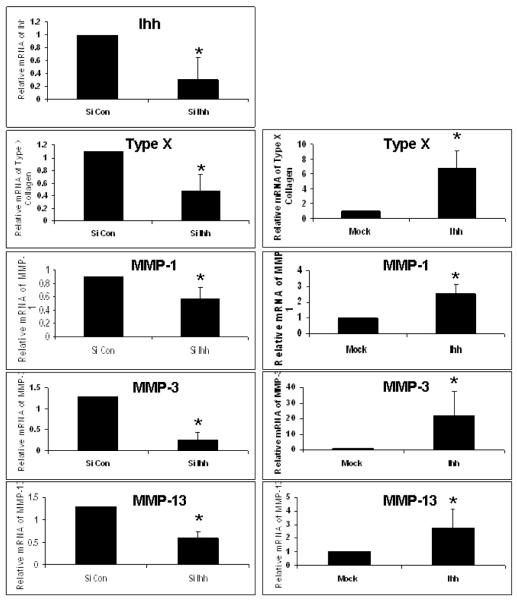
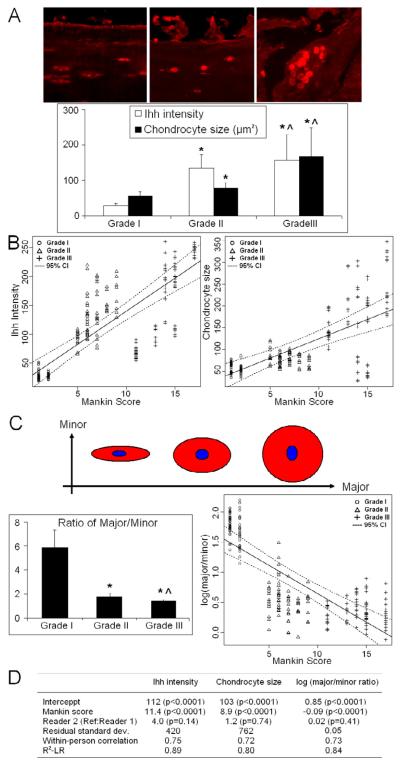
Ihh expression was increased 2.6 fold in OA cartilage and 37% in OA synovial fluid when compared to normal control samples. Increased expression of Ihh was associated with the severity of OA and expression of markers of chondrocyte hypertrophy: type X collagen and MMP-13, and chondocyte size. Chondrocytes were more spherical with increasing severity of OA. There was a significant correlation between Mankin score and cell size (r(2) = 0.80) and Ihh intensity (r(2) = 0.89). Exogenous Ihh induced a 6.8 fold increase of type X collagen and 2.8 fold increase of MMP-13 mRNA expression in cultured chondrocytes. Conversely, knockdown of Ihh by siRNA and Hh inhibitor cyclopamine had the opposite effect.
Ihh expression correlates with OA progression and changes in chondrocyte morphology and gene expression consistent with chondrocyte hypertrophy and cartilage degradation seen in OA cartilage. Thus, Ihh may be a potential therapeutic target to prevent OA progression.
本研究的目的是:(1) 确定骨关节炎 (OA) 与印度刺猬 (Ihh) 表达之间的相关性,(2) 确定 Ihh 对人 OA 软骨中软骨细胞肥大和基质金属蛋白酶 (MMP)-13 表达标志物的影响。
在全膝关节置换术中获取 OA 软骨和滑液样本。从关节内肿瘤切除术中获得正常软骨样本,从健康志愿者和前交叉韧带重建患者的对侧未受伤膝关节中获得正常滑液样本。使用 Mankin 评分对 OA 进行分级。通过 Western blot 确定滑液中 Ihh 的表达。通过实时 PCR 确定 Ihh、X 型胶原和 MMP-13 mRNA 的表达。通过免疫组织化学分析软骨样本中 X 型胶原和 MMP-13 的蛋白表达。使用图像分析测量软骨细胞大小。
与正常对照样本相比,OA 软骨中 Ihh 的表达增加了 2.6 倍,OA 滑液中增加了 37%。Ihh 的表达增加与 OA 的严重程度以及软骨细胞肥大标志物:X 型胶原和 MMP-13 以及软骨细胞大小有关。OA 严重程度增加,软骨细胞变得更圆。Mankin 评分与细胞大小(r²=0.80)和 Ihh 强度(r²=0.89)之间存在显著相关性。外源性 Ihh 诱导培养的软骨细胞中 X 型胶原增加 6.8 倍,MMP-13 mRNA 表达增加 2.8 倍。相反,siRNA 和 Hh 抑制剂环巴胺对 Ihh 的敲低则产生相反的效果。
Ihh 的表达与 OA 进展以及软骨细胞形态和基因表达的变化相关,这些变化与 OA 软骨中所见的软骨细胞肥大和软骨降解一致。因此,Ihh 可能是预防 OA 进展的潜在治疗靶点。