Department of Paediatrics, Mount Sinai Hospital, Toronto, Canada.
BMC Pediatr. 2012 Apr 4;12:43. doi: 10.1186/1471-2431-12-43.
The use of mechanical ventilation is associated with lung injury in preterm infants and therefore the goal is to avoid or minimize its use. To date there is very little consensus on what is considered the "best non-invasive ventilation mode" to be used post-extubation. The objective of this study was to compare the effectiveness of biphasic nasal continuous positive airway pressure (BP-NCPAP) vs. NCPAP in facilitating sustained extubation in infants ≤ 1,250 grams.
We performed a randomized controlled trial of BP-NCPAP vs. NCPAP in infants ≤ 1,250 grams extubated for the first time following mechanical ventilation since birth. Infants were extubated using preset criteria or at the discretion of the attending neonatologist. The primary outcome was the incidence of sustained extubation for 7 days. Secondary outcomes included incidence of adverse events and short-term neonatal outcomes.
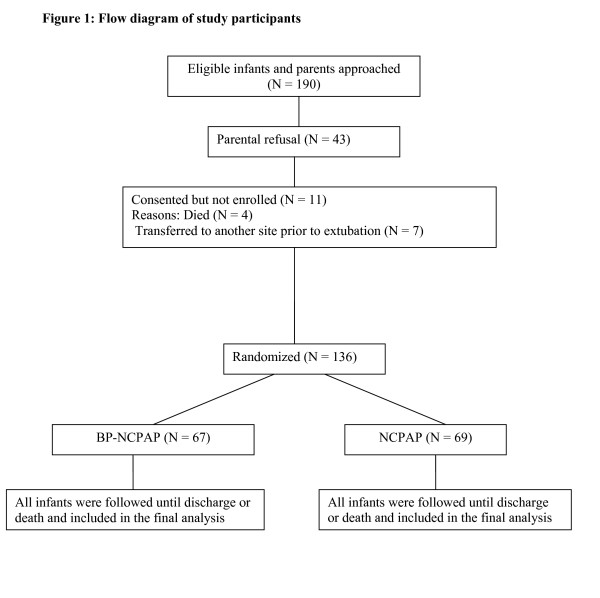
Sixty-seven infants received BP-NCPAP and 69 NCPAP. Baseline characteristics were similar between groups. The trial was stopped early due to increased use of non-invasive ventilation from birth, falling short of our calculated sample size of 141 infants per group. The incidence of sustained extubation was not statistically different between the BP-NCPAP vs. NCPAP group (67% vs. 58%, P = 0.27). The incidence of adverse events and short-term neonatal outcomes were similar between the two groups (P > 0.05) except for retinopathy of prematurity which was noted to be higher (P = 0.02) in the BP-NCPAP group.
Biphasic NCPAP may be used to assist in weaning from mechanical ventilation. The effectiveness and safety of BP-NCPAP compared to NCPAP needs to be confirmed in a large multi-center trial as our study conclusions are limited by inadequate sample size. CLINICAL TRIALS REGISTRATION #: NCT00308789 SOURCE OF SUPPORT: Grant # 06-06, Physicians Services Incorporated Foundation, Toronto, Canada. Summit technologies Inc. provided additional NCPAP systems and an unrestricted educational grant.Abstract presented at The Society for Pediatric Research Meeting, Baltimore, USA, May 2nd-5th, 2009 and Canadian Paediatric Society Meeting, June 23rd-29th, Ottawa, 2009.
机械通气会导致早产儿的肺损伤,因此目标是避免或尽量减少其使用。迄今为止,对于何为“最佳的无创通气模式”,尚无广泛共识,特别是在拔管后。本研究旨在比较双相鼻塞持续气道正压通气(BP-NCPAP)与 NCPAP 对 ≤1250 克早产儿拔管后持续通气的效果。
我们对 ≤1250 克的早产儿进行了一项 BP-NCPAP 与 NCPAP 的随机对照试验,这些婴儿在出生后首次通过机械通气进行了机械通气。婴儿通过预设标准或主治新生儿科医生的判断进行拔管。主要结局是 7 天持续拔管的发生率。次要结局包括不良事件和短期新生儿结局的发生率。
67 例婴儿接受了 BP-NCPAP,69 例婴儿接受了 NCPAP。两组的基线特征相似。由于从出生开始无创通气的使用增加,试验提前终止,未达到我们计算的每组 141 名婴儿的样本量。BP-NCPAP 组与 NCPAP 组的持续拔管发生率无统计学差异(67%与 58%,P=0.27)。两组的不良事件和短期新生儿结局发生率相似(P>0.05),但早产儿视网膜病变发生率更高(P=0.02)。
双相 NCPAP 可用于辅助机械通气撤机。BP-NCPAP 与 NCPAP 相比的有效性和安全性需要在大型多中心试验中得到证实,因为我们的研究结论受到样本量不足的限制。临床试验注册号:NCT00308789 支持来源:加拿大安大略省多伦多的医生服务公司基金会拨款#06-06。Summit 技术公司提供了额外的 NCPAP 系统和无限制的教育赠款。摘要发表于 2009 年 5 月 2 日至 5 日在美国巴尔的摩举行的儿科学会研究会议和 2009 年 6 月 23 日至 29 日在渥太华举行的加拿大儿科学会会议。