Finelli Palma, Sirchia Silvia Maria, Masciadri Maura, Crippa Milena, Recalcati Maria Paola, Rusconi Daniela, Giardino Daniela, Monti Laura, Cogliati Francesca, Faravelli Francesca, Natacci Federica, Zoccante Leonardo, Bernardina Bernardo Dalla, Russo Silvia, Larizza Lidia
Laboratory of Medical Cytogenetics and Molecular Genetics, Istituto Auxologico Italiano, Cusano Milanino 20095, Italy.
Mol Cytogenet. 2012 Apr 4;5:16. doi: 10.1186/1755-8166-5-16.
The term "position effect" is used when the expression of a gene is deleteriously affected by an alteration in its chromosomal environment even though the integrity of the protein coding sequences is maintained. We describe a patient affected by epilepsy and severe neurodevelopment delay carrying a balanced translocation t(15;16)(p11.2;q12.1)dn that we assume caused a position effect as a result of the accidental juxtaposition of heterochromatin in the euchromatic region.
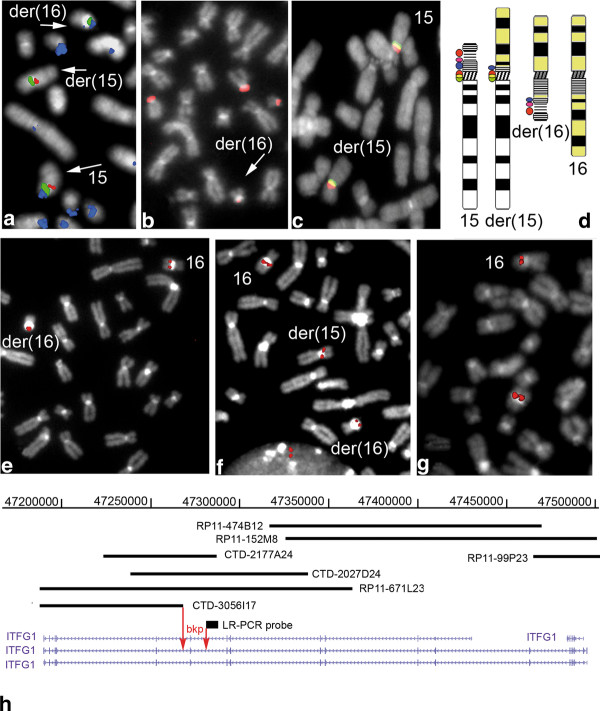
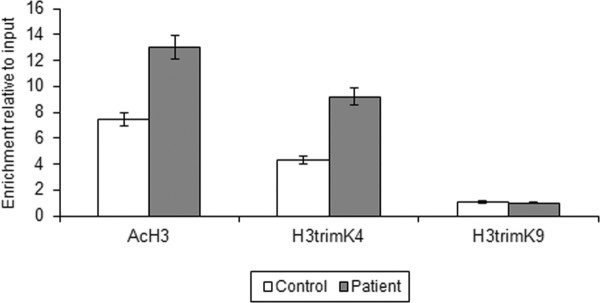
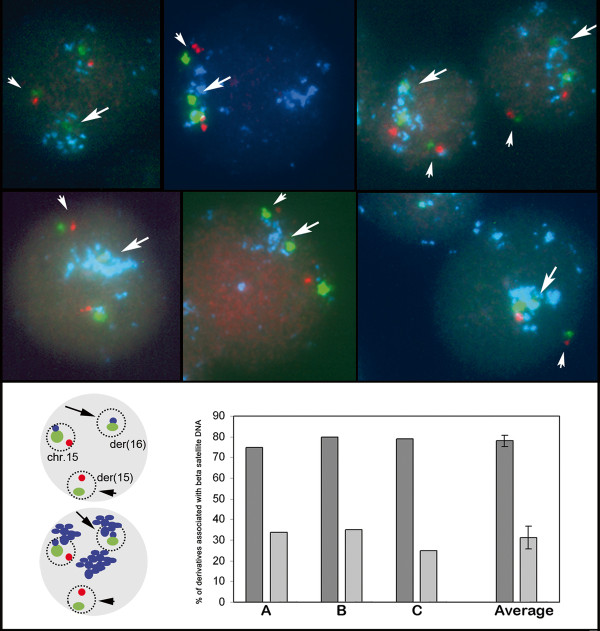
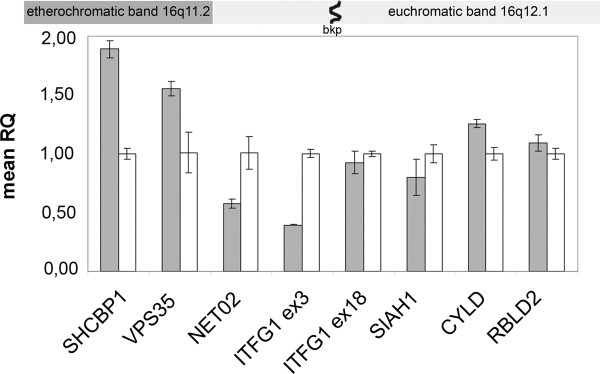
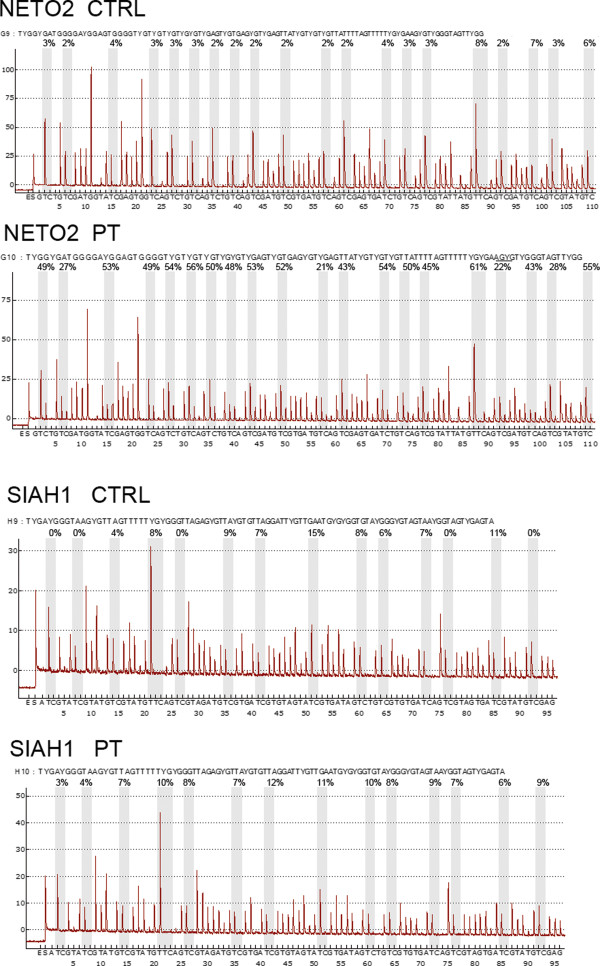
FISH mapped the translocation breakpoints (bkps) to 15p11.2 within satellite III and the 16q12.1 euchromatic band within the ITFG1 gene. The expression of the genes located on both sides of the translocation were tested by means of real-time PCR and three, all located on der(16), were found to be variously perturbed: the euchromatic gene NETO2/BTCL2 was silenced, whereas VPS35 and SHCBP1, located within the major heterochromatic block of chromosome 16q11.2, were over-expressed. Pyrosequencing and chromatin immunoprecipitation of NETO2/BTCL2 and VPS35 confirmed the expression findings. Interphase FISH analysis showed that der(16) localised to regions occupied by the beta satellite heterochromatic blocks more frequently than der(15).
To the best of our knowledge, this is the first report of a heterochromatic position effect in humans caused by the juxtaposition of euchromatin/heterochromatin as a result of chromosomal rearrangement. The overall results are fully in keeping with the observations in Drosophila and suggest the occurrence of a human heterochromatin position effect associated with the nuclear repositioning of the der(16) and its causative role in the patient's syndromic phenotype.
当一个基因的表达受到其染色体环境改变的有害影响,即使其蛋白质编码序列的完整性得以维持时,就会使用“位置效应”这一术语。我们描述了一名患有癫痫和严重神经发育迟缓的患者,其携带一种平衡易位t(15;16)(p11.2;q12.1)dn,我们认为这是由于常染色质区域中异染色质的意外并置导致了位置效应。
荧光原位杂交(FISH)将易位断点定位到卫星III内的15p11.2以及ITFG1基因内的16q12.1常染色质带。通过实时聚合酶链反应(PCR)检测了位于易位两侧的基因的表达,发现位于der(16)上的三个基因受到了不同程度的干扰:常染色质基因NETO2/BTCL2沉默,而位于16q11.2主要异染色质块内的VPS35和SHCBP1则过度表达。NETO2/BTCL2和VPS35的焦磷酸测序和染色质免疫沉淀证实了表达结果。间期FISH分析表明,der(16)比der(15)更频繁地定位到β卫星异染色质块占据的区域。
据我们所知,这是第一份关于由于染色体重排导致常染色质/异染色质并置而引起人类异染色质位置效应的报告。总体结果与在果蝇中的观察结果完全一致,并表明存在与der(16)的核重新定位相关的人类异染色质位置效应及其在患者综合征表型中的致病作用。