Department of Ecology and Evolutionary Biology, Yale University, New Haven, Connecticut, USA.
PLoS Biol. 2012;10(3):e1001292. doi: 10.1371/journal.pbio.1001292. Epub 2012 Mar 27.
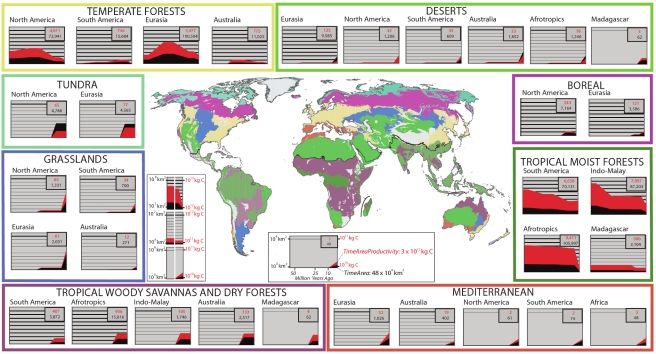
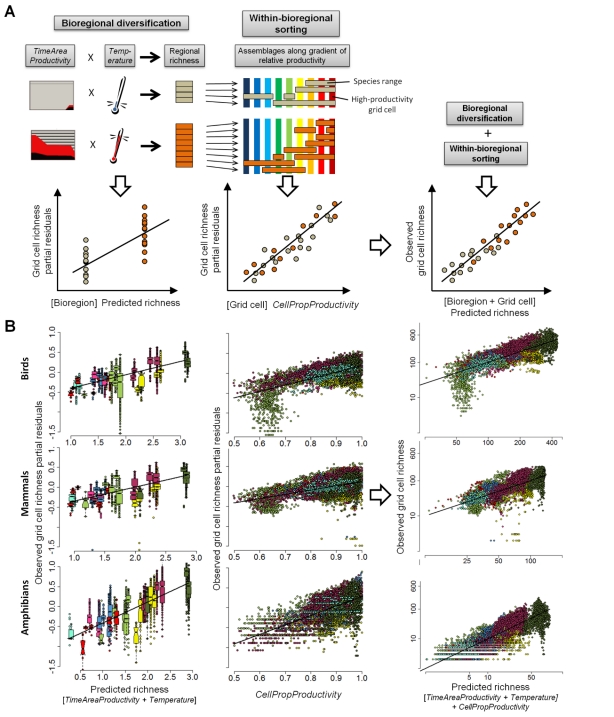
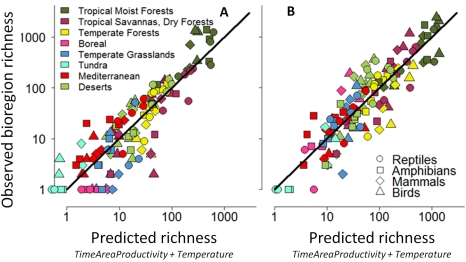
Broad-scale geographic gradients in species richness have now been extensively documented, but their historical underpinning is still not well understood. While the importance of productivity, temperature, and a scale dependence of the determinants of diversity is broadly acknowledged, we argue here that limitation to a single analysis scale and data pseudo-replication have impeded an integrated evolutionary and ecological understanding of diversity gradients. We develop and apply a hierarchical analysis framework for global diversity gradients that incorporates an explicit accounting of past environmental variation and provides an appropriate measurement of richness. Due to environmental niche conservatism, organisms generally reside in climatically defined bioregions, or "evolutionary arenas," characterized by in situ speciation and extinction. These bioregions differ in age and their total productivity and have varied over time in area and energy available for diversification. We show that, consistently across the four major terrestrial vertebrate groups, current-day species richness of the world's main 32 bioregions is best explained by a model that integrates area and productivity over geological time together with temperature. Adding finer scale variation in energy availability as an ecological predictor of within-bioregional patterns of richness explains much of the remaining global variation in richness at the 110 km grain. These results highlight the separate evolutionary and ecological effects of energy availability and provide a first conceptual and empirical integration of the key drivers of broad-scale richness gradients. Avoiding the pseudo-replication that hampers the evolutionary interpretation of non-hierarchical macroecological analyses, our findings integrate evolutionary and ecological mechanisms at their most relevant scales and offer a new synthesis regarding global diversity gradients.
目前已经广泛记录了物种丰富度的大规模地理梯度,但它们的历史基础仍未得到很好的理解。虽然生产力、温度以及多样性决定因素的尺度依赖性的重要性已得到广泛认可,但我们在此认为,仅在单一分析尺度上进行限制以及数据的伪复制,阻碍了对多样性梯度的综合进化和生态理解。我们开发并应用了一个全球多样性梯度的分层分析框架,该框架明确考虑了过去环境变化,并提供了对丰富度的适当衡量。由于环境生态位保守性,生物通常居住在气候定义的生物区或“进化竞技场”中,这些生物区以原地物种形成和灭绝为特征。这些生物区在年龄、总生产力以及可用于多样化的面积和能量方面存在差异,并随时间发生变化。我们表明,在四大陆生脊椎动物群体中,一致地,当今世界 32 个主要生物区的物种丰富度,最好通过一个模型来解释,该模型将地质时间内的面积和生产力与温度相结合。将能量可用性的更精细尺度变化作为生物区内丰富度模式的生态预测因子添加进来,可以解释在 110 公里粒度上丰富度的大部分剩余全球变化。这些结果突出了能量可用性的单独进化和生态效应,并为广泛的丰富度梯度的关键驱动因素提供了第一个概念和经验上的综合。通过避免阻碍非层次宏观生态学分析的进化解释的伪复制,我们的研究结果整合了最相关尺度的进化和生态机制,并为全球多样性梯度提供了新的综合。