Miyata Kaori, Ose Keiko
Environmental Health Science Laboratory, Sumitomo Chemical Company Limited, 1-98 Kasugadenaka 3 chome, Konohana-ku, Osaka 554-8558, Japan.
J Toxicol Pathol. 2012 Mar;25(1):1-9. doi: 10.1293/tox.25.1.
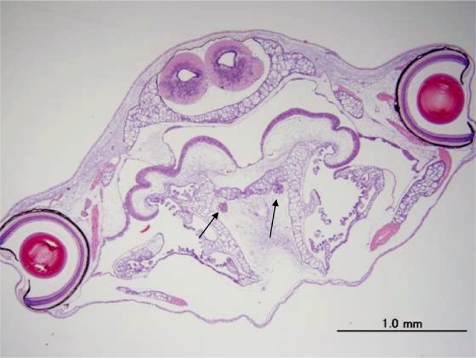
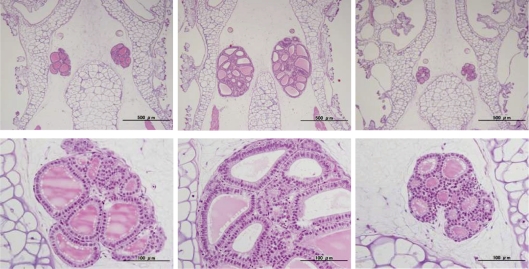
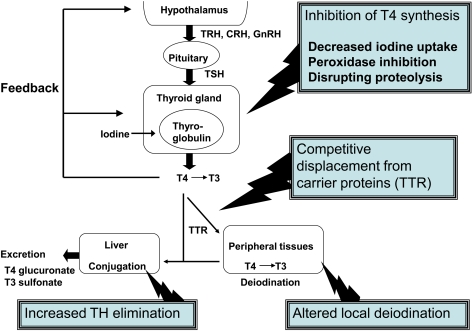
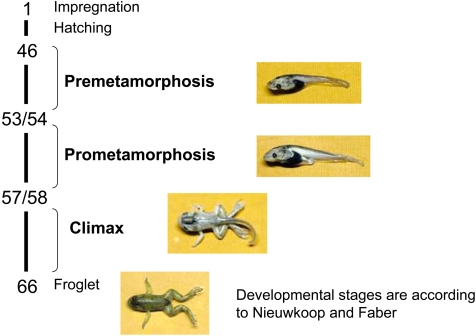
There are continued concerns about endocrine-disrupting chemical effects, and appropriate vertebrate models for assessment of risk are a high priority. Frog tadpoles are very sensitive to environmental substances because of their habitat and the complex processes of metamorphosis regulated by the endocrine system, mainly thyroid hormones. During metamorphosis, marked alteration in hormonal factors occurs, as well as dramatic structural and functional changes in larval tissues. There are a variety of mechanisms determining thyroid hormone balance or disruption directly or indirectly. Direct-acting agents can cause changes in thyroxine synthesis and/or secretion in thyroid through effects on peroxidases, thyroidal iodide uptake, deiodinase, and proteolysis. At the same time, indirect action may result from biochemical processes such as sulfation, deiodination and glucuronidation. Because their potential to disrupt thyroid hormones has been identified as an important consideration for the regulation of chemicals, the OECD and the EPA have each established guidelines that make use of larval African clawed frogs (Xenopus laevis) and frog metamorphosis for screening and testing of potential endocrine disrupters. The guidelines are based on evaluation of alteration in the hypothalamic-pituitary-thyroid axis. One of the primary endpoints is thyroid gland histopathology. Others are mortality, developmental stage, hind limb length, snout-vent length and wet body weight. Regarding histopathological features, the guidelines include core criteria and additional qualitative parameters along with grading. Taking into account the difficulties in evaluating amphibian thyroid glands, which change continuously throughout metamorphosis, histopathological examination has been shown to be a very sensitive approach.
人们持续关注内分泌干扰化学物质的影响,因此,拥有合适的脊椎动物模型来评估风险成为当务之急。由于蛙蝌蚪的栖息地以及由内分泌系统(主要是甲状腺激素)调节的复杂变态过程,它们对环境物质非常敏感。在变态过程中,激素因子会发生显著变化,幼虫组织也会出现剧烈的结构和功能变化。存在多种直接或间接决定甲状腺激素平衡或干扰的机制。直接作用剂可通过影响过氧化物酶、甲状腺碘摄取、脱碘酶和蛋白水解作用,导致甲状腺中甲状腺素合成和/或分泌的变化。同时,间接作用可能源于硫酸化、脱碘和葡萄糖醛酸化等生化过程。由于其干扰甲状腺激素的潜力已被确定为化学品监管的重要考虑因素,经济合作与发展组织(OECD)和美国环境保护局(EPA)各自制定了指南,利用非洲爪蟾(Xenopus laevis)幼虫和蛙变态来筛选和测试潜在的内分泌干扰物。这些指南基于对下丘脑 - 垂体 - 甲状腺轴变化的评估。主要终点之一是甲状腺组织病理学。其他终点包括死亡率、发育阶段、后肢长度、吻肛长度和湿体重。关于组织病理学特征,指南包括核心标准、额外的定性参数以及分级。考虑到评估两栖动物甲状腺的困难,甲状腺在变态过程中会不断变化,组织病理学检查已被证明是一种非常敏感的方法。