AIDS Research Center, National Institute of Infectious Diseases, 1-23-1 Toyama, Shinjuku-ku, Tokyo 162-8640, Japan.
Sci Rep. 2012;2:359. doi: 10.1038/srep00359. Epub 2012 Apr 11.
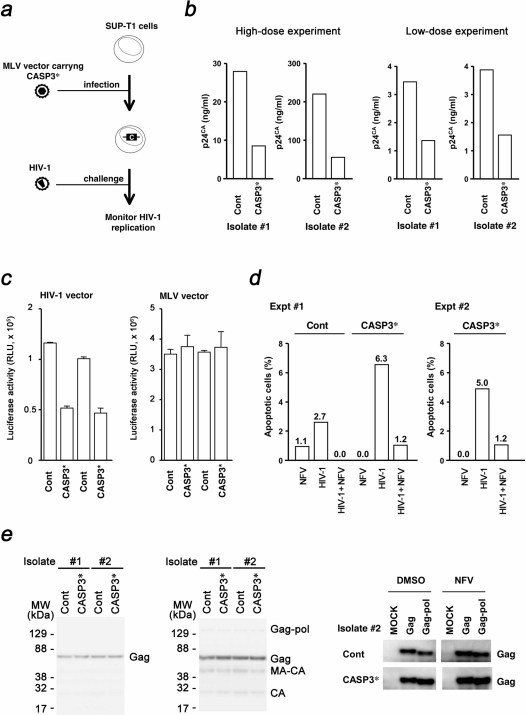
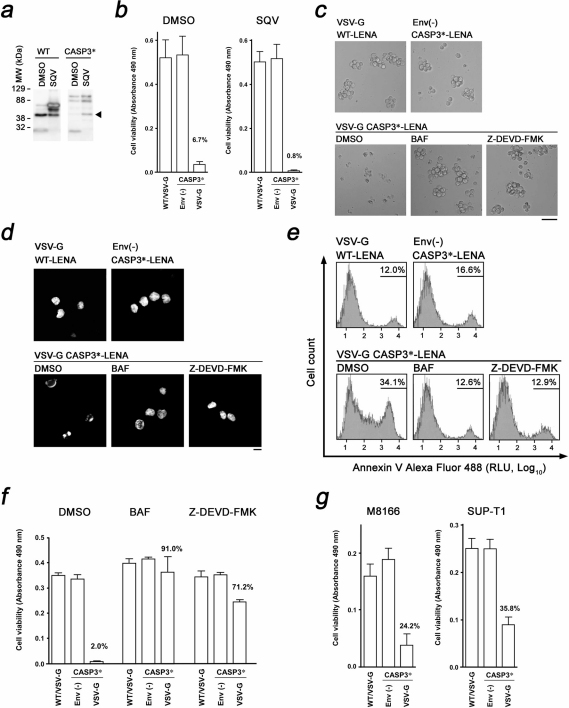
Development of a therapeutic application of CASP3/caspase 3/CPP32, an executor of apoptosis, has been challenging because regulation of its activation is complicated. This study aimed to inhibit cancer cell growth and human immunodeficiency virus type 1 (HIV-1) propagation through a CASP3 mutant, CASP3*, activable by HIV-1-encoded aspartate protease. Active CASP3* was delivered to leukemic cells using a protein transduction vehicle, the lentivirus-like nanoparticle (LENA), which should contain thousands of CASP3*-Gag protein molecules and release the activated CASP3* into the target cell cytoplasm. CASP3*-LENA induced apoptosis in various types of leukemic cells. In addition to being effective against leukemic cells, constitutive expression of CASP3* restricted HIV-1 propagation in SUP-T1 cells. The attenuation of HIV-1 replication in SUP-T1/CASP3* cells was attributed to the elimination of HIV-1-infected cells by apoptosis. These data suggest that CASP3* has therapeutic potential against both lymphoid malignancies and HIV-1 infection.
开发细胞凋亡执行器 CASP3/caspase 3/CPP32 的治疗应用一直具有挑战性,因为其激活的调节很复杂。本研究旨在通过 HIV-1 编码的天冬氨酸蛋白酶可激活的 CASP3 突变体 CASP3来抑制癌细胞生长和人类免疫缺陷病毒 1(HIV-1)的繁殖。使用蛋白转导载体,即类慢病毒纳米颗粒(LENA)将活性 CASP3递送至白血病细胞,LENA 应包含数千个 CASP3*-Gag 蛋白分子,并将激活的 CASP3释放到靶细胞质中。CASP3-LENA 诱导各种类型的白血病细胞凋亡。除了对白血病细胞有效外,CASP3的组成型表达还限制了 SUP-T1 细胞中 HIV-1 的繁殖。SUP-T1/CASP3细胞中 HIV-1 复制的衰减归因于通过凋亡消除了感染 HIV-1 的细胞。这些数据表明,CASP3*具有针对淋巴样恶性肿瘤和 HIV-1 感染的治疗潜力。