Institut de Neurosciences des Systèmes, INSERM UMR1106, Faculté de Médecine La Timone, 27 Boulevard Jean Moulin, 13005 Marseille, France.
Neuron. 2012 Apr 12;74(1):57-64. doi: 10.1016/j.neuron.2012.01.026.
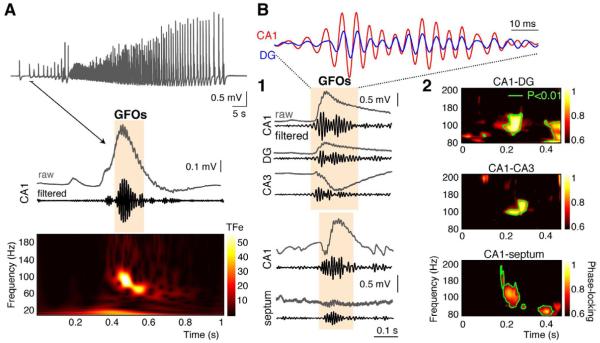
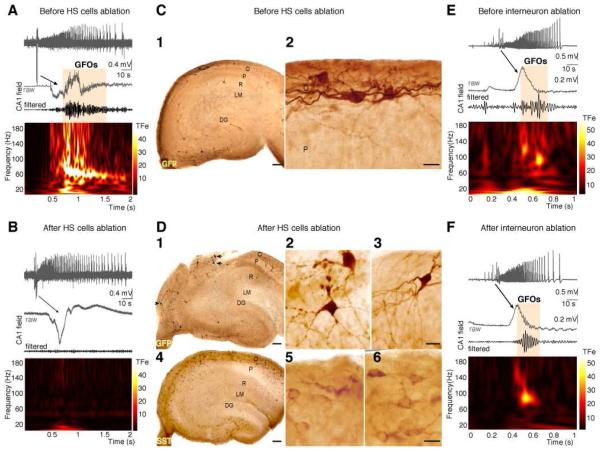
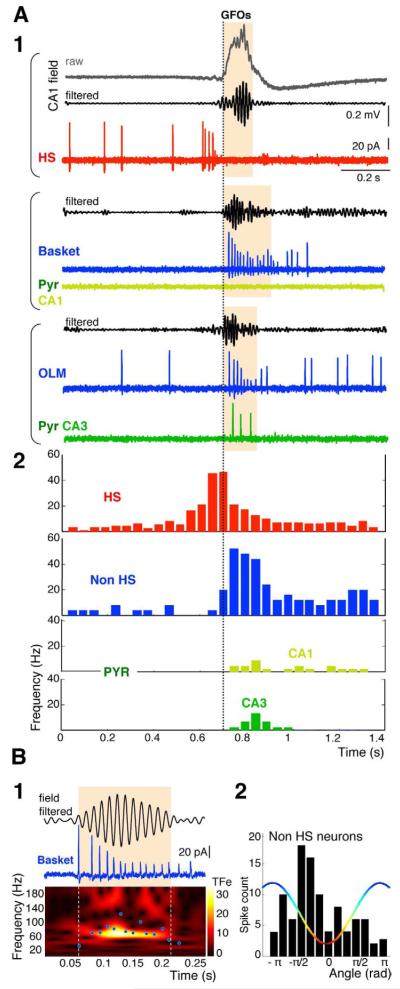
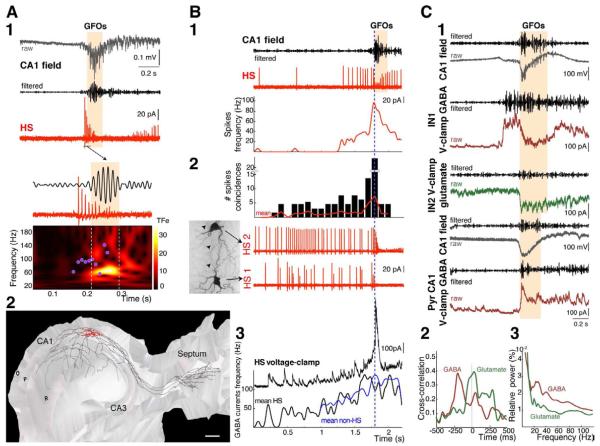
Gamma-frequency oscillations (GFOs, >40 Hz) are a general network signature at seizure onset at all stages of development, with possible deleterious consequences in the immature brain. At early developmental stages, the simultaneous occurrence of GFOs in different brain regions suggests the existence of a long-ranging synchronizing mechanism at seizure onset. Here, we show that hippocamposeptal (HS) neurons, which are GABA long-range projection neurons, are mandatory to drive the firing of hippocampal interneurons in a high-frequency regime at the onset of epileptiform discharges in the intact, immature septohippocampal formation. The synchronized firing of interneurons in turn produces GFOs, which are abolished after the elimination of a small number of HS neurons. Because they provide the necessary fast conduit for pacing large neuronal populations and display intra- and extrahippocampal long-range projections, HS neurons appear to belong to the class of hub cells that play a crucial role in the synchronization of developing networks.
伽马频率振荡 (GFOs,>40 Hz) 是发育各个阶段癫痫发作的一般网络特征,在未成熟的大脑中可能产生有害的后果。在早期发育阶段,不同脑区同时出现 GFOs 表明在癫痫发作时有一个长程同步机制的存在。在这里,我们表明海马-隔核(HS)神经元,即 GABA 长程投射神经元,在完整的未成熟隔海马结构中,癫痫样放电发作时,是驱动海马中间神经元在高频状态下放电所必需的。中间神经元的同步放电反过来产生 GFOs,在消除少量 HS 神经元后,GFOs 被消除。因为它们为起搏大神经元群体提供了必要的快速通道,并显示出海马内外的长程投射,HS 神经元似乎属于枢纽细胞类,在发育中的网络同步中起着关键作用。