Department of Neurology, Mount Sinai School of Medicine, One Gustave L. Levy Place, New York, NY 10029, USA.
BMC Med. 2012 Apr 13;10:36. doi: 10.1186/1741-7015-10-36.
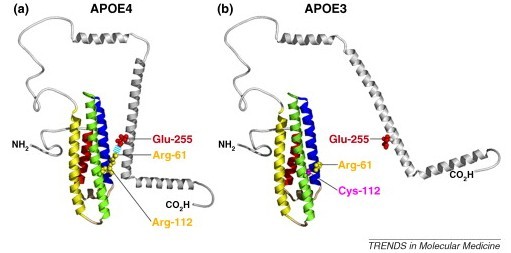
Temporal lobe epilepsy (TLE) is associated with some of the same neuropathological features as those reported for early stages of typical Alzheimer's disease (AD). The APOE ε4 allele is associated with a gene-dose-dependent increase in AD risk and in the severity of amyloid-β (Aβ) pathology. In a study published in the current BMC Medicine, Sue Griffin and colleagues studied markers of brain resilience in the amputated temporal lobes of TLE patients. They discovered compelling evidence that the APOE ε3 isoform in TLE patients is apparently more neuroprotective from Aβ toxicity than is the APOE ε4 isoform, as shown by the reduced levels of neuronal damage, glial activation, and expression of IL-1α in the APOE ε3/ε3 brains. This result points to a new property of APOE isoforms: not only are APOE ε4 alleles associated with increased brain amyloid plaque burden, but these alleles are also apparently inferior to APOE ε3 alleles in conveying resistance to Aβ neurotoxicity. This 'double whammy' result opens up a new direction for studies aimed at elucidating the relevant neurobiological activities of APOE isoforms in the pathogenesis of AD.
颞叶癫痫(TLE)与一些与典型阿尔茨海默病(AD)早期阶段报告的神经病理学特征有关。APOE ε4 等位基因与 AD 风险和淀粉样蛋白-β(Aβ)病理学严重程度的基因剂量依赖性增加有关。在当前发表在 BMC Medicine 上的一项研究中,Sue Griffin 和同事研究了 TLE 患者切除的颞叶中大脑弹性的标志物。他们发现了令人信服的证据,表明与 APOE ε4 同工型相比,TLE 患者的 APOE ε3 同工型显然对 Aβ 毒性具有更强的神经保护作用,这表现在 APOE ε3/ε3 大脑中神经元损伤、神经胶质激活和 IL-1α 表达水平降低。这一结果指向了 APOE 同工型的一个新特性:不仅 APOE ε4 等位基因与大脑淀粉样斑块负担增加有关,而且这些等位基因在传递对 Aβ 神经毒性的抗性方面显然不如 APOE ε3 等位基因。这一“双重打击”的结果为旨在阐明 AD 发病机制中 APOE 同工型相关神经生物学活性的研究开辟了新的方向。