Department of Biochemistry, University of Wisconsin, Madison, WI 53706, USA.
J Cell Biol. 2012 Apr 16;197(2):301-12. doi: 10.1083/jcb.201109132.
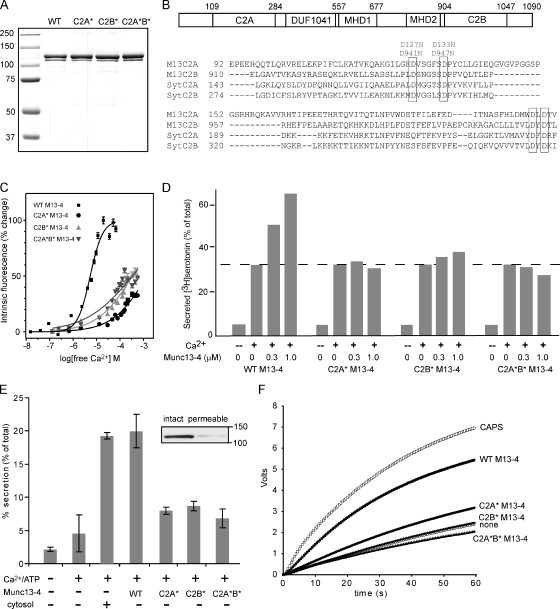
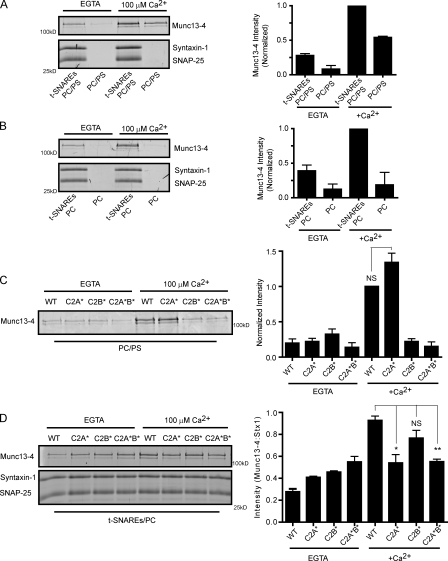
Munc13-4 is a widely expressed member of the CAPS/Munc13 protein family proposed to function in priming secretory granules for exocytosis. Munc13-4 contains N- and C-terminal C2 domains (C2A and C2B) predicted to bind Ca(2+), but Ca(2+)-dependent regulation of Munc13-4 activity has not been described. The C2 domains bracket a predicted SNARE-binding domain, but whether Munc13-4 interacts with SNARE proteins is unknown. We report that Munc13-4 bound Ca(2+) and restored Ca(2+)-dependent granule exocytosis to permeable cells (platelets, mast, and neuroendocrine cells) dependent on putative Ca(2+)-binding residues in C2A and C2B. Munc13-4 exhibited Ca(2+)-stimulated SNARE interactions dependent on C2A and Ca(2+)-dependent membrane binding dependent on C2B. In an apparent coupling of membrane and SNARE binding, Munc13-4 stimulated SNARE-dependent liposome fusion dependent on putative Ca(2+)-binding residues in both C2A and C2B domains. Munc13-4 is the first priming factor shown to promote Ca(2+)-dependent SNARE complex formation and SNARE-mediated liposome fusion. These properties of Munc13-4 suggest its function as a Ca(2+) sensor at rate-limiting priming steps in granule exocytosis.
Munc13-4 是 CAPS/Munc13 蛋白家族中广泛表达的成员,据推测其在分泌颗粒的胞吐作用中发挥作用。Munc13-4 包含 N 端和 C 端的两个 C2 结构域(C2A 和 C2B),预测其能结合 Ca2+,但 Munc13-4 活性的 Ca2+依赖性调节尚未被描述。这两个 C2 结构域夹在一个预测的 SNARE 结合结构域之间,但 Munc13-4 是否与 SNARE 蛋白相互作用尚不清楚。我们报告称,Munc13-4 结合 Ca2+,并恢复了依赖于 C2A 和 C2B 中潜在 Ca2+结合残基的 Ca2+-依赖性颗粒胞吐作用,在可渗透的细胞(血小板、肥大细胞和神经内分泌细胞)中。Munc13-4 表现出 Ca2+刺激的 SNARE 相互作用,这依赖于 C2A,并且依赖于 C2B 的 Ca2+依赖性膜结合。在膜和 SNARE 结合的明显偶联中,Munc13-4 刺激依赖于 C2A 和 C2B 结构域中潜在 Ca2+结合残基的 SNARE 依赖性脂质体融合。Munc13-4 是第一个被证明能促进 Ca2+-依赖性 SNARE 复合物形成和 SNARE 介导的脂质体融合的启动因子。Munc13-4 的这些特性表明其在颗粒胞吐作用的限速启动步骤中作为 Ca2+传感器发挥作用。