SomaLogic, Inc, Boulder, Colorado, United States of America.
PLoS One. 2012;7(4):e35157. doi: 10.1371/journal.pone.0035157. Epub 2012 Apr 11.
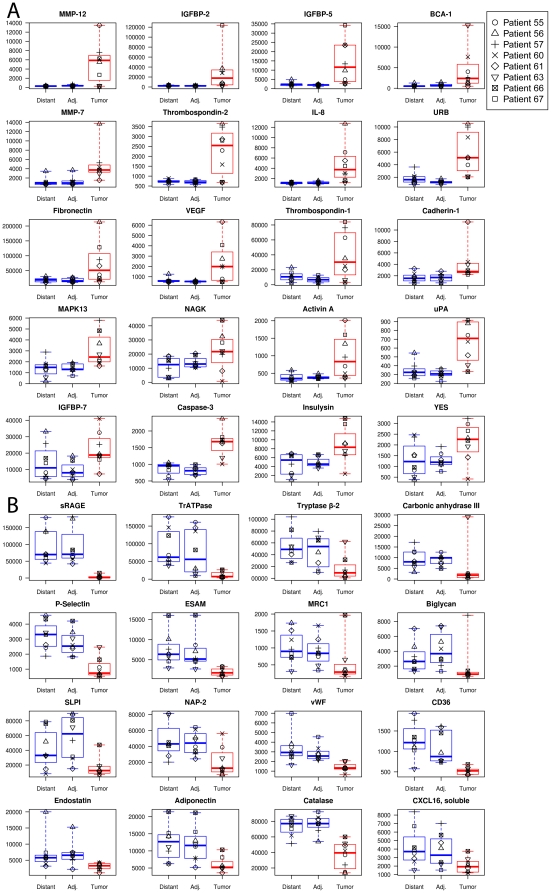
Lung cancer remains the most common cause of cancer-related mortality. We applied a highly multiplexed proteomic technology (SOMAscan) to compare protein expression signatures of non small-cell lung cancer (NSCLC) tissues with healthy adjacent and distant tissues from surgical resections. In this first report of SOMAscan applied to tissues, we highlight 36 proteins that exhibit the largest expression differences between matched tumor and non-tumor tissues. The concentrations of twenty proteins increased and sixteen decreased in tumor tissue, thirteen of which are novel for NSCLC. NSCLC tissue biomarkers identified here overlap with a core set identified in a large serum-based NSCLC study with SOMAscan. We show that large-scale comparative analysis of protein expression can be used to develop novel histochemical probes. As expected, relative differences in protein expression are greater in tissues than in serum. The combined results from tissue and serum present the most extensive view to date of the complex changes in NSCLC protein expression and provide important implications for diagnosis and treatment.
肺癌仍然是癌症相关死亡的最常见原因。我们应用了一种高度多重化的蛋白质组学技术(SOMAscan)来比较非小细胞肺癌(NSCLC)组织与手术切除的健康相邻和远处组织的蛋白质表达特征。在这篇首次将 SOMAscan 应用于组织的报告中,我们强调了 36 种在匹配的肿瘤和非肿瘤组织之间表现出最大表达差异的蛋白质。在肿瘤组织中,有 20 种蛋白质的浓度增加,16 种蛋白质的浓度降低,其中 13 种是 NSCLC 的新标志物。这里鉴定的 NSCLC 组织生物标志物与使用 SOMAscan 在大型基于血清的 NSCLC 研究中鉴定的核心标志物集重叠。我们表明,大规模的蛋白质表达比较分析可用于开发新的组织化学探针。正如预期的那样,与血清相比,蛋白质表达的相对差异在组织中更大。组织和血清的综合结果提供了迄今为止 NSCLC 蛋白质表达复杂变化的最广泛的视图,并为诊断和治疗提供了重要意义。