Wealth from Oceans National Research Flagship, Commonwealth Scientific and Industrial Research Organisation, Division of Marine and Atmospheric Research, Hobart, Tasmania, Australia.
PLoS One. 2012;7(4):e34550. doi: 10.1371/journal.pone.0034550. Epub 2012 Apr 13.
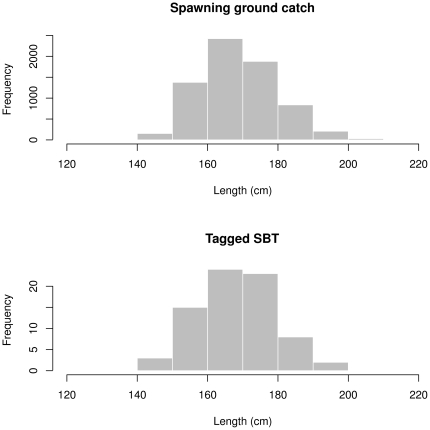
Southern bluefin tuna (SBT) appear to comprise a single stock that is assumed to be both mixed across its distribution and having reproductive adults that are obligate, annual spawners. The putative annual migration cycle of mature SBT consists of dispersed foraging at temperate latitudes with migration to a single spawning ground in the tropical eastern Indian Ocean. Spawning migrations have been assumed to target two peaks in spawning activity; one in September-October and a second in February-March. SBT of sizes comparable to that of individuals observed on the spawning ground were satellite tagged in the Tasman Sea region (2003-2008) and demonstrated both migrations to the spawning grounds and residency in the Tasman Sea region throughout the whole year. All individuals undertaking apparent spawning migrations timed their movements to coincide with the second recognised spawning peak or even later. These observations suggest that SBT may demonstrate substantial flexibility in the scheduling of reproductive events and may even not spawn annually as currently assumed. Further, the population on the spawning grounds may be temporally structured in association with foraging regions. These findings provide new perspectives on bluefin population and spatial dynamics and warrant further investigation and consideration of reproductive schedules in this species.
南方蓝鳍金枪鱼(SBT)似乎由一个单一的群体组成,据认为该群体在其分布范围内是混合的,并且其生殖成鱼是强制性的、一年生的产卵者。成熟 SBT 的假定年度洄游周期包括在温带地区分散觅食,然后迁移到印度洋东部的一个单一产卵场。产卵洄游被认为以两次产卵活动高峰为目标;一次在 9 月至 10 月,另一次在 2 月至 3 月。在塔斯曼海地区(2003-2008 年),对与在产卵场观察到的个体大小相当的 SBT 进行了卫星标记,并证明它们全年都在进行向产卵场的洄游和在塔斯曼海地区的居留。所有进行明显产卵洄游的个体都将其运动时间安排与第二个公认的产卵高峰甚至更晚的时间相吻合。这些观察结果表明,SBT 在生殖事件的安排上可能具有很大的灵活性,甚至可能不像目前假设的那样每年产卵。此外,产卵场的种群可能与觅食区在时间上有关。这些发现为蓝鳍金枪鱼种群和空间动态提供了新的视角,并需要进一步调查和考虑该物种的生殖计划。