State Key Laboratories for Agrobiotechnology, Ministry of Agriculture, National Animal Transmissible Spongiform Encephalopathy Laboratory, College of Veterinary Medicine, China Agricultural University, Beijing, 100193, China.
J Neuroinflammation. 2012 Jul 11;9:73. doi: 10.1186/1742-2094-9-73.
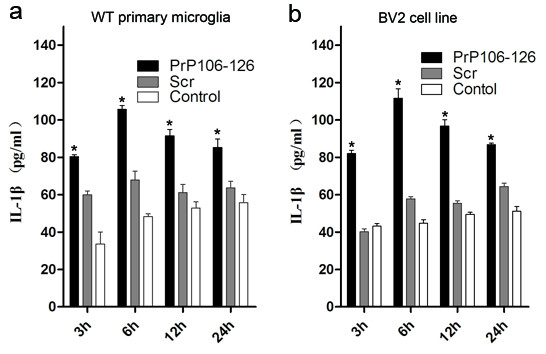
Prion diseases are neurodegenerative disorders characterized by the accumulation of an abnormal disease-associated prion protein, PrPSc. In prion-infected brains, activated microglia are often present in the vicinity of PrPSc aggregates, and microglial activation is thought to play a key role in the pathogenesis of prion diseases. Although interleukin (IL)-1β release by prion-induced microglia has been widely reported, the mechanism by which primed microglia become activated and secrete IL-1β in prion diseases has not yet been elucidated. In this study, we investigated the role of the NACHT, LRR and PYD domains-containing protein (NALP)3 inflammasome in IL-1β release from lipopolysaccharide (LPS)-primed microglia after exposure to a synthetic neurotoxic prion fragment (PrP106-126).
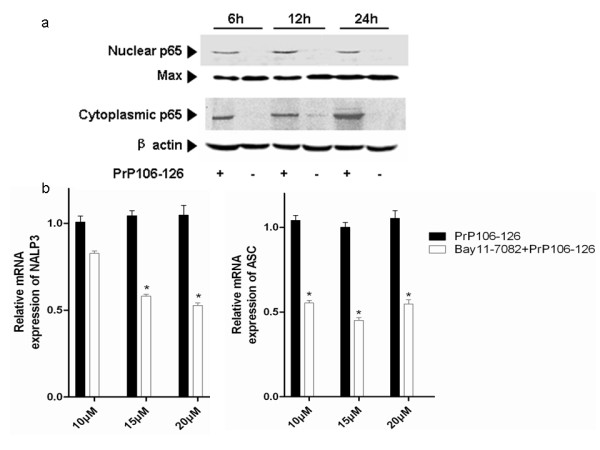
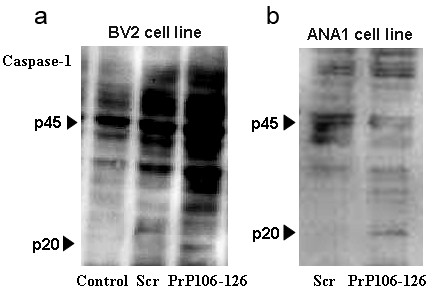
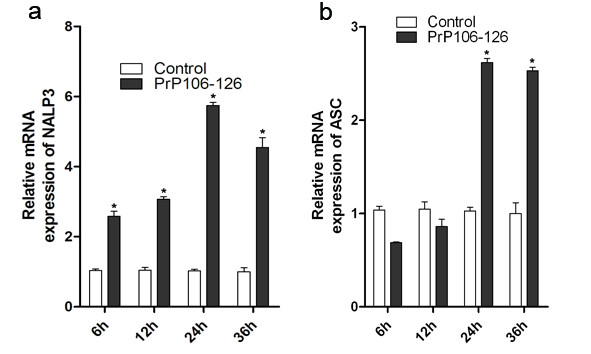
The inflammasome components NALP3 and apoptosis-associated speck-like protein (ASC) were knocked down by gene silencing. IL-1β production was assessed using ELISA. The mRNA expression of NALP3, ASC, and pro-inflammatory factors was measured by quantitative PCR. Western blot analysis was used to detect the protein level of NALP3, ASC, caspase-1 and nuclear factor-κB.
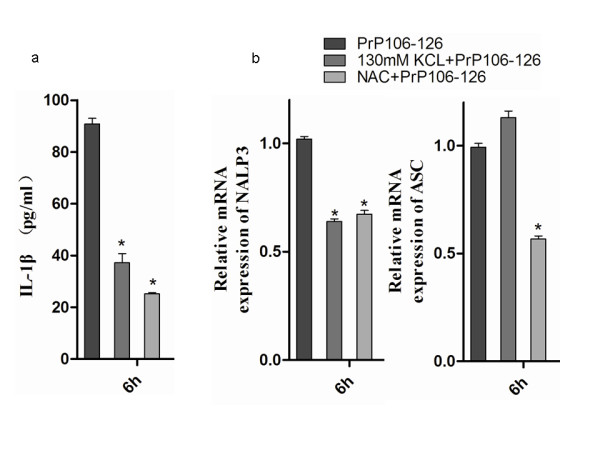
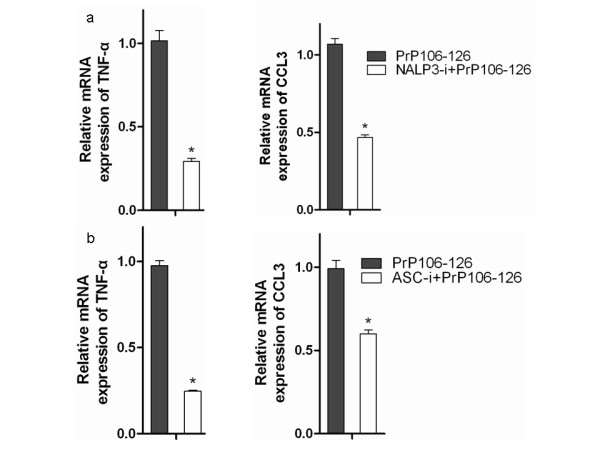
We found that that PrP106-126-induced IL-1β release depends on NALP3 inflammasome activation, that inflammasome activation is required for the synthesis of pro-inflammatory and chemotactic factors by PrP106-126-activated microglia, that inhibition of NF-κB activation abrogated PrP106-126-induced NALP3 upregulation, and that potassium efflux and production of reactive oxygen species were implicated in PrP106-126-induced NALP3 inflammasome activation in microglia.
We conclude that the NALP3 inflammasome is involved in neurotoxic prion peptide-induced microglial activation. To our knowledge, this is the first time that strong evidence for the involvement of NALP3 inflammasome in prion-associated inflammation has been found.
朊病毒病是一种神经退行性疾病,其特征是异常疾病相关朊病毒蛋白(PrPSc)的积累。在朊病毒感染的大脑中,激活的小胶质细胞通常存在于 PrPSc 聚集物附近,并且小胶质细胞的激活被认为在朊病毒病的发病机制中起关键作用。尽管已广泛报道朊病毒诱导的小胶质细胞释放白细胞介素(IL)-1β,但尚未阐明引发的小胶质细胞在朊病毒病中激活并分泌 IL-1β的机制。在这项研究中,我们研究了 NACHT,LRR 和 PYD 结构域包含蛋白(NALP)3 炎性小体在暴露于合成神经毒性朊病毒片段(PrP106-126)后从脂多糖(LPS)引发的小胶质细胞中释放 IL-1β中的作用。
通过基因沉默敲低炎性小体成分 NALP3 和凋亡相关斑点样蛋白(ASC)。使用 ELISA 评估 IL-1β 的产生。通过定量 PCR 测量 NALP3、ASC 和促炎因子的 mRNA 表达。使用 Western blot 分析检测 NALP3、ASC、半胱天冬酶-1 和核因子-κB 的蛋白水平。
我们发现 PrP106-126 诱导的 IL-1β 释放依赖于 NALP3 炎性小体的激活,炎性小体的激活对于 PrP106-126 激活的小胶质细胞合成促炎和趋化因子是必需的,NF-κB 激活的抑制消除了 PrP106-126 诱导的 NALP3 上调,钾外流和活性氧的产生参与了 PrP106-126 诱导的小胶质细胞中 NALP3 炎性小体的激活。
我们得出结论,NALP3 炎性小体参与神经毒性朊病毒肽诱导的小胶质细胞激活。据我们所知,这是首次发现 NALP3 炎性小体参与朊病毒相关炎症的有力证据。