Department of Nautical Medicine, Second Military Medical University, Shanghai, P R China.
J Neuroinflammation. 2012 Jul 6;9:75. doi: 10.1186/1742-2094-9-75.
Experiences and inflammatory mediators are fundamental in the provocation of major depressive disorders (MDDs). We investigated the roles and mechanisms of inducible nitric oxide synthase (iNOS) in stress-induced depression.
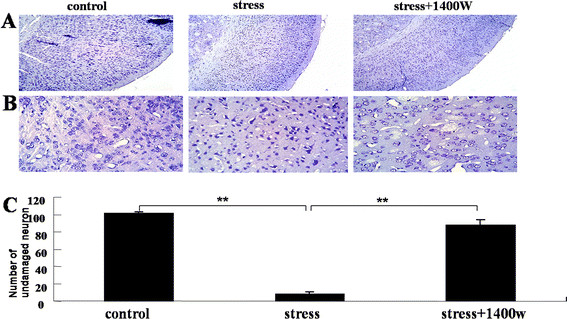
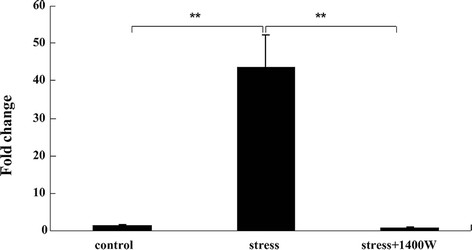
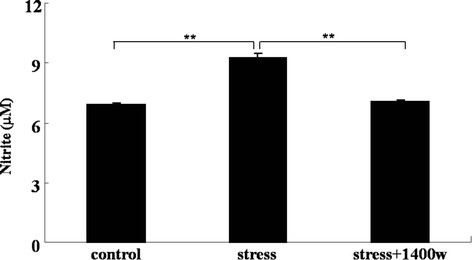
We used a depressive-like state mouse model induced by unpredictable chronic mild stress (UCMS). Depressive-like behaviors were evaluated after 4 weeks of UCMS, in the presence and absence of the iNOS inhibitor N-(3-(aminomethyl)benzyl)acetamidine (1400 W) compared with the control group. Immunohistochemistry was used to check the loss of Nissl bodies in cerebral cortex neurons. The levels of iNOS mRNA expression in the cortex and nitrites in the plasma were measured with real-time reverse transcription PCR (RT-PCR) and Griess reagent respectively.
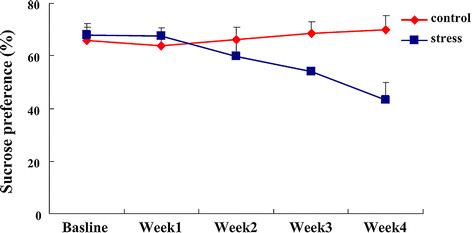
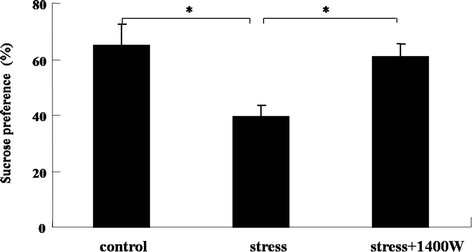
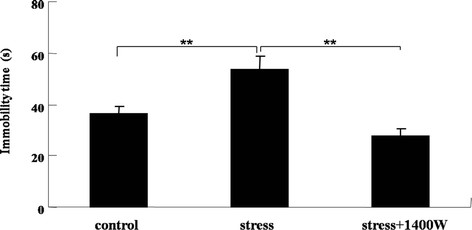
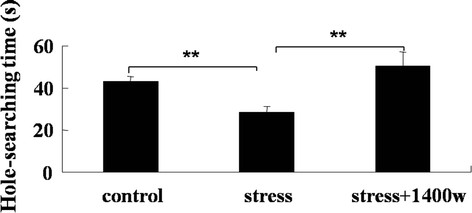
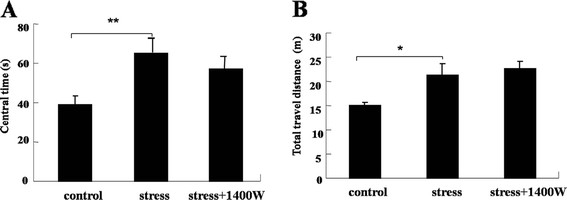
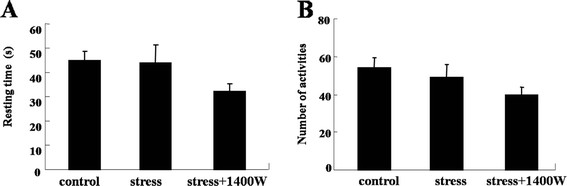
Results showed that the 4-week UCMS significantly induced depressive-like behaviors, including decreased sucrose preference in a sucrose preference test, increased duration of immobility in a forced swim test, and decreased hole-searching time in a locomotor activity test. Meanwhile, in the locomotor activity test, UCMS had no effect on normal locomotor activities, such as resting time, active time and total travel distance. Furthermore, the levels of iNOS mRNA expression in the cortex and nitrites in the plasma of UCMS-exposed mice were significantly increased compared with that of the control group. Neurons of cerebral cortex in UCMS-exposed mice were shrunken with dark staining, together with loss of Nissl bodies. The above-mentioned stress-related depressive-like behaviors, increase of iNOS mRNA expression in the cortex and nitrites in the plasma, and neuron damage, could be abrogated remarkably by pretreating the mice with an iNOS inhibitor (1400 W). Moreover, neurons with abundant Nissl bodies were significantly increased in the 1400 W + UCMS group.
These results support the notion that stress-related NO (derived from iNOS) may contribute to depressive-like behaviors in a mouse model, potentially concurrent with neurodegenerative effects within the cerebral cortex.
体验和炎症介质是引发重度抑郁症(MDD)的基础。我们研究了诱导型一氧化氮合酶(iNOS)在应激诱导性抑郁中的作用和机制。
我们使用不可预测的慢性轻度应激(UCMS)诱导的抑郁样状态小鼠模型。在存在和不存在 iNOS 抑制剂 N-(3-(氨甲基)苄基)乙脒(1400 W)的情况下,比较对照组,4 周 UCMS 后评估抑郁样行为。免疫组织化学用于检查大脑皮层神经元中尼氏小体的丢失。使用实时逆转录 PCR(RT-PCR)和 Griese 试剂分别测量皮质中 iNOS mRNA 表达水平和血浆中硝酸盐水平。
结果表明,4 周 UCMS 可显著诱导抑郁样行为,包括蔗糖偏好试验中蔗糖偏好降低、强迫游泳试验中不动时间延长以及活动试验中洞探时间减少。同时,在活动试验中,UCMS 对正常运动活动(如静止时间、活动时间和总行进距离)没有影响。此外,与对照组相比,UCMS 暴露小鼠皮质中 iNOS mRNA 表达水平和血浆中硝酸盐水平显著升高。UCMS 暴露小鼠大脑皮层神经元萎缩,染色深,尼氏小体丢失。上述应激相关的抑郁样行为、皮质中 iNOS mRNA 表达的增加、血浆中的硝酸盐以及神经元损伤,可通过预先用 iNOS 抑制剂(1400 W)处理小鼠而显著减弱。此外,1400 W+UCMS 组中具有丰富尼氏小体的神经元显著增加。
这些结果支持这样一种观点,即应激相关的 NO(来源于 iNOS)可能导致小鼠模型中出现抑郁样行为,可能与大脑皮层内的神经退行性效应有关。