Edward A. Doisy Department of Biochemistry and Molecular Biology, Saint Louis University School of Medicine, Saint Louis, MO 63104, USA.
Biochemistry. 2012 May 15;51(19):4078-85. doi: 10.1021/bi300353c. Epub 2012 May 2.
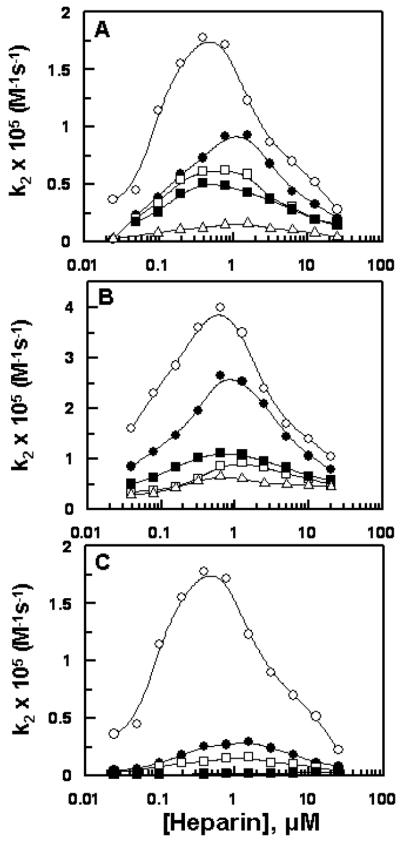
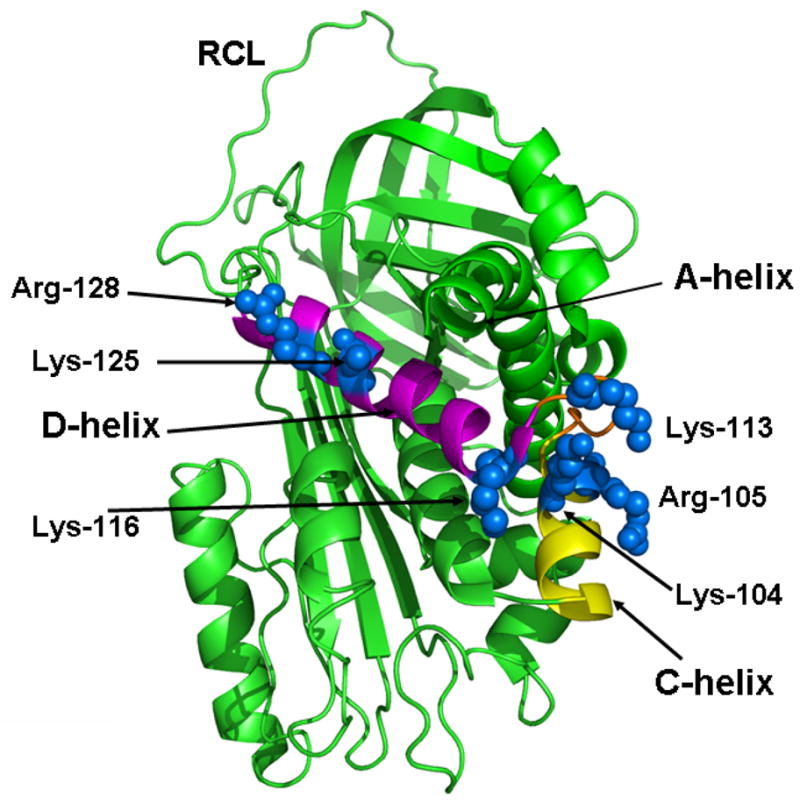
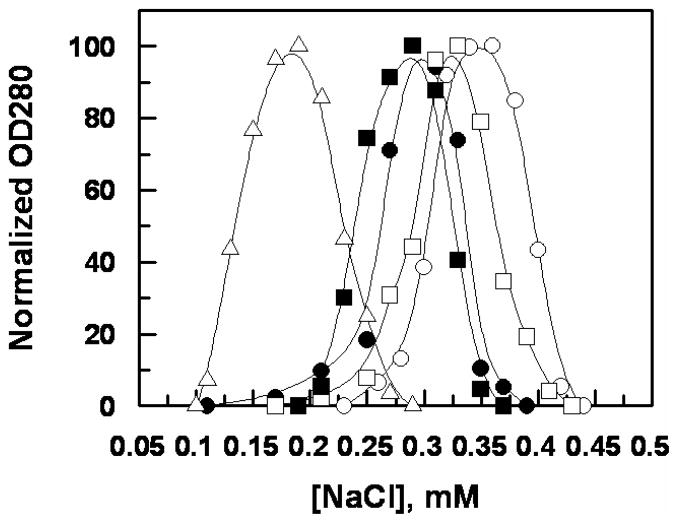
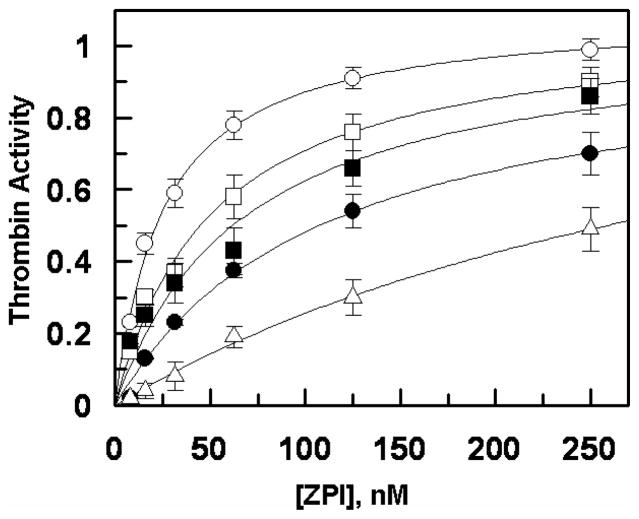
High-molecular weight heparins promote the protein Z-dependent protease inhibitor (ZPI) inhibition of factors Xa (FXa) and XIa (FXIa) by a template mechanism. To map the heparin-binding site of ZPI, the role of basic residues of the D-helix (residues Lys-113, Lys-116, and Lys-125) in the interaction with heparin was evaluated by either substituting these residues with Ala (ZPI-3A) or replacing the D-helix with the corresponding loop of the non-heparin-binding serpin α(1)-proteinase inhibitor (ZPI-D-helix(α1-PI)). Furthermore, both the C-helix (contains two basic residues, Lys-104 and Arg-105) and the D-helix of ZPI were substituted with the corresponding loops of α(1)-proteinase inhibitor (ZPI-CD-helix(α1-PI)). All mutants exhibited near normal reactivity with FXa and FXIa in the absence of cofactors and in the presence of protein Z and membrane cofactors. By contrast, the mutants interacted with heparin with a lower affinity and the 48-fold heparin-mediated enhancement in the rate of FXa inhibition by ZPI was reduced to ~30-fold for ZPI-3A, ~15-fold for ZPI-D-helix(α1-PI), and ~8-fold for ZPI-CD-helix(α1-PI). Consistent with a template mechanism for heparin cofactor action, ZPI-CD-helix(α1-PI) inhibition of a FXa mutant containing a mutation in the heparin-binding site (FXa-R240A) was minimally affected by heparin. A significant decrease (2-5-fold) in the heparin template effect was also observed for the inhibition of FXIa by ZPI mutants. Interestingly, ZPI derivatives exhibited a markedly elevated stoichiometry of inhibition with FXIa in the absence of heparin. These results suggest that basic residues of both helices C and D of ZPI interact with heparin to modulate the inhibitory function of the serpin.
高分子量肝素通过模板机制促进蛋白 Z 依赖性蛋白酶抑制剂(ZPI)抑制因子 Xa(FXa)和因子 XIa(FXIa)。为了绘制 ZPI 的肝素结合位点图,通过用丙氨酸取代这些残基(ZPI-3A)或用非肝素结合丝氨酸蛋白酶抑制剂 α1(ZPI-D-螺旋(α1-PI)的相应环替换 D-螺旋,评估 D-螺旋(残基 Lys-113、Lys-116 和 Lys-125)中的碱性残基在与肝素相互作用中的作用。此外,ZPI 的 C-螺旋(包含两个碱性残基,Lys-104 和 Arg-105)和 D-螺旋均被 α1-蛋白酶抑制剂(ZPI-CD-螺旋(α1-PI)的相应环取代。所有突变体在缺乏辅因子以及存在蛋白 Z 和膜辅因子的情况下,与 FXa 和 FXIa 的反应性几乎正常。相比之下,突变体与肝素的亲和力降低,肝素介导的 ZPI 对 FXa 抑制率提高约 48 倍,降低至 ZPI-3A 的约 30 倍,ZPI-D-螺旋(α1-PI)的约 15 倍和 ZPI-CD-螺旋(α1-PI)的约 8 倍。与肝素辅因子作用的模板机制一致,ZPI-CD-螺旋(α1-PI)对肝素结合位点突变(FXa-R240A)的 FXa 突变体的抑制作用受肝素的影响最小。ZPI 突变体对 FXIa 的抑制作用也观察到肝素模板效应显著降低(~2-5 倍)。有趣的是,在没有肝素的情况下,ZPI 衍生物对 FXIa 的抑制表现出明显升高的计量关系。这些结果表明,ZPI 的 C 螺旋和 D 螺旋的碱性残基与肝素相互作用,调节丝氨酸蛋白酶抑制剂的抑制功能。