Laboratorio de Microbiología Molecular, Facultad Ciencias Biológicas, Universidad Andres Bello, Santiago, Chile.
BMC Microbiol. 2012 May 22;12:63. doi: 10.1186/1471-2180-12-63.
Hydrogen peroxide (H2O2) and hypochlorous acid (HOCl) are reactive oxygen species that are part of the oxidative burst encountered by Salmonella enterica serovar Typhimurium (S. Typhimurium) upon internalization by phagocytic cells. In order to survive, bacteria must sense these signals and modulate gene expression. Growing evidence indicates that the ArcAB two component system plays a role in the resistance to reactive oxygen species. We investigated the influx of H2O2 and HOCl through OmpW and the role of ArcAB in modulating its expression after exposure to both toxic compounds in S. Typhimurium.
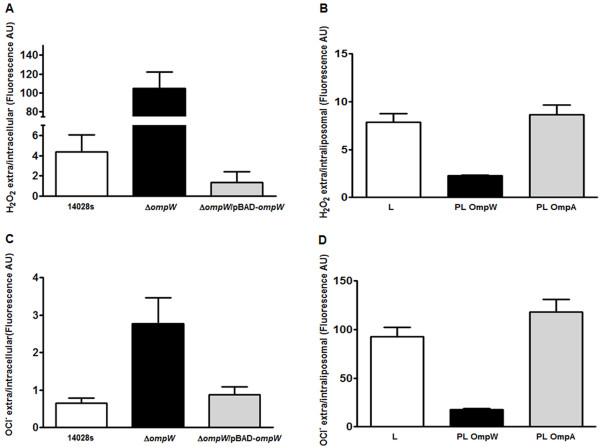
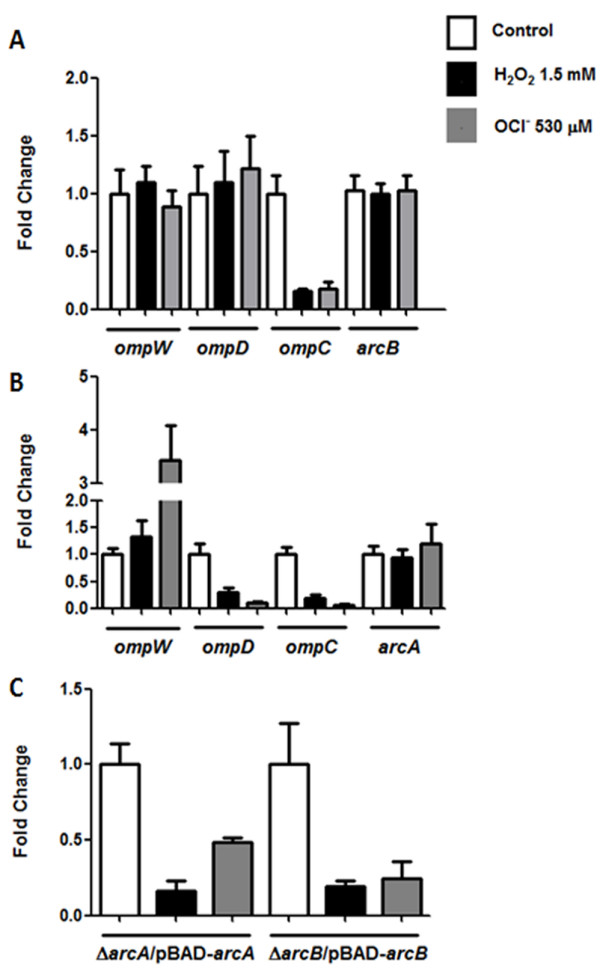
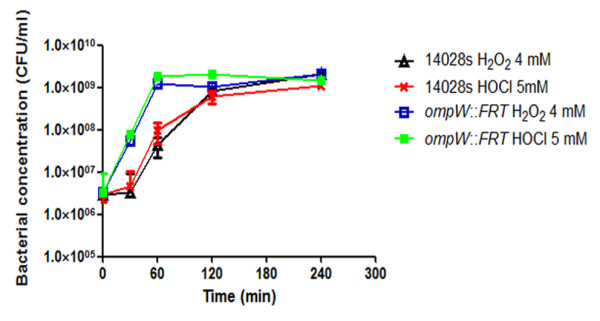
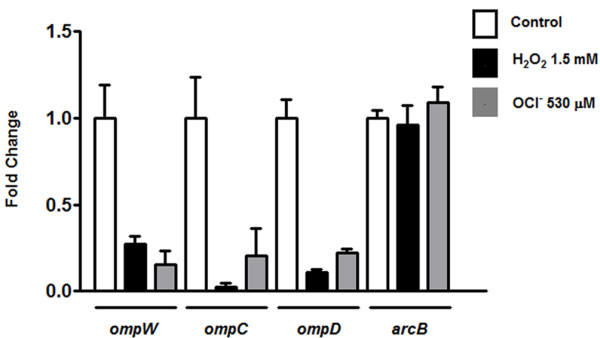
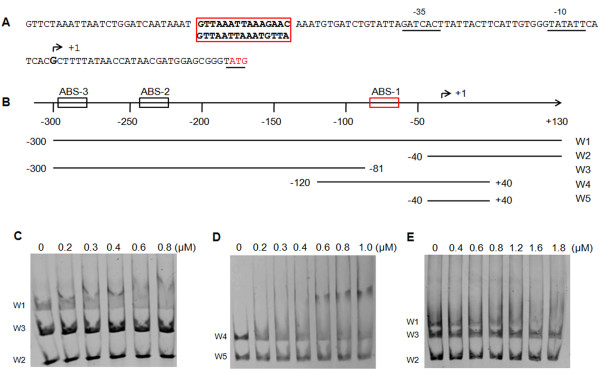
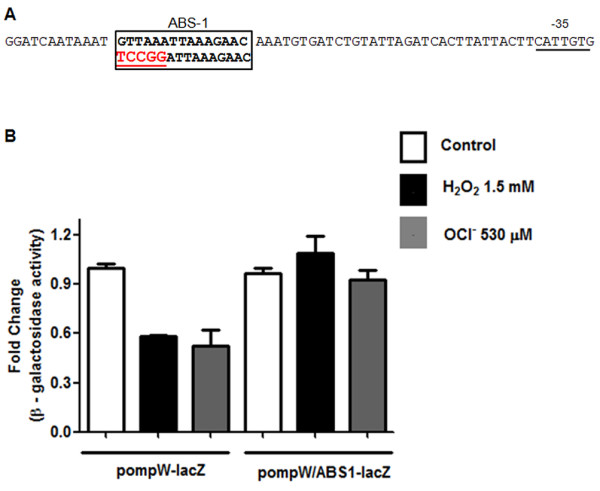
H2O2 and HOCl influx was determined both in vitro and in vivo. A S. Typhimurium ompW mutant strain (∆ompW) exposed to sub-lethal levels of H2O2 and HOCl showed a decreased influx of both compounds as compared to a wild type strain. Further evidence of H2O2 and HOCl diffusion through OmpW was obtained by using reconstituted proteoliposomes. We hypothesized that ompW expression should be negatively regulated upon exposure to H2O2 and HOCl to better exclude these compounds from the cell. As expected, qRT-PCR showed a negative regulation in a wild type strain treated with sub-lethal concentrations of these compounds. A bioinformatic analysis in search for potential negative regulators predicted the presence of three ArcA binding sites at the ompW promoter region. By electrophoretic mobility shift assay (EMSA) and using transcriptional fusions we demonstrated an interaction between ArcA and one site at the ompW promoter region. Moreover, qRT-PCR showed that the negative regulation observed in the wild type strain was lost in an arcA and in arcB mutant strains.
OmpW allows the influx of H2O2 and HOCl and is negatively regulated by ArcA by direct interaction with the ompW promoter region upon exposure to both toxic compounds.
过氧化氢(H2O2)和次氯酸(HOCl)是活性氧物质,是沙门氏菌肠亚种 Typhimurium(S. Typhimurium)被吞噬细胞内化时遇到的氧化爆发的一部分。为了生存,细菌必须感知这些信号并调节基因表达。越来越多的证据表明,ArcAB 双组分系统在抵抗活性氧物质方面发挥作用。我们研究了 H2O2 和 HOCl 通过 OmpW 的流入,以及在 S. Typhimurium 暴露于这两种有毒化合物后,ArcAB 在调节其表达中的作用。
我们在体外和体内都测定了 H2O2 和 HOCl 的流入。与野生型菌株相比,暴露于亚致死水平的 H2O2 和 HOCl 的 S. Typhimurium ompW 突变菌株(∆ompW)显示出这两种化合物的流入减少。通过使用重组质体蛋白体进一步证明了 H2O2 和 HOCl 通过 OmpW 的扩散。我们假设,ompW 的表达应该在暴露于 H2O2 和 HOCl 时受到负调控,以更好地将这些化合物排除在细胞之外。正如预期的那样,qRT-PCR 显示在用这些化合物的亚致死浓度处理的野生型菌株中存在负调控。生物信息学分析寻找潜在的负调控因子预测了 ompW 启动子区域存在三个 ArcA 结合位点。通过电泳迁移率变动分析(EMSA)和使用转录融合,我们证明了 ArcA 与 ompW 启动子区域的一个位点之间存在相互作用。此外,qRT-PCR 显示,在 arcA 和 arcB 突变菌株中,观察到的野生型菌株中的负调控丧失。
OmpW 允许 H2O2 和 HOCl 的流入,并通过与 ompW 启动子区域的直接相互作用,在暴露于这两种有毒化合物时受到 ArcA 的负调控。