Institute of Psychiatric Research, Department of Psychiatry, Indiana University School of Medicine, Indianapolis, IN 46202, USA.
Physiol Behav. 2012 Dec 5;107(5):733-42. doi: 10.1016/j.physbeh.2012.04.016. Epub 2012 Apr 24.
Although the hypothalamic orexin system is known to regulate appetitive behaviors and promote wakefulness and arousal (Sakurai, 2007 [56]), this system may also be important in adaptive and pathological anxiety/stress responses (Suzuki et al., 2005 [4]). In a recent study, we demonstrated that CSF orexin levels were significantly higher in patients experiencing panic attacks compared to non-panicking depressed subjects (Johnson et al., 2010 [9]). Furthermore, genetically silencing orexin synthesis or blocking orexin 1 receptors attenuated lactate-induced panic in an animal model of panic disorder. Therefore, in the present study, we tested if orexin (ORX) modulates panic responses and brain pathways activated by two different panicogenic drugs.
We conducted a series of pharmacological, behavioral, physiological and immunohistochemical experiments to study the modulation by the orexinergic inputs of anxiety behaviors, autonomic responses, and activation of brain pathways elicited by systemic injections of anxiogenic/panicogenic drugs in rats.
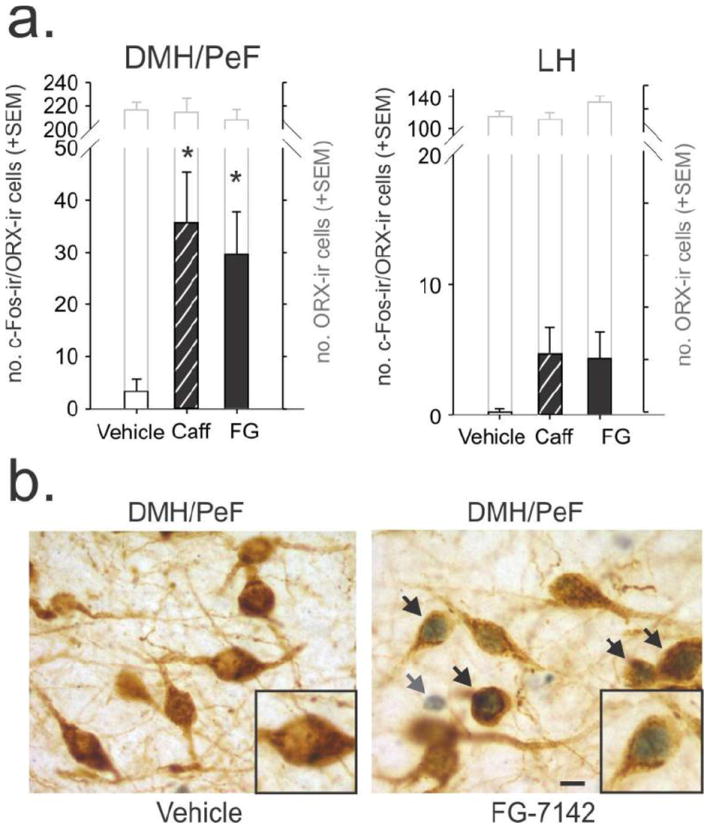
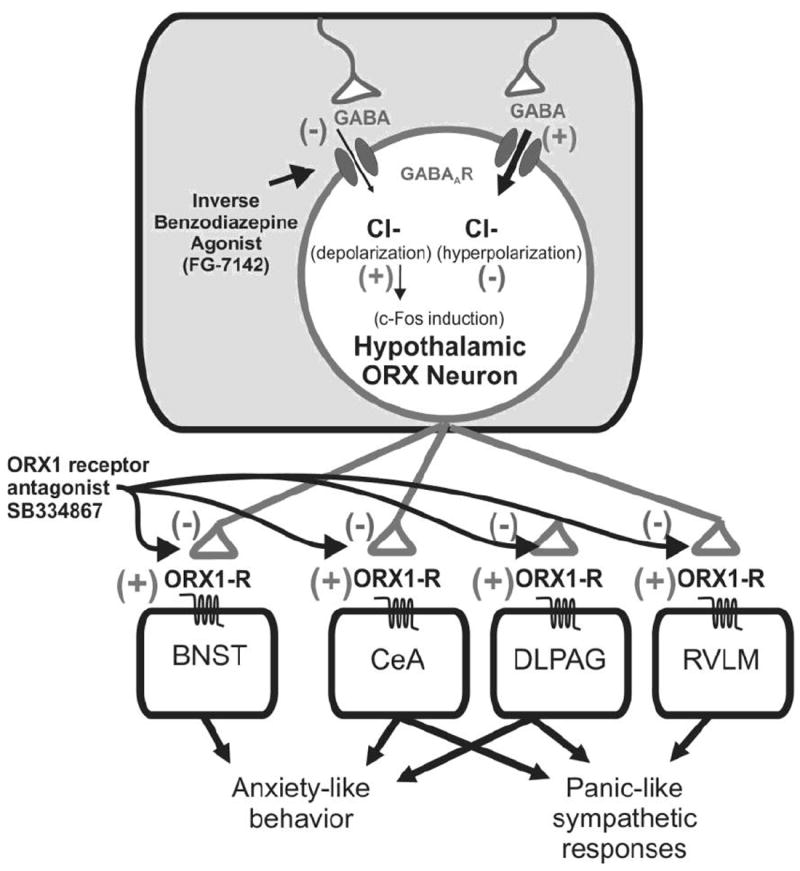
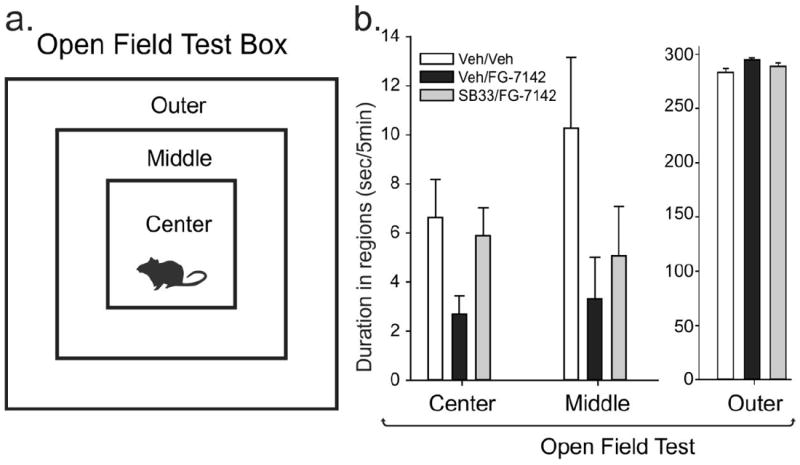
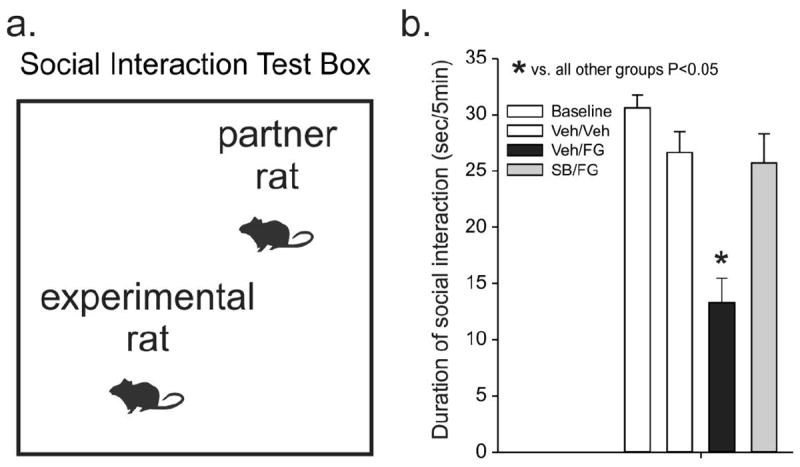
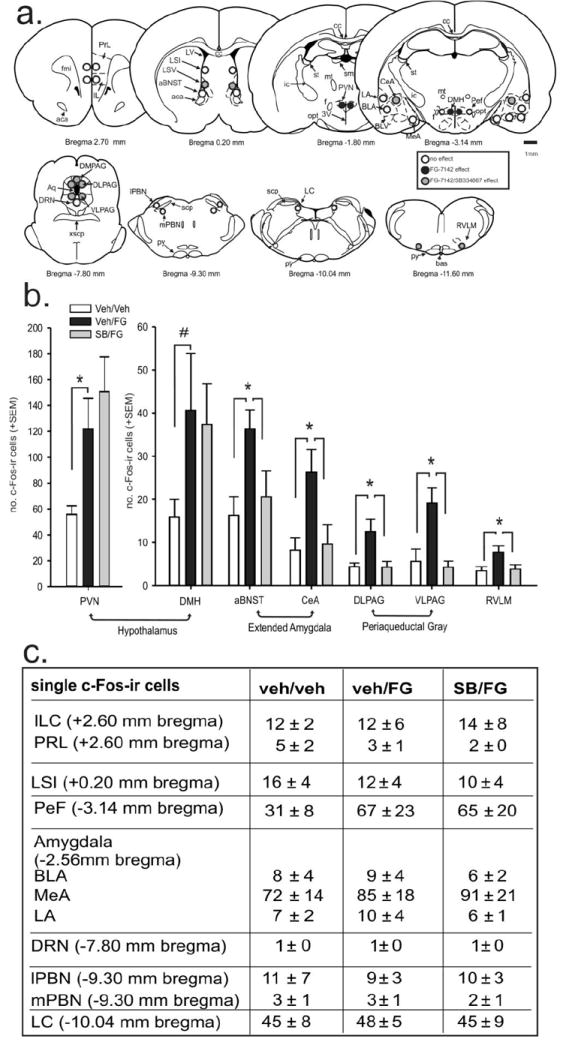
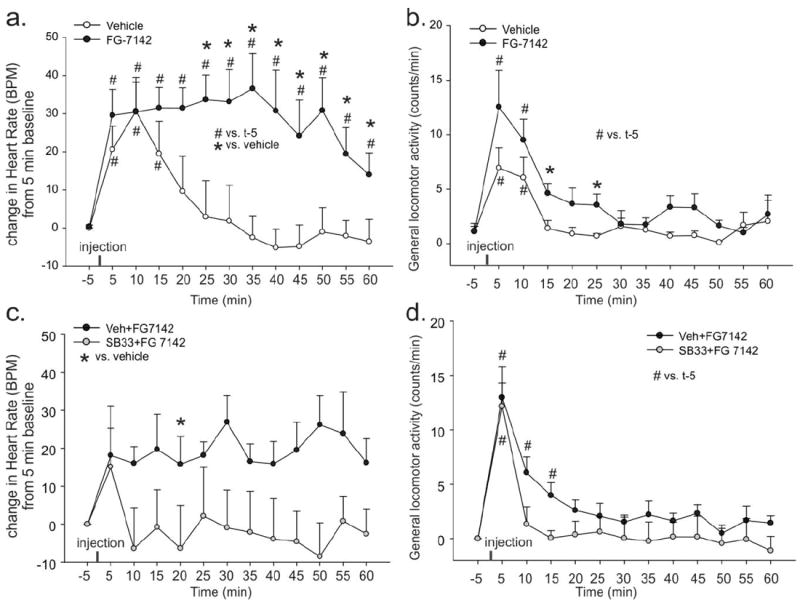
We show that systemic injections of two different anxiogenic/panicogenic drugs (FG-7142, an inverse agonist at the benzodiazepine site of the GABA(A) receptor, and caffeine, a nonselective competitive adenosine receptor antagonist) increased c-Fos induction in a specific subset of orexin neurons located in the dorsomedial/perifornical (DMH/PeF) but not the lateral hypothalamus. Pretreating rats with an orexin 1 receptor antagonist attenuated the FG-7142-induced anxiety-like behaviors, increased heart rate, and neuronal activation in key panic pathways, including subregions of the central nucleus of the amygdala, bed nucleus of the stria terminalis, periaqueductal gray and in the rostroventrolateral medulla.
Overall, the data here suggest that the ORX neurons in the DMH/PeF region are critical to eliciting coordinated panic responses and that ORX1 receptor antagonists constitute a potential novel treatment strategy for panic and related anxiety disorders. The neural pathways through which ORX1 receptor antagonists attenuate panic responses involve the extended amygdala, periaqueductal gray, and medullary autonomic centers.
尽管已知下丘脑食欲素系统调节食欲行为并促进觉醒和唤醒(Sakurai,2007[56]),但该系统在适应性和病理性焦虑/应激反应中也可能很重要(Suzuki 等人,2005[4])。在最近的一项研究中,我们证明与非惊恐抑郁患者相比,经历惊恐发作的患者脑脊液食欲素水平显着升高(Johnson 等人,2010[9])。此外,通过基因沉默食欲素合成或阻断食欲素 1 受体可减弱动物惊恐障碍模型中乳酸引起的惊恐。因此,在本研究中,我们测试了食欲素(ORX)是否调节两种不同的惊恐症药物引起的惊恐反应和大脑途径。
我们进行了一系列药理学、行为学、生理学和免疫组织化学实验,以研究通过全身注射焦虑/惊恐药物引起的焦虑行为、自主反应和大脑途径的激活,调节食欲素能传入。
我们表明,两种不同的焦虑/惊恐药物(FG-7142,GABA(A)受体苯二氮䓬位点的反向激动剂和咖啡因,一种非选择性竞争性腺苷受体拮抗剂)的全身注射增加了位于背内侧/peri 中的特定食欲素神经元子集的 c-Fos 诱导(DMH/PeF)但不是外侧下丘脑。用食欲素 1 受体拮抗剂预处理大鼠可减弱 FG-7142 引起的焦虑样行为、增加心率和关键惊恐途径中的神经元激活,包括杏仁核中央核、终纹床核、中脑导水管周围灰质和头侧腹外侧延髓的亚区。
总体而言,这些数据表明 DMH/PeF 区域的 ORX 神经元对于引发协调的惊恐反应至关重要,并且 ORX1 受体拮抗剂构成了惊恐和相关焦虑障碍的潜在新治疗策略。ORX1 受体拮抗剂减弱惊恐反应的神经通路涉及扩展的杏仁核、中脑导水管周围灰质和髓质自主中心。