Sección de Parasitología, Instituto Conmemorativo Gorgas de Estudios de la Salud, Panama City, Panama.
PLoS One. 2012;7(4):e34657. doi: 10.1371/journal.pone.0034657. Epub 2012 Apr 25.
Chagas disease was originally reported in Panama in 1931. Currently, the best knowledge of this zoonosis is restricted to studies done in historically endemic regions. However, little is known about the distribution and epidemiology of Chagas disease in other rural areas of the country.
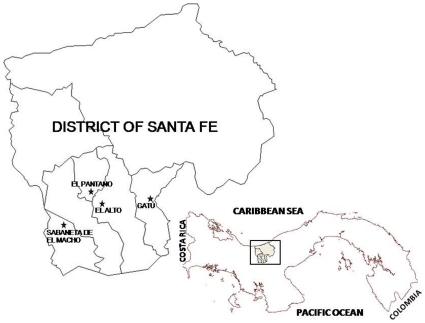
A cross-sectional descriptive study was carried out between May 2005 - July 2008 in four rural communities of the Santa Fe District, Veraguas Province. The study included an entomologic search to collect triatomines, bloodmeal type identification and infection rate with trypanosomes in collected vectors using a dot- blot and PCR analysis, genotyping of circulating Trypanosoma cruzi (mini-exon gene PCR analysis) and the detection of chagasic antibodies among inhabitants. The vector Rhodnius pallescens was more frequently found in La Culaca and El Pantano communities (788 specimens), where it was a sporadic household visitor. These triatomines presented darker coloration and larger sizescompared with typical specimens collected in Central Panama. Triatoma dimidiata was more common in Sabaneta de El Macho (162 specimens). In one small sub-region (El Macho), 60% of the houses were colonized by this vector. Of the examined R. pallescens, 54.7.0% (88/161) had fed on Didelphis marsupialis, and 24.6% (34/138) of T. dimidiata specimens collected inside houses were positive for human blood. R. pallescens presented an infection index with T. cruzi of 17.7% (24/136), with T. rangeli of 12.5% (17/136) and 50.7% (69/136) were mixed infections. In 117 T. dimidiata domestic specimens the infection index with T. cruzi was 21.4%. Lineage I of T. cruzi was confirmed circulating in these vectors. A T. cruzi infection seroprevalence of 2.3% (24/1,056) was found in this population.
This is the first report of Chagas disease endemicity in Santa Fe District, and it should be considered a neglected public health problem in this area of Panama.
1931 年,在巴拿马首次报告了恰加斯病。目前,对这种人畜共患病的最佳了解仅限于在历史流行地区进行的研究。然而,关于该国其他农村地区的恰加斯病的分布和流行病学情况,人们知之甚少。
2005 年 5 月至 2008 年 7 月,在巴拿马 Veraguas 省 Santa Fe 区的四个农村社区进行了一项横断面描述性研究。该研究包括进行昆虫学搜索,以收集锥蝽;使用斑点印迹和 PCR 分析鉴定血餐类型和收集到的媒介中的寄生虫感染率;对循环中的 Trypanosoma cruzi 进行基因分型(mini-exon 基因 PCR 分析);以及检测居民中的恰加斯抗体。在 La Culaca 和 El Pantano 社区(788 只标本)中,发现更多的 Rhodnius pallescens 这种媒介,它是一种偶发性的家庭访客。与在中 panama 收集到的典型标本相比,这些锥蝽的颜色更深,体型更大。在 Sabaneta de El Macho(162 只标本)中,更常见的是 Triatoma dimidiata。在一个小的分区(El Macho)中,有 60%的房屋被这种媒介占据。在检查的 Rhodnius pallescens 中,54.7.0%(88/161)以 Didelphis marsupialis 为食,24.6%(34/138)在室内采集的 T. dimidiata 标本对人血呈阳性。R. pallescens 的 T. cruzi 感染指数为 17.7%(24/136),T. rangeli 为 12.5%(17/136),50.7%(69/136)为混合感染。在 117 只 domestic 标本中,T. cruzi 的感染指数为 21.4%。在这些媒介中,确认了循环的 T. cruzi 谱系 I。在该人群中发现 T. cruzi 感染血清流行率为 2.3%(24/1,056)。
这是 Santa Fe 区恰加斯病流行的首次报告,在巴拿马该地区应被视为一个被忽视的公共卫生问题。