Department of Ecology and Parasitology, Zoological Institute 1, University of Karlsruhe, 76131, Karlsruhe, Germany.
BMC Evol Biol. 2012 May 4;12:60. doi: 10.1186/1471-2148-12-60.
Anguillicolidae Yamaguti, 1935 is a family of parasitic nematode infecting fresh-water eels of the genus Anguilla, comprising five species in the genera Anguillicola and Anguillicoloides. Anguillicoloides crassus is of particular importance, as it has recently spread from its endemic range in the Eastern Pacific to Europe and North America, where it poses a significant threat to new, naïve hosts such as the economic important eel species Anguilla anguilla and Anguilla rostrata. The Anguillicolidae are therefore all potentially invasive taxa, but the relationships of the described species remain unclear. Anguillicolidae is part of Spirurina, a diverse clade made up of only animal parasites, but placement of the family within Spirurina is based on limited data.
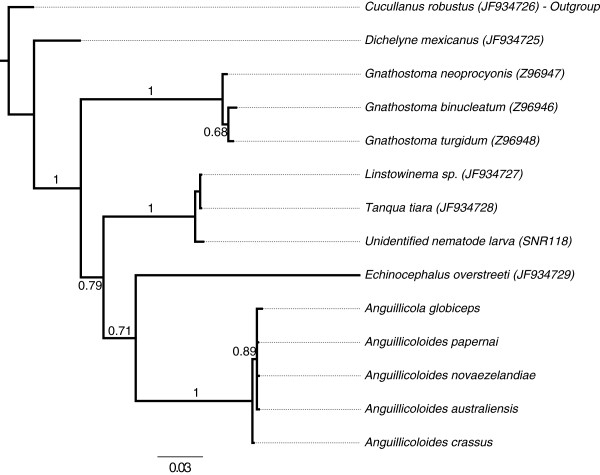
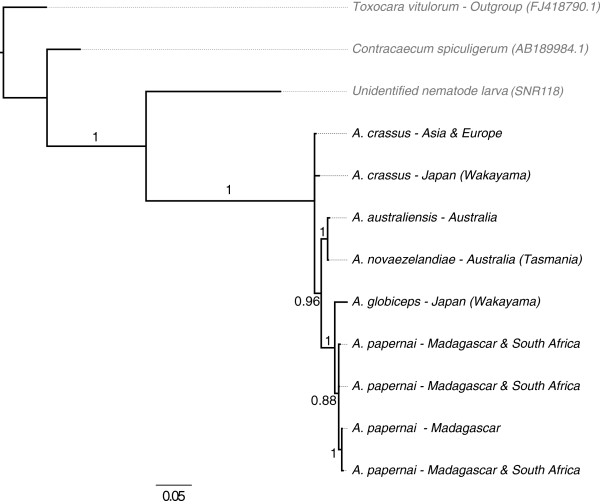
We generated an extensive DNA sequence dataset from three loci (the 5' one-third of the nuclear small subunit ribosomal RNA, the D2-D3 region of the nuclear large subunit ribosomal RNA and the 5' half of the mitochondrial cytochrome c oxidase I gene) for the five species of Anguillicolidae and used this to investigate specific and generic boundaries within the family, and the relationship of Anguillicolidae to other spirurine nematodes. Neither nuclear nor mitochondrial sequences supported monophyly of Anguillicoloides. Genetic diversity within the African species Anguillicoloides papernai was suggestive of cryptic taxa, as was the finding of distinct lineages of Anguillicoloides novaezelandiae in New Zealand and Tasmania. Phylogenetic analysis of the Spirurina grouped the Anguillicolidae together with members of the Gnathostomatidae and Seuratidae.
The Anguillicolidae is part of a complex radiation of parasitic nematodes of vertebrates with wide host diversity (chondrichthyes, teleosts, squamates and mammals), most closely related to other marine vertebrate parasites that also have complex life cycles. Molecular analyses do not support the recent division of Anguillicolidae into two genera. The described species may hide cryptic taxa, identified here by DNA taxonomy, and this DNA barcoding approach may assist in tracking species invasions. The propensity for host switching, and thus the potential for invasive behaviour, is found in A. crassus, A. novaezelandiae and A. papernai, and thus may be common to the group.
鳗蛔科(Anguillicolidae)是一类寄生线虫,感染鳗鲡属的淡水鳗,包括鳗蛔属和鳗蛔样属的五个种。鳗蛔样新线虫(Anguillicoloides crassus)尤为重要,因为它最近从其东太平洋的特有分布范围扩散到欧洲和北美,对经济重要的鳗鲡种类,如欧洲鳗(Anguilla anguilla)和美洲鳗(Anguilla rostrata)等新的、无经验的宿主构成了重大威胁。因此,鳗蛔科都是具有潜在入侵性的分类群,但描述种的关系仍不清楚。鳗蛔科是螺旋线虫目的一部分,这是一个由仅动物寄生虫组成的多样化类群,但将该科归入螺旋线虫目是基于有限的数据。
我们从三个基因座(核小亚基核糖体 RNA 的 5'三分之一、核大亚基核糖体 RNA 的 D2-D3 区和线粒体细胞色素 c 氧化酶 I 基因的 5'一半)生成了鳗蛔科五个种的广泛 DNA 序列数据集,并利用该数据集研究了该科内的特有和属级界限,以及鳗蛔科与其他螺旋线虫的关系。核和线粒体序列均不支持鳗蛔样属的单系性。非洲种鳗蛔样新线虫内的遗传多样性表明存在隐存种,在新西兰和塔斯马尼亚发现的鳗蛔样新线虫的不同谱系也表明存在隐存种。螺旋线虫的系统发育分析将鳗蛔科与颚口线虫科和毛圆线虫科聚在一起。
鳗蛔科是具有广泛宿主多样性的脊椎动物寄生线虫的复杂辐射的一部分(软骨鱼、硬骨鱼、有鳞目和哺乳动物),与其他具有复杂生活史的海洋脊椎动物寄生虫关系最密切。分子分析不支持最近将鳗蛔科分为两个属。描述的种可能隐藏着隐存种,这里通过 DNA 分类学来识别,这种 DNA 条形码方法可能有助于追踪物种入侵。种间转换的倾向,因此具有入侵行为的潜力,在鳗蛔样新线虫、鳗蛔样新西兰线虫和鳗蛔样papernai 中被发现,因此可能在该组中很常见。