Wang Cong-Jun, Xiao Chao-Wen, You Tian-Geng, Zheng Ya-Xin, Gao Wei, Zhou Zhu-Qing, Chen Jun, Xue Xin-Bo, Fan Jia, Zhang Hui
Department of General Surgery, Shanghai East Hospital, Tongji University School of Medicine, Shanghai 200120, China.
Mol Cancer. 2012 May 8;11:31. doi: 10.1186/1476-4598-11-31.
Hepatocellular carcinoma (HCC) has a dismal 5-year-survival rate of 10%, so novel strategies are warranted. IL-24 mediates anti-tumor activity reducing STAT3 expression, which suggests that interferon (IFN) alpha may augment tumor cell lysis and reduce angiogenesis. We investigated the antitumor activity of treatment with IFN-α, with the oncolytic adenovirus SG600-IL-24, or the combination of both in HCC in vitro and in vivo.
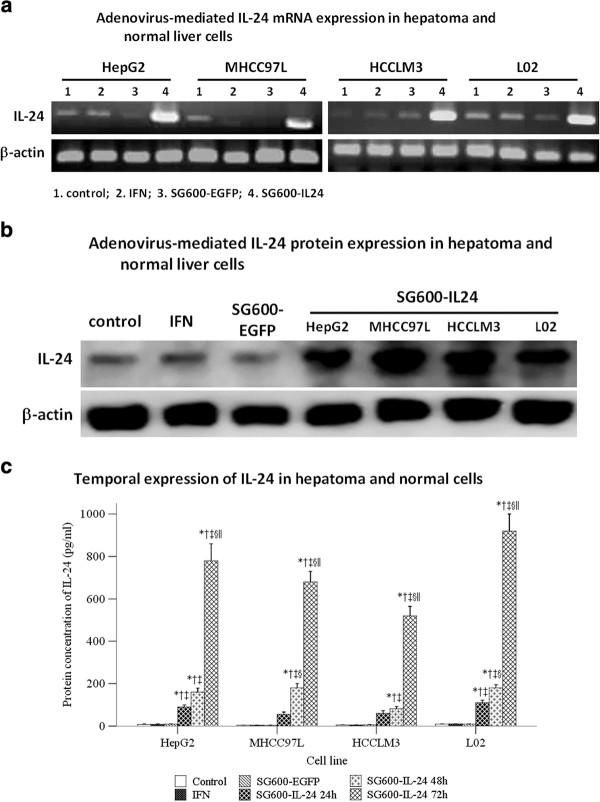
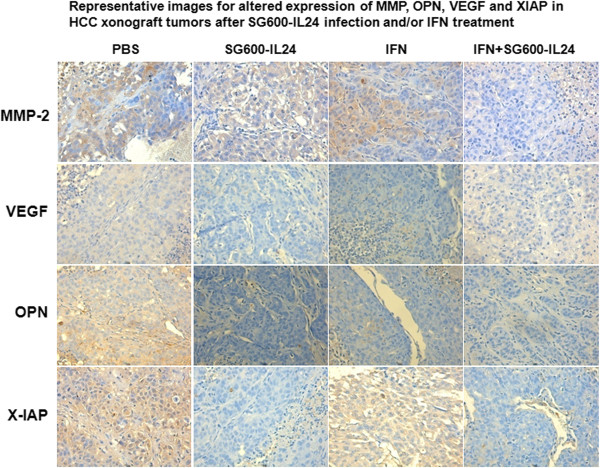
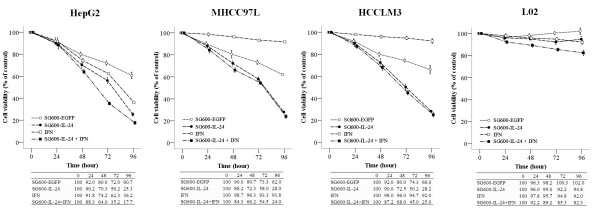
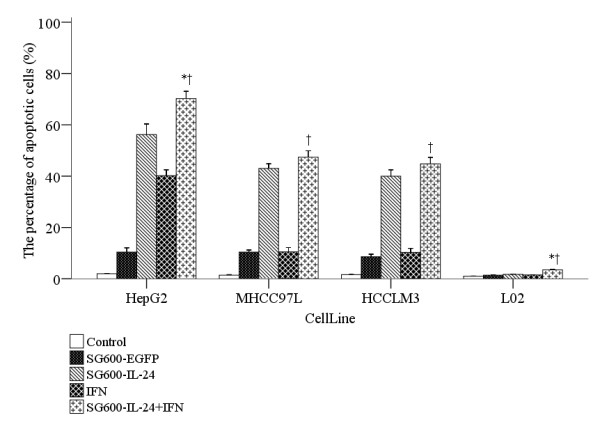
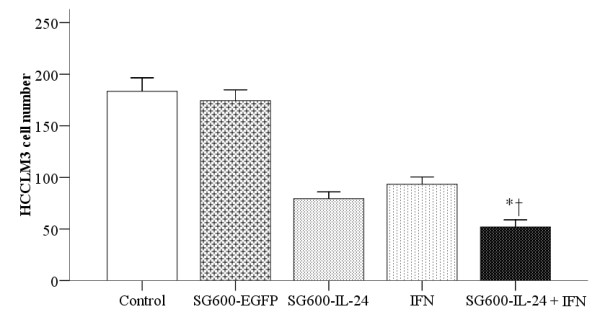
RT-PCR, ELISA assay and Western-blot confirmed that the exogenous IL-24 gene was highly expressed in HCC cells infected with SG600-IL-24. Treatment with combined IFN-α and SG600-IL-24 suppressed growth and promoted apoptosis of the HepG2, MHCC97L, and HCCLM3 cell lines compared with the normal cell line L02. The combined therapy increased STAT1 and SOCS1 and apoptosis, but decreased the expression of the metastatic and angiogenic proteins MMP-2, XIAP, OPN, and VEGF, which are regulated by STAT3 in HCC cells in vitro. To assess the effects in vivo, the HCC cell line HCCLM3 was transplanted subcutaneously into the right flanks of nude mice. Mice in the IFN-α group, the SG600-IL-24 group, or the combined therapy group had significantly suppressed growth of the HCC xenografted tumors compared to the PBS control group of mice. Among the mice treated with the combination of IFN-α and SG600-IL-24, three of those eight mice had long-term survival and no evidence of a tumor. These mice also had decreased expression of the metastatic and angiogenic proteins MMP-2, XIAP, OPN, and VEGF.
The present study demonstrated for the first time the potential antitumor activity of IFN-α combined with the oncolytic adenovirus SG600-IL-24 in HCC both in vitro and in vivo, and suggests its further development as a potential candidate for HCC cancer gene therapy.
肝细胞癌(HCC)的5年生存率低至10%,令人沮丧,因此需要新的治疗策略。白细胞介素-24(IL-24)通过降低信号转导和转录激活因子3(STAT3)的表达介导抗肿瘤活性,这表明α干扰素(IFN)可能增强肿瘤细胞裂解并减少血管生成。我们研究了IFN-α、溶瘤腺病毒SG600-IL-24或两者联合治疗在体外和体内对HCC的抗肿瘤活性。
逆转录-聚合酶链反应(RT-PCR)、酶联免疫吸附测定(ELISA)和蛋白质免疫印迹法(Western-blot)证实,外源性IL-24基因在感染SG600-IL-24的HCC细胞中高表达。与正常细胞系L02相比,IFN-α与SG600-IL-24联合治疗可抑制HepG2、MHCC97L和HCCLM3细胞系的生长并促进其凋亡。联合治疗可增加信号转导和转录激活因子1(STAT1)和细胞因子信号转导抑制因子1(SOCS1)的表达并促进凋亡,但可降低由STAT3调节的转移和血管生成蛋白基质金属蛋白酶-2(MMP-2)、X连锁凋亡抑制蛋白(XIAP)、骨桥蛋白(OPN)和血管内皮生长因子(VEGF)在体外HCC细胞中的表达。为了评估体内效果,将HCC细胞系HCCLM3皮下移植到裸鼠右腹。与磷酸盐缓冲液(PBS)对照组小鼠相比,IFN-α组、SG600-IL-24组或联合治疗组小鼠的HCC异种移植瘤生长均受到显著抑制。在接受IFN-α与SG600-IL-24联合治疗的小鼠中,8只小鼠中有3只长期存活且无肿瘤迹象。这些小鼠的转移和血管生成蛋白MMP-2、XIAP、OPN和VEGF的表达也降低。
本研究首次证明了IFN-α与溶瘤腺病毒SG600-IL-24联合治疗在体外和体内对HCC具有潜在的抗肿瘤活性,并表明其作为HCC癌症基因治疗的潜在候选药物具有进一步开发的价值。