Doerenkamp-Zbinden Chair of In Vitro Toxicology and Biomedicine, University of Konstanz, Konstanz, Germany.
Environ Health Perspect. 2012 Aug;120(8):1116-22. doi: 10.1289/ehp.1104489. Epub 2012 May 9.
Information on the potential developmental toxicity (DT) of the majority of chemicals is scarce, and test capacities for further animal-based testing are limited. Therefore, new approaches with higher throughput are required. A screening strategy based on the use of relevant human cell types has been proposed by the U.S. Environmental Protection Agency and others. Because impaired neural crest (NC) function is one of the known causes for teratologic effects, testing of toxicant effects on NC cells is desirable for a DT test battery.
We developed a robust and widely applicable human-relevant NC function assay that would allow for sensitive screening of environmental toxicants and defining toxicity pathways.
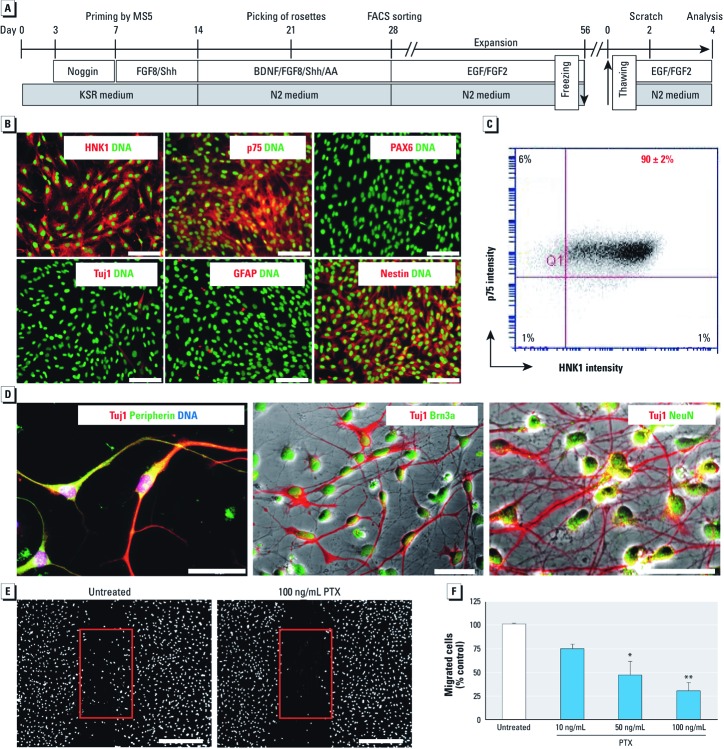
We generated NC cells from human embryonic stem cells, and after establishing a migration assay of NC cells (MINC assay), we tested environmental toxicants as well as inhibitors of physiological signal transduction pathways.
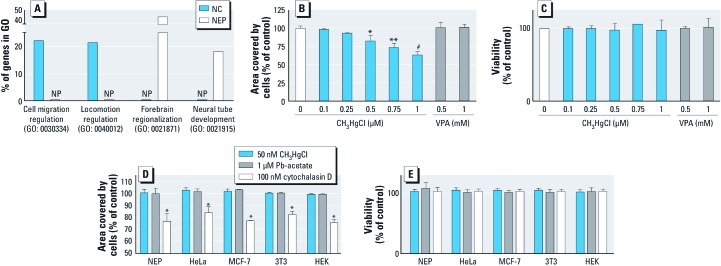
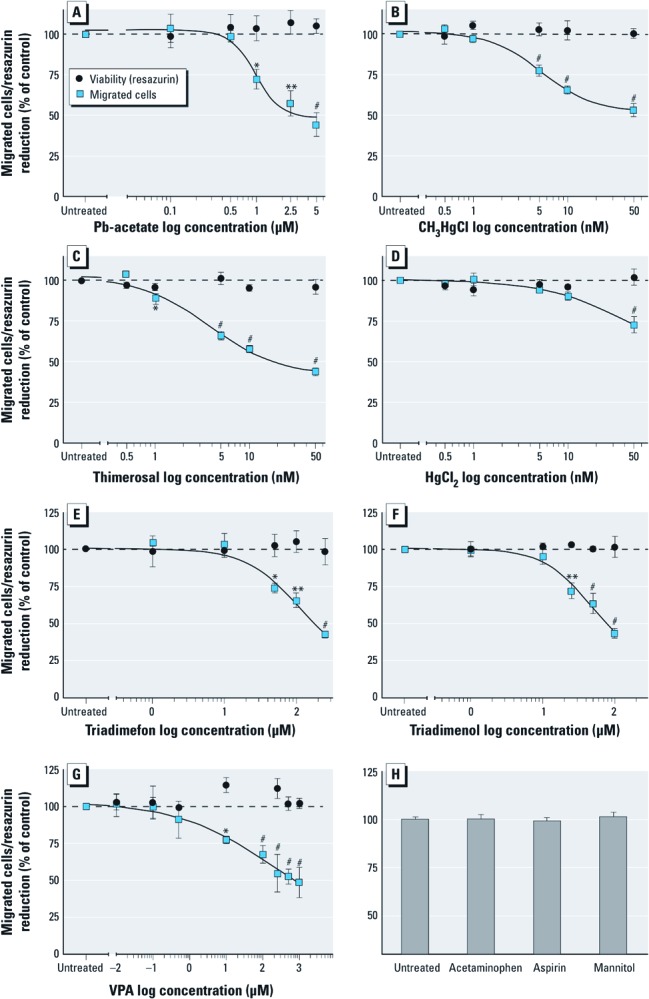
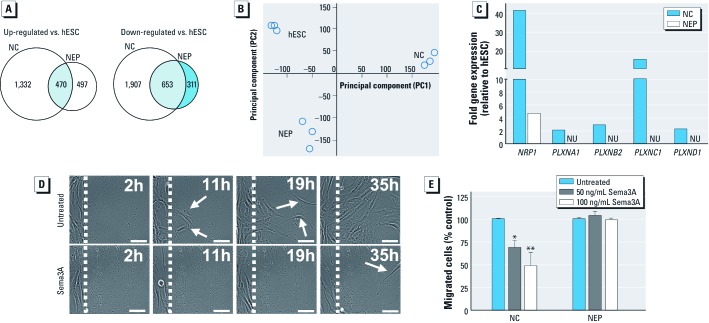
Methylmercury (50 nM), valproic acid (> 10 µM), and lead-acetate [Pb(CH3CO2)4] (1 µM) affected the migration of NC cells more potently than migration of other cell types. The MINC assay correctly identified the NC toxicants triadimefon and triadimenol. Additionally, it showed different sensitivities to various organic and inorganic mercury compounds. Using the MINC assay and applying classic pharmacologic inhibitors and large-scale microarray gene expression profiling, we found several signaling pathways that are relevant for the migration of NC cells.
The MINC assay faithfully models human NC cell migration, and it reveals impairment of this function by developmental toxicants with good sensitivity and specificity.
大多数化学物质潜在发育毒性(DT)的信息稀缺,进一步进行动物基础测试的能力有限。因此,需要具有更高通量的新方法。美国环境保护署和其他机构提出了一种基于使用相关人类细胞类型的筛选策略。由于神经嵴(NC)功能受损是致畸作用的已知原因之一,因此对 NC 细胞的毒性物质作用进行测试是 DT 测试组合的理想选择。
我们开发了一种稳健且广泛适用的人类相关 NC 功能测定法,可用于敏感筛选环境毒物并定义毒性途径。
我们从人类胚胎干细胞中生成 NC 细胞,并在建立 NC 细胞迁移测定法(MINC 测定法)后,测试环境毒物以及生理信号转导途径抑制剂。
甲基汞(50 nM)、丙戊酸(>10 µM)和醋酸铅[Pb(CH3CO2)4](1 µM)对 NC 细胞迁移的影响比其他细胞类型的迁移更有效。MINC 测定法正确识别了 NC 毒物三唑酮和三唑醇。此外,它对各种有机和无机汞化合物表现出不同的敏感性。使用 MINC 测定法并应用经典药理学抑制剂和大规模微阵列基因表达谱分析,我们发现了几个与 NC 细胞迁移相关的信号通路。
MINC 测定法忠实地模拟了人类 NC 细胞的迁移,并且它以良好的灵敏度和特异性揭示了发育毒物对这种功能的损害。