Jane Anne Nohl Division of Hematology and Center for the Study of Blood Diseases, University of Southern California Keck School of Medicine, Los Angeles, California, United States of America.
PLoS One. 2012;7(5):e36601. doi: 10.1371/journal.pone.0036601. Epub 2012 May 8.
Kaposi's sarcoma associated herpesvirus encoded viral FLICE inhibitory protein (vFLIP) K13 activates the NF-κB pathway by binding to the NEMO/IKKγ subunit of the IκB kinase (IKK) complex. However, it has remained enigmatic how K13-NEMO interaction results in the activation of the IKK complex. Recent studies have implicated TRAF6, TAK1 and linear ubiquitin chains assembled by a linear ubiquitin chain assembly complex (LUBAC) consisting of HOIL-1, HOIP and SHARPIN in IKK activation by proinflammatory cytokines.
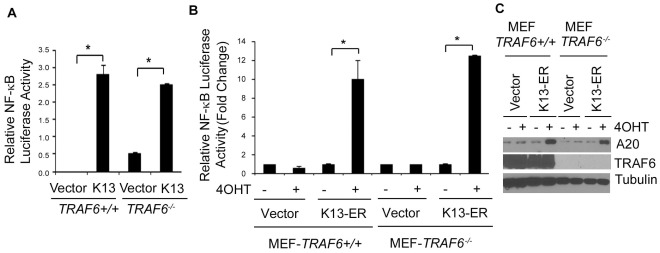
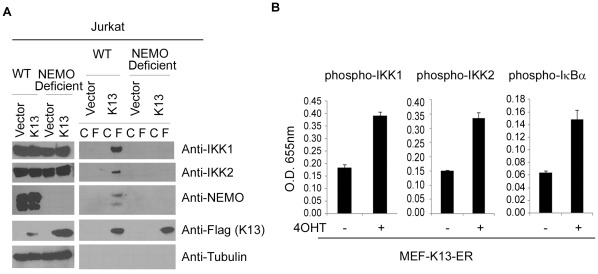
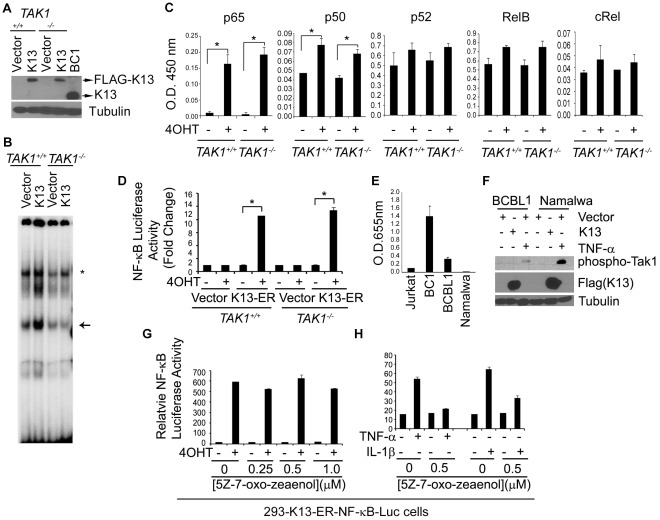
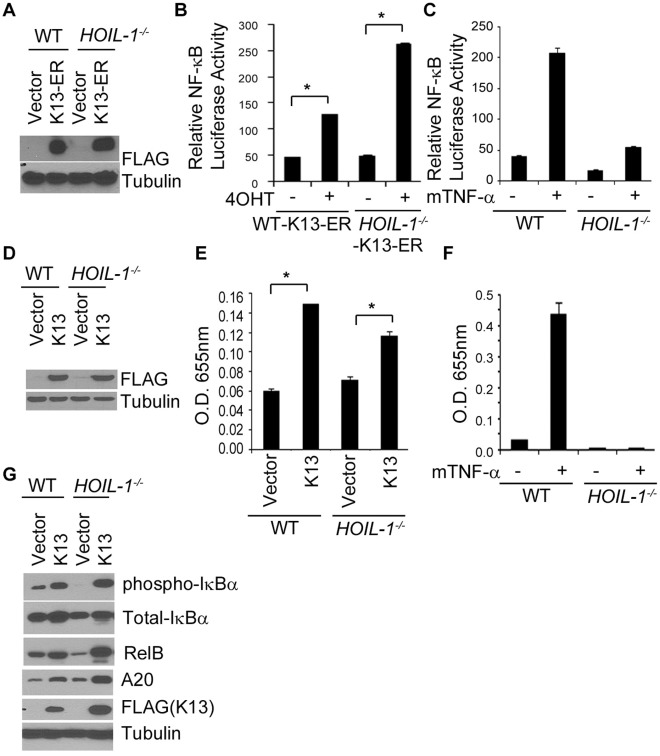
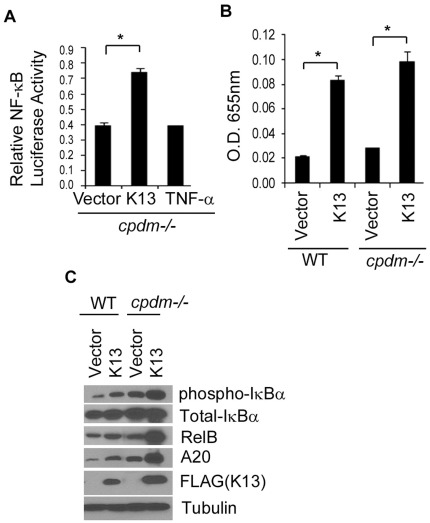
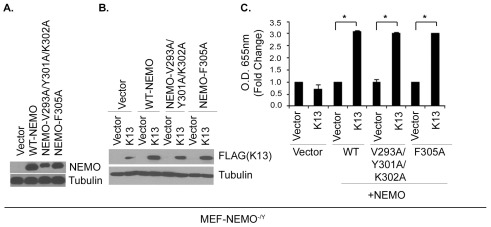
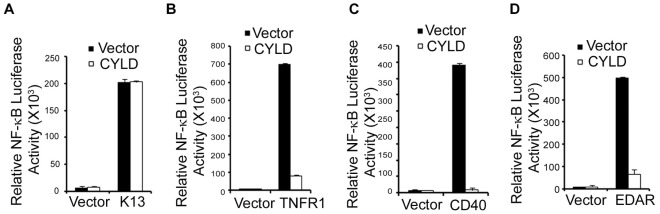
METHODOLOGY/PRINCIPAL FINDINGS: Here we demonstrate that K13-induced NF-κB DNA binding and transcriptional activities are not impaired in cells derived from mice with targeted disruption of TRAF6, TAK1 and HOIL-1 genes and in cells derived from mice with chronic proliferative dermatitis (cpdm), which have mutation in the Sharpin gene (Sharpin(cpdm/cpdm)). Furthermore, reconstitution of NEMO-deficient murine embryonic fibroblast cells with NEMO mutants that are incapable of binding to linear ubiquitin chains supported K13-induced NF-κB activity. K13-induced NF-κB activity was not blocked by CYLD, a deubiquitylating enzyme that can cleave linear and Lys63-linked ubiquitin chains. On the other hand, NEMO was required for interaction of K13 with IKK1/IKKα and IKK2/IKKβ, which resulted in their activation by "T Loop" phosphorylation.
CONCLUSIONS/SIGNIFICANCE: Our results demonstrate that K13 activates the NF-κB pathway by binding to NEMO which results in the recruitment of IKK1/IKKα and IKK2/IKKβ and their subsequent activation by phosphorylation. Thus, K13 activates NF-κB via a mechanism distinct from that utilized by inflammatory cytokines. These results have important implications for the development of therapeutic agents targeting K13-induced NF-κB for the treatment of KSHV-associated malignancies.
卡波氏肉瘤相关疱疹病毒编码的病毒 FLICE 抑制蛋白(vFLIP)K13 通过与 IκB 激酶(IKK)复合物的 NEMO/IKKγ 亚基结合来激活 NF-κB 途径。然而,K13-NEMO 相互作用如何导致 IKK 复合物的激活仍然是个谜。最近的研究表明,在促炎细胞因子激活 IKK 过程中,TRAF6、TAK1 和由 HOIL-1、HOIP 和 SHARPIN 组成的线性泛素链组装复合物(LUBAC)组装的线性泛素链涉及到 TRAF6、TAK1 和线性泛素链组装复合物(LUBAC)组装的线性泛素链。
方法/主要发现:在这里,我们证明 K13 诱导的 NF-κB DNA 结合和转录活性在靶向敲除 TRAF6、TAK1 和 HOIL-1 基因的细胞和慢性增殖性皮炎(cpdm)衍生的细胞中不受影响,cpdm 中存在 Sharpin 基因(Sharpin(cpdm/cpdm))突变。此外,用不能与线性泛素链结合的 NEMO 突变体重建 NEMO 缺陷型小鼠胚胎成纤维细胞支持 K13 诱导的 NF-κB 活性。K13 诱导的 NF-κB 活性不受 CYLD 的抑制,CYLD 是一种可以切割线性和 Lys63 连接泛素链的去泛素化酶。另一方面,NEMO 是 K13 与 IKK1/IKKα 和 IKK2/IKKβ 相互作用所必需的,这导致它们通过“T 环”磷酸化激活。
结论/意义:我们的结果表明,K13 通过与 NEMO 结合激活 NF-κB 途径,导致 IKK1/IKKα 和 IKK2/IKKβ 的募集,随后通过磷酸化激活。因此,K13 通过一种与炎症细胞因子不同的机制激活 NF-κB。这些结果对于开发针对 K13 诱导的 NF-κB 的治疗剂以治疗 KSHV 相关恶性肿瘤具有重要意义。