
利用噬菌体展示技术筛选基质金属蛋白酶-2的肽抑制剂及其对胰腺癌细胞系 PANC-1 和 CFPAC-1 的影响。
Selection of peptide inhibitor to matrix metalloproteinase-2 using phage display and its effects on pancreatic cancer cell lines PANC-1 and CFPAC-1.
机构信息
Key Laboratory of Human Functional Genomics of Jiangsu Province, Clinical Diabetes Centre of Jiangsu Province, the Department of Biochemistry and Molecular Biology, Nanjing Medical University, Nanjing 210029, Jiangsu, China.
出版信息
Int J Biol Sci. 2012;8(5):650-62. doi: 10.7150/ijbs.3897. Epub 2012 May 5.
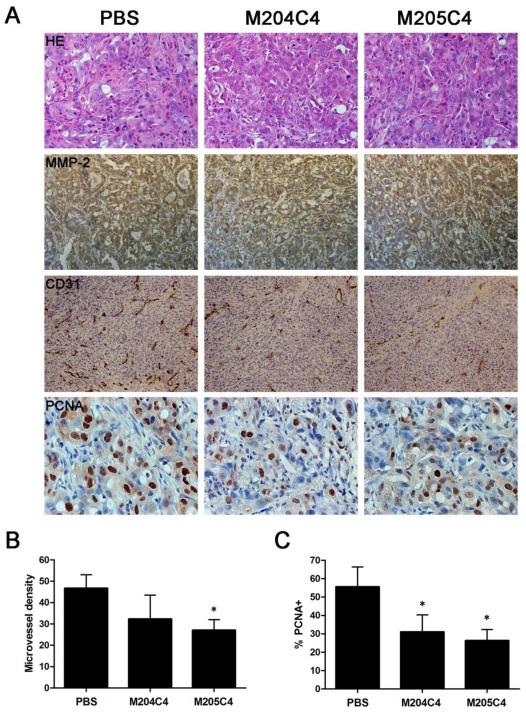
Despite tremendous advances in cancer treatment and survival rates, pancreatic cancer remains one of the most deadly afflictions and the fourth leading cause of cancer deaths in the world. Matrix Metalloproteinases (MMPs) are thought to be involved in cancer progression. Matrix metalloproteinase (MMP)-2 is known to play a pivotal role in tumor invasion, metastasis and angiogenesis, and validated to be the anticancer target. Inhibition of MMP-2 activity is able to reduce the cancer cell invasion and suppress tumor growth in vivo. Two novel peptides, M204C4 and M205C4, which could specially inhibit MMP-2 activity, were identified by a phage display library screening. We showed that M204C4 and M205C4 inhibited the activity of MMP-2 in a dose dependent manner in vitro. Two peptides reduced MMP-2 mediated invasion of the pancreatic cancer cell lines PANC-1 and CFPAC-1, but not affected the expression and release of MMP-2. Furthermore, these two peptides could suppress tumor growth in vivo. Our results indicated that two peptides selected by phase display technology may be used as anticancer drugs in the future.
尽管癌症治疗和存活率取得了巨大进展,但胰腺癌仍然是最致命的疾病之一,也是世界上癌症死亡的第四大主要原因。基质金属蛋白酶(MMPs)被认为与癌症的进展有关。已知基质金属蛋白酶-2(MMP-2)在肿瘤侵袭、转移和血管生成中起关键作用,并且已被验证为抗癌靶点。抑制 MMP-2 的活性能够减少癌细胞的侵袭并抑制体内肿瘤的生长。通过噬菌体展示文库筛选,鉴定出两种新型肽 M204C4 和 M205C4,它们能够特异性抑制 MMP-2 的活性。我们表明,M204C4 和 M205C4 在体外以剂量依赖的方式抑制 MMP-2 的活性。这两种肽均能降低胰腺癌细胞系 PANC-1 和 CFPAC-1 的 MMP-2 介导的侵袭,但不影响 MMP-2 的表达和释放。此外,这两种肽能够抑制体内肿瘤的生长。我们的结果表明,通过噬菌体展示技术筛选出的两种肽可能在未来被用作抗癌药物。


 Zotero 插件