Slapak Etienne J, Duitman JanWillem, Tekin Cansu, Bijlsma Maarten F, Spek C Arnold
Center of Experimental and Molecular Medicine, University of Amsterdam, Amsterdam UMC, 1105 AZ Amsterdam, The Netherlands.
Laboratory for Experimental Oncology and Radiobiology, Cancer Center Amsterdam, University of Amsterdam, Amsterdam UMC, 1105 AZ Amsterdam, The Netherlands.
Biology (Basel). 2020 Apr 18;9(4):80. doi: 10.3390/biology9040080.
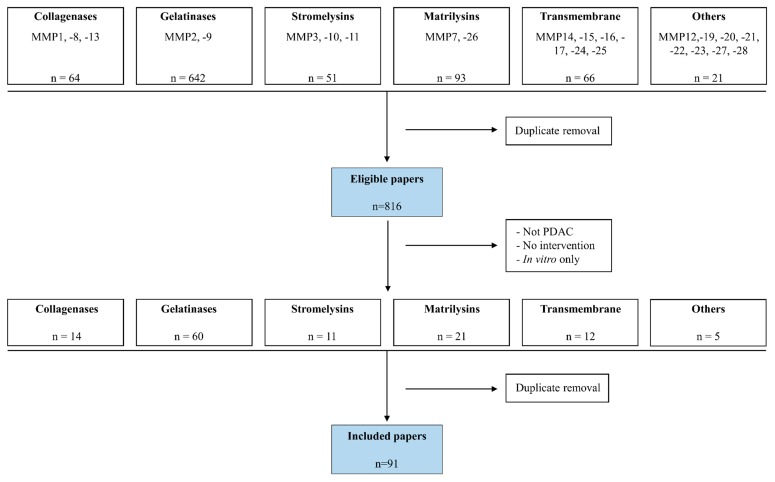
Pancreatic cancer is a dismal disorder that is histologically characterized by a dense fibrotic stroma around the tumor cells. As the extracellular matrix comprises the bulk of the stroma, matrix degrading proteases may play an important role in pancreatic cancer. It has been suggested that matrix metalloproteases are key drivers of both tumor growth and metastasis during pancreatic cancer progression. Based upon this notion, changes in matrix metalloprotease expression levels are often considered surrogate markers for pancreatic cancer progression and/or treatment response. Indeed, reduced matrix metalloprotease levels upon treatment (either pharmacological or due to genetic ablation) are considered as proof of the anti-tumorigenic potential of the mediator under study. In the current review, we aim to establish whether matrix metalloproteases indeed drive pancreatic cancer progression and whether decreased matrix metalloprotease levels in experimental settings are therefore indicative of treatment response. After a systematic review of the studies focusing on matrix metalloproteases in pancreatic cancer, we conclude that the available literature is not as convincing as expected and that, although individual matrix metalloproteases may contribute to pancreatic cancer growth and metastasis, this does not support the generalized notion that matrix metalloproteases drive pancreatic ductal adenocarcinoma progression.
胰腺癌是一种预后不佳的疾病,其组织学特征是肿瘤细胞周围存在致密的纤维化基质。由于细胞外基质构成了基质的主体,基质降解蛋白酶可能在胰腺癌中发挥重要作用。有人提出,基质金属蛋白酶是胰腺癌进展过程中肿瘤生长和转移的关键驱动因素。基于这一观点,基质金属蛋白酶表达水平的变化常被视为胰腺癌进展和/或治疗反应的替代标志物。事实上,治疗后(无论是药物治疗还是基因消融导致)基质金属蛋白酶水平降低被认为是所研究介质具有抗肿瘤潜力的证据。在本综述中,我们旨在确定基质金属蛋白酶是否确实推动胰腺癌进展,以及在实验环境中基质金属蛋白酶水平降低是否因此表明治疗反应。在对聚焦于胰腺癌中基质金属蛋白酶的研究进行系统综述后,我们得出结论,现有文献并不像预期的那样有说服力,并且,尽管个别基质金属蛋白酶可能有助于胰腺癌的生长和转移,但这并不支持基质金属蛋白酶驱动胰腺导管腺癌进展这一普遍观点。