Graduate School of Life and Environmental Sciences, University of Tsukuba, Tsukuba, Japan.
PLoS One. 2012;7(5):e37307. doi: 10.1371/journal.pone.0037307. Epub 2012 May 11.
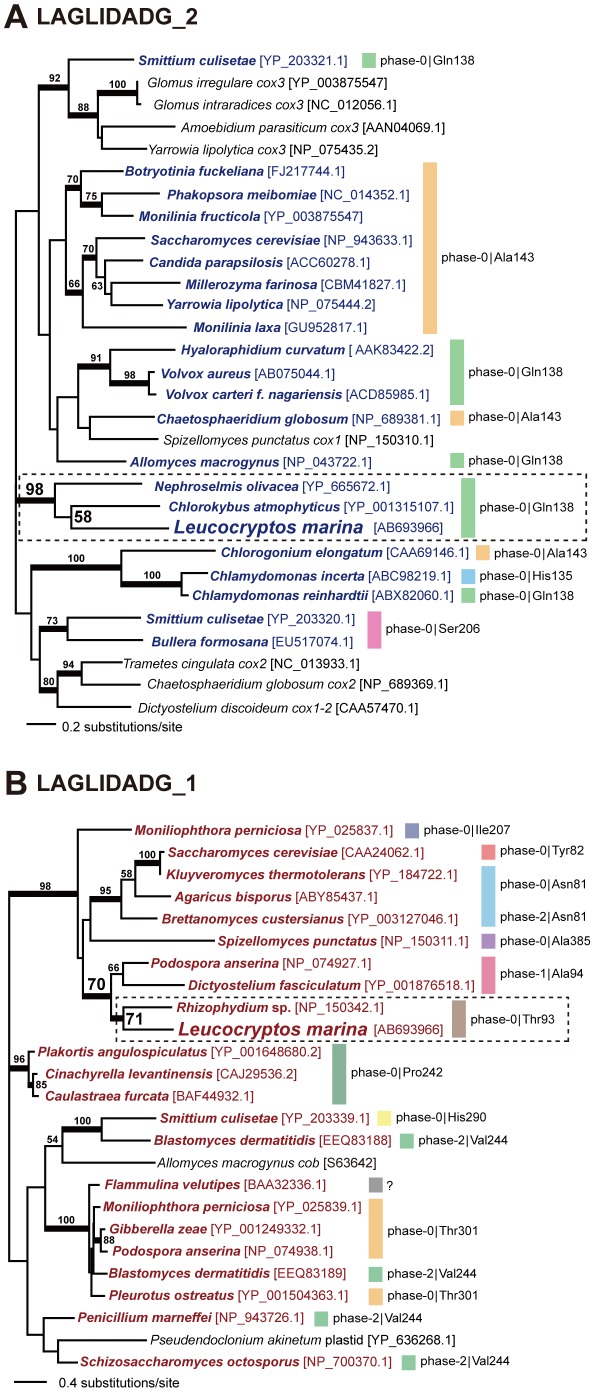
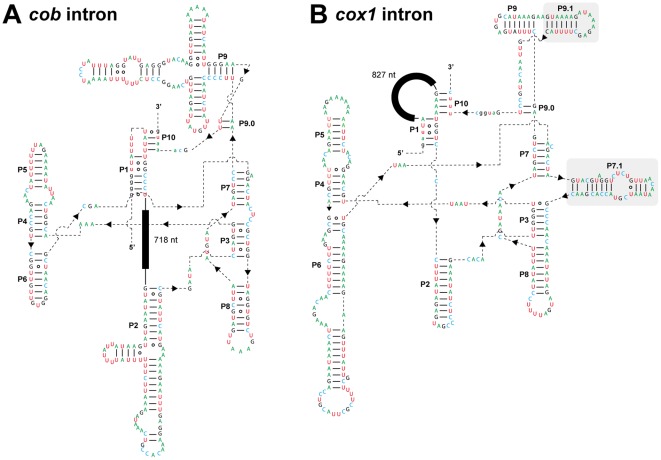
Mitochondria are descendants of the endosymbiotic α-proteobacterium most likely engulfed by the ancestral eukaryotic cells, and the proto-mitochondrial genome should have been severely streamlined in terms of both genome size and gene repertoire. In addition, mitochondrial (mt) sequence data indicated that frequent intron gain/loss events contributed to shaping the modern mt genome organizations, resulting in the homologous introns being shared between two distantly related mt genomes. Unfortunately, the bulk of mt sequence data currently available are of phylogenetically restricted lineages, i.e., metazoans, fungi, and land plants, and are insufficient to elucidate the entire picture of intron evolution in mt genomes. In this work, we sequenced a 12 kbp-fragment of the mt genome of the katablepharid Leucocryptos marina. Among nine protein-coding genes included in the mt genome fragment, the genes encoding cytochrome b and cytochrome c oxidase subunit I (cob and cox1) were interrupted by group I introns. We further identified that the cob and cox1 introns host open reading frames for homing endonucleases (HEs) belonging to distantly related superfamilies. Phylogenetic analyses recovered an affinity between the HE in the Leucocryptos cob intron and two green algal HEs, and that between the HE in the Leucocryptos cox1 intron and a fungal HE, suggesting that the Leucocryptos cob and cox1 introns possess distinct evolutionary origins. Although the current intron (and intronic HE) data are insufficient to infer how the homologous introns were distributed to distantly related mt genomes, the results presented here successfully expanded the evolutionary dynamism of group I introns in mt genomes.
线粒体是内共生α-变形菌的后代,最有可能被原始真核细胞吞噬,原始线粒体基因组在基因组大小和基因库方面都应该严重简化。此外,线粒体(mt)序列数据表明,频繁的内含子获得/丢失事件有助于塑造现代 mt 基因组结构,导致两个远缘 mt 基因组之间共享同源内含子。不幸的是,目前可用的大量 mt 序列数据仅限于进化受限的谱系,即后生动物、真菌和陆地植物,不足以阐明 mt 基因组内含子进化的全貌。在这项工作中,我们对 katablepharid Leucocryptos marina 的线粒体基因组的 12 kbp 片段进行了测序。在所包含的 mt 基因组片段的 9 个编码蛋白的基因中,编码细胞色素 b 和细胞色素 c 氧化酶亚基 I(cob 和 cox1)的基因被 I 组内含子打断。我们进一步鉴定出 cob 和 cox1 内含子宿主属于远缘超家族的归巢内切酶(HEs)的开放阅读框。系统发育分析恢复了 Leucocryptos cob 内含子中的 HE 与两个绿藻 HE 之间的亲和力,以及 Leucocryptos cox1 内含子中的 HE 与真菌 HE 之间的亲和力,表明 Leucocryptos cob 和 cox1 内含子具有不同的进化起源。尽管目前的内含子(和内含子 HE)数据不足以推断同源内含子是如何分布到远缘 mt 基因组中的,但这里呈现的结果成功扩展了 mt 基因组中 I 组内含子的进化动态。