Department of Chemistry and Chemical Biology, Northeastern University, 360 Huntington Avenue, Boston, MA 02115-5000, USA.
Bioorg Med Chem. 2012 Jun 15;20(12):3768-80. doi: 10.1016/j.bmc.2012.04.041. Epub 2012 May 7.
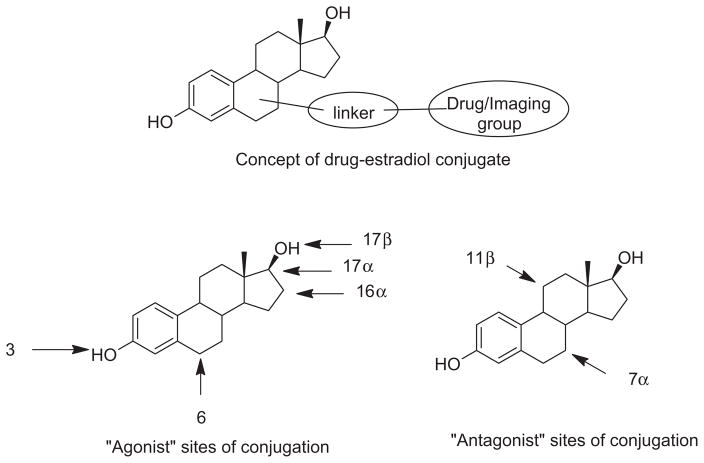
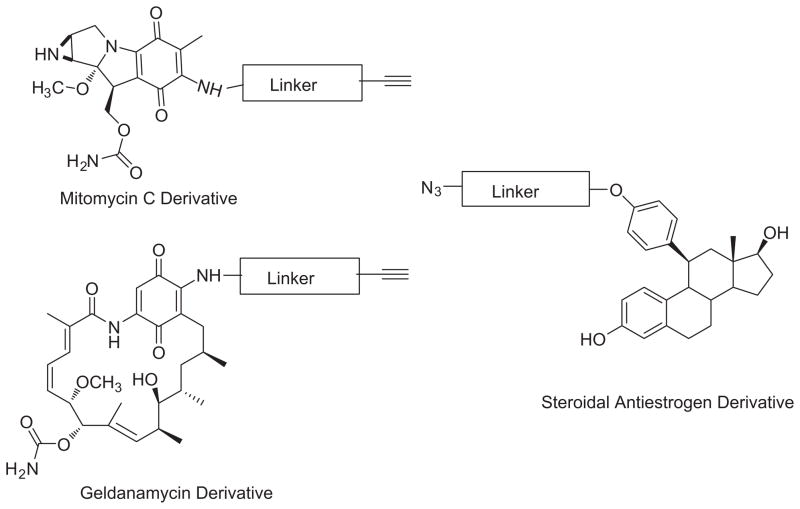
As part of our program to develop estrogen receptor (ER) targeted imaging and therapeutic agents we chose to evaluate 11β-substituted estradiol analogs as a representative scaffold. Previous synthetic studies provided an entry into this class of compounds and other work indicated that 11β-(substituted aryl) estradiol analogs were potent antagonists of the ER. Little information existed about the specific structural features involved in the transition from agonism to antagonism for the 11β-aryl estradiol analogs or their potential as scaffolds for drug conjugation.
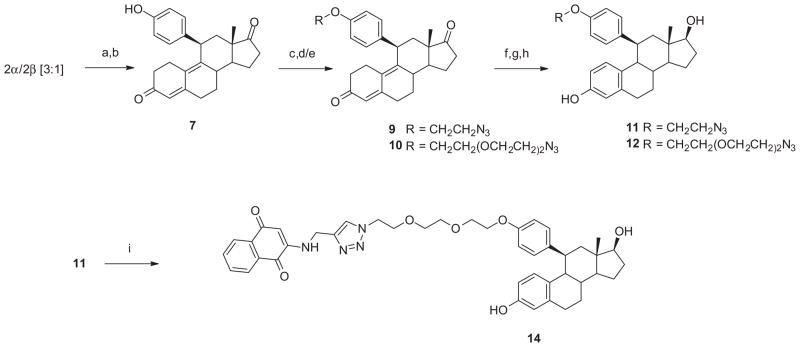
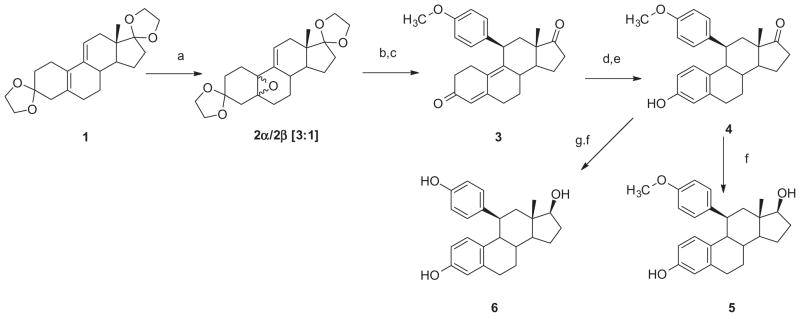
We prepared and characterized a series of 11β-(4-Substituted phenyl) estradiol analogs using modifications of existing synthetic methods. The new compounds, as well as standard steroidal agonists and antagonists, were evaluated as competitive ligands for the ERβ-LBD. Functional assays used the induction of alkaline phosphatase in Ishikawa cells to determine potency of the compounds as ER agonists or antagonists.
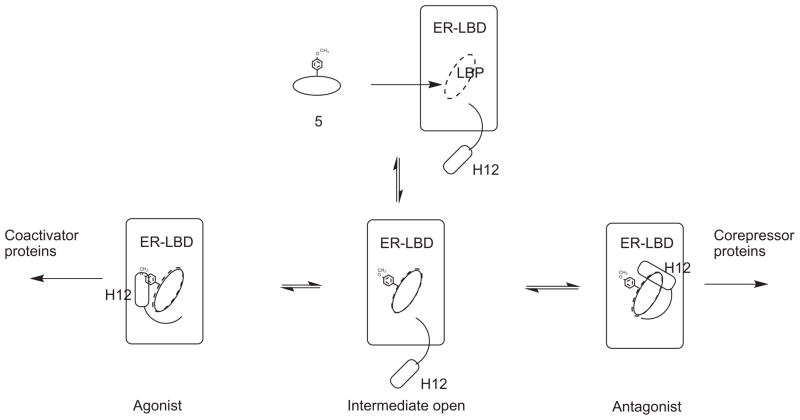
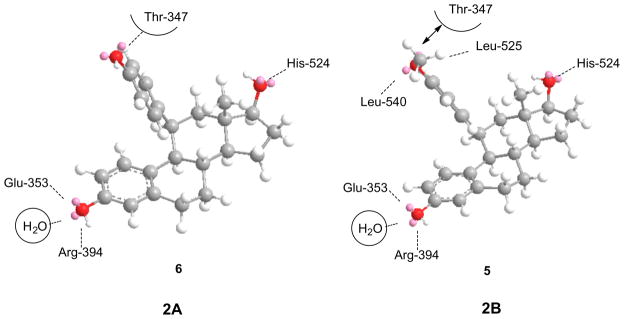
The synthetic strategy successfully generated a series of compounds in which the 4-substituent was sequentially modified from hydroxyl to methoxy to azidoethoxy/N,N-dimethylaminoethoxy and eventually to a prototypical 1,4-naphthoquinone-containing moiety. The new compounds all retained high relative binding affinity (RBA) for the ERα-LBD, ranging from 13-83% that of estradiol. No subtype selectivity was observed. More importantly, the transition from agonist to antagonist activity occurs at the 4-methoxy stage where the compound is a mixed antagonist. More notably, antagonism appeared to be more dependent upon the size of the 11β-substituent than upon the nature of the terminal group
We have developed a synthetic strategy that provides facile access to potent 11β-(4-substituted phenyl) estradiol analogs. The resultant compounds retain high affinity for the ERα-LBD and, more importantly, demonstrate potent antagonist activity in cells. Large functionalities distal to the 11β-phenyl ring had little additional effect on either affinity or efficacy, suggesting the incorporation of diverse imaging or biologically active groups can be attached without significantly compromising the ER-binding capacity. Future studies are in progress to exploit the 11β-aryl estradiol analogs as potential drug delivery systems and imaging agents.
作为开发雌激素受体(ER)靶向成像和治疗剂计划的一部分,我们选择评估 11β-取代的雌二醇类似物作为代表性支架。以前的合成研究为进入这一类化合物提供了途径,其他工作表明,11β-(取代芳基)雌二醇类似物是 ER 的有效拮抗剂。关于从激动剂向 11β-芳基雌二醇类似物的拮抗剂转变涉及的特定结构特征,或它们作为药物偶联物支架的潜力,信息很少。
我们使用现有的合成方法的修改,制备并表征了一系列 11β-(4-取代苯基)雌二醇类似物。新化合物以及标准甾体激动剂和拮抗剂被评估为 ERβ-LBD 的竞争性配体。功能测定使用诱导 Ishikawa 细胞中碱性磷酸酶来确定化合物作为 ER 激动剂或拮抗剂的效力。
合成策略成功地生成了一系列化合物,其中 4-取代基依次从羟基修改为甲氧基、叠氮乙氧基/N,N-二甲氨基乙氧基,最终为典型的 1,4-萘醌含有部分。新化合物均保留了对 ERα-LBD 的高相对结合亲和力(RBA),范围为 13-83%,与雌二醇相当。未观察到亚型选择性。更重要的是,从激动剂向拮抗剂活性的转变发生在 4-甲氧基阶段,其中化合物为混合拮抗剂。更值得注意的是,拮抗作用似乎更依赖于 11β-取代基的大小,而不是末端基团的性质。
我们已经开发出一种合成策略,该策略可轻松获得有效的 11β-(4-取代苯基)雌二醇类似物。所得化合物保留了对 ERα-LBD 的高亲和力,更重要的是,在细胞中表现出有效的拮抗剂活性。远端到 11β-苯基环的大官能团对亲和力或功效几乎没有进一步的影响,这表明可以引入不同的成像或生物活性基团,而不会显著降低 ER 结合能力。未来的研究正在进行中,以探索 11β-芳基雌二醇类似物作为潜在的药物输送系统和成像剂。