Radiation Countermeasures Program, Armed Forces Radiobiology Research Institute, Uniformed Services University of the Health Sciences, Bethesda, Maryland, United States of America.
PLoS One. 2012;7(5):e36604. doi: 10.1371/journal.pone.0036604. Epub 2012 May 18.
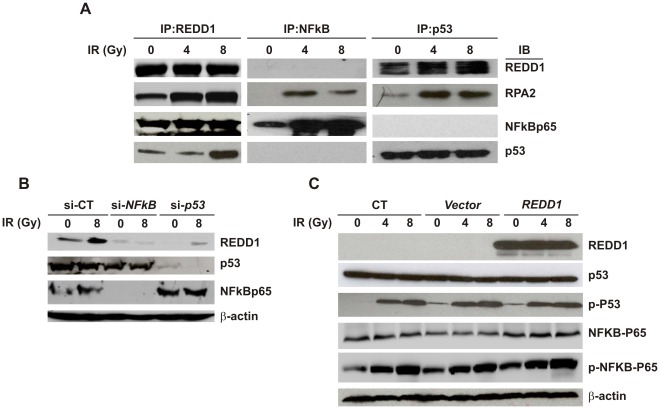
Radiotherapy is commonly used for cancer treatment. However, it often results in side effects due to radiation damage in normal tissue, such as bone marrow (BM) failure. Adult hematopoietic stem and progenitor cells (HSPC) reside in BM next to the endosteal bone surface, which is lined primarily by hematopoietic niche osteoblastic cells. Osteoblasts are relatively more radiation-resistant than HSPCs, but the mechanisms are not well understood. In the present study, we demonstrated that the stress response gene REDD1 (regulated in development and DNA damage responses 1) was highly expressed in human osteoblast cell line (hFOB) cells after γ irradiation. Knockdown of REDD1 with siRNA resulted in a decrease in hFOB cell numbers, whereas transfection of PCMV6-AC-GFP-REDD1 plasmid DNA into hFOB cells inhibited mammalian target of rapamycin (mTOR) and p21 expression and protected these cells from radiation-induced premature senescence (PS). The PS in irradiated hFOB cells were characterized by significant inhibition of clonogenicity, activation of senescence biomarker SA-β-gal, and the senescence-associated cytokine secretory phenotype (SASP) after 4 or 8 Gy irradiation. Immunoprecipitation assays demonstrated that the stress response proteins p53 and nuclear factor κ B (NFkB) interacted with REDD1 in hFOB cells. Knockdown of NFkB or p53 gene dramatically suppressed REDD1 protein expression in these cells, indicating that REDD1 was regulated by both factors. Our data demonstrated that REDD1 is a protective factor in radiation-induced osteoblast cell premature senescence.
放射疗法常用于癌症治疗。然而,由于正常组织中的辐射损伤,如骨髓(BM)衰竭,它经常会导致副作用。成人造血干细胞和祖细胞(HSPC)位于靠近骨内膜骨表面的 BM 中,主要由造血龛成骨细胞排列。成骨细胞比 HSPC 具有相对更强的辐射抗性,但机制尚不清楚。在本研究中,我们证明了应激反应基因 REDD1(发育和 DNA 损伤反应调节 1)在 γ 照射后在人成骨细胞系(hFOB)细胞中高度表达。用 siRNA 敲低 REDD1 导致 hFOB 细胞数量减少,而将 PCMV6-AC-GFP-REDD1 质粒 DNA 转染到 hFOB 细胞中则抑制了哺乳动物雷帕霉素靶蛋白(mTOR)和 p21 的表达,并保护这些细胞免受辐射诱导的过早衰老(PS)。经 4 或 8 Gy 照射后,被照射的 hFOB 细胞中的 PS 表现为克隆形成能力显著抑制、衰老生物标志物 SA-β-gal 激活以及衰老相关细胞因子分泌表型(SASP)。免疫沉淀测定表明,应激反应蛋白 p53 和核因子 κ B(NFkB)在 hFOB 细胞中与 REDD1 相互作用。NFkB 或 p53 基因的敲低显著抑制了这些细胞中 REDD1 蛋白的表达,表明 REDD1 受到这两个因素的调节。我们的数据表明,REDD1 是辐射诱导成骨细胞过早衰老的保护因子。