Department of Health Informatics, King Saud bin Abdulaziz University for Health Sciences, Riyadh, Kingdom of Saudi Arabia.
BMC Med Inform Decis Mak. 2012 May 28;12:44. doi: 10.1186/1472-6947-12-44.
Compared with the increasingly widespread use of picture archiving and communication systems (PACSs), knowledge concerning users' acceptance of such systems is limited. Knowledge of acceptance is needed given the large (and growing) financial investment associated with the implementation of PACSs, and because the level of user acceptance influences the degree to which the benefits of the systems for healthcare can be realized.
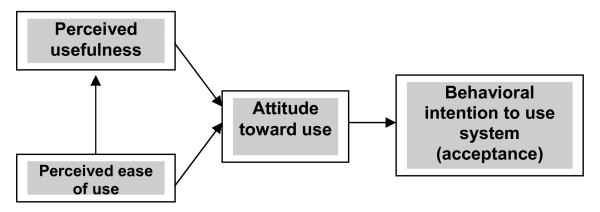
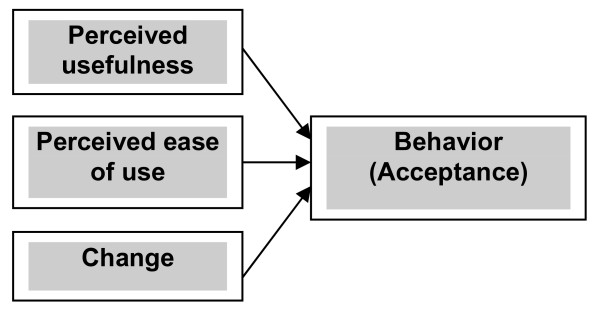
A Technology Acceptance Model (TAM) was used to assess the level of acceptance of the host PACS by staff in the radiology department at King Abdulaziz Medical City (KAMC), Riyadh, Saudi Arabia. A questionnaire survey of 89 PACS users was employed to obtain data regarding user characteristics, perceived usefulness (PU) (6 items), perceived ease of use (PEU) (4 items), a change construct (4 items), and a behavior (acceptance) construct (9 items). Respondents graded each item in each construct using five-point likert scales.
Surveyed users reported high levels of PU (4.33/5), PEU (4.15/5), change (4.26/5), and acceptance (3.86/5). The three constructs of PU, PEU, and change explained 41 % of the variation in PACS user acceptance. PU was the most important predictor, explaining 38 % of the variation on its own. The most important single item in the explanatory constructs was that users found PACS to have improved the quality of their work in providing better patient care. Technologists had lower acceptance ratings than did clinicians/radiologists, but no influence on acceptance level was found due to gender, age, or length of experience using the PACS. Although not directly measured, there appeared to be no cultural influence on either the level of acceptance or its determinants.
User acceptance must be considered when an organization implements a PACS, in order to enhance its successful adoption. Health organizations should adopt a PACS that offers all required functions and which is likely to generate high PU on the part of its users, rather than a system that is easy to use. Training/familiarization programs should aim at establishing high levels of PU in all users, particularly technologists. Health organizations are advised to measure all the factors that influence the acceptance of a PACS by their staff, in order to optimize the productivity of the system and realize the potential benefits to the greatest extent possible.
与日益广泛使用的图像存档与通信系统(PACS)相比,人们对用户接受此类系统的认识有限。鉴于与 PACS 实施相关的大量(且不断增加的)财务投资,以及用户接受程度会影响医疗保健系统效益的实现程度,因此需要了解接受程度。
采用技术接受模型(TAM)评估沙特阿拉伯利雅得阿卜杜勒阿齐兹国王医疗城(KAMC)放射科工作人员对主机 PACS 的接受程度。采用问卷调查了 89 名 PACS 用户,获取有关用户特征、感知有用性(PU)(6 项)、感知易用性(PEU)(4 项)、变化构建(4 项)和行为(接受)构建(9 项)的数据。受访者使用五点李克特量表对每个构建中的每个项目进行评分。
调查用户报告了高水平的 PU(4.33/5)、PEU(4.15/5)、变化(4.26/5)和接受度(3.86/5)。PU、PEU 和变化这三个构建解释了 PACS 用户接受度变化的 41%。PU 是最重要的预测指标,单独解释了 38%的变化。在解释性构建中最重要的单项是用户认为 PACS 提高了他们提供更好患者护理的工作质量。技术人员的接受度评分低于临床医生/放射科医生,但未发现性别、年龄或使用 PACS 的经验长短对接受度水平有影响。尽管没有直接测量,但似乎文化对接受度或其决定因素都没有影响。
在组织实施 PACS 时,必须考虑用户接受度,以增强其成功采用。卫生组织应采用提供所有必需功能且可能使用户产生高 PU 的 PACS,而不是采用易于使用的系统。培训/熟悉计划应旨在使所有用户,特别是技术人员,建立高水平的 PU。建议卫生组织衡量所有影响员工接受 PACS 的因素,以最大限度地提高系统的生产力并尽可能实现潜在效益。