Department of Medicine, Michael E. DeBakey Veterans Affairs Medical Center, Baylor College of Medicine, Houston, TX, USA.
J Cachexia Sarcopenia Muscle. 2012 Dec;3(4):245-51. doi: 10.1007/s13539-012-0075-5. Epub 2012 May 31.
Cancer can lead to weight loss, anorexia, and poor nutritional status, which are associated with decreased survival in cancer patients.
Male cancer patients (n = 136) were followed for a mean time of 4.5 years. Variables were obtained at baseline: cancer stage, albumin, hemoglobin, tumor necrosis factor alpha (TNF-α), interleukin (IL)-6, bioavailable testosterone, appetite questionnaire, and weight change from baseline to 18 months. Primary statistical tests included Kaplan-Meier survival analysis and Cox proportional hazard regression (PHREG).
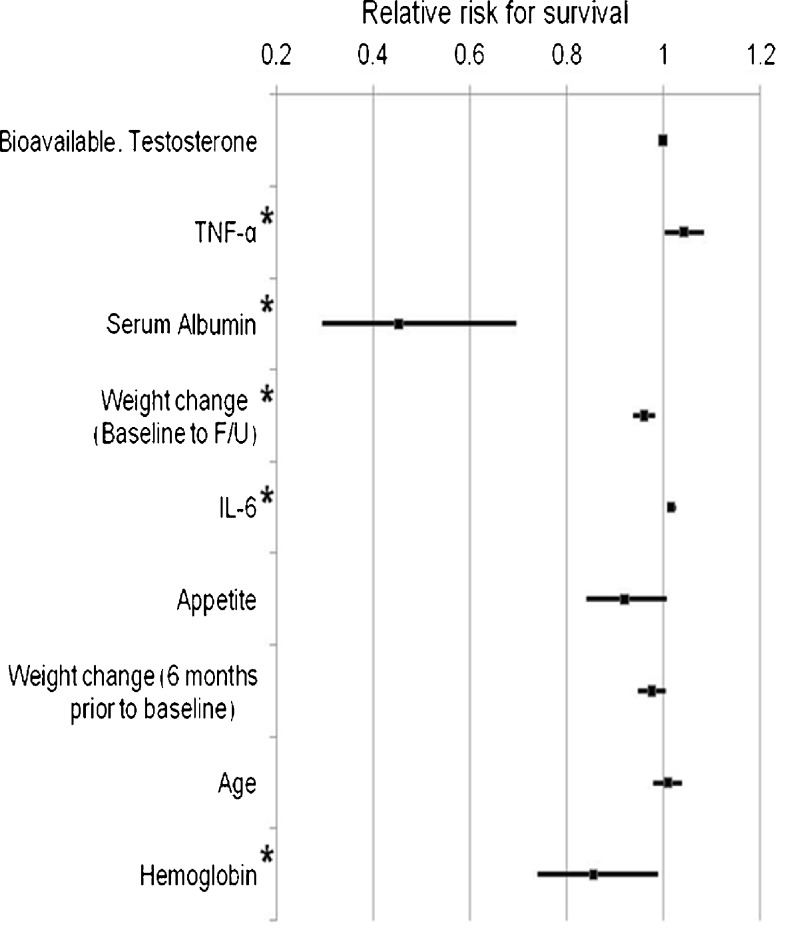
Univariate PHREG showed that cancer stage, albumin, hemoglobin, TNF-α, IL-6, and weight change were each significantly associated with mortality risk (P < 0.05), but bioavailable testosterone was not. Multivariate PHREG analysis established that weight change and albumin were jointly statistically significant even after adjusting for stage.
In this sample of male oncology patients, cancer stage, serum albumin, and weight loss predicted survival. High levels of inflammatory markers and hemoglobin are associated with increased mortality, but do not significantly improve the ability to predict survival above and beyond cancer stage, albumin, and weight loss.
癌症可导致体重下降、厌食和营养状况不佳,这些与癌症患者的生存率降低有关。
对 136 名男性癌症患者进行了平均 4.5 年的随访。在基线时获得了变量:癌症分期、白蛋白、血红蛋白、肿瘤坏死因子-α(TNF-α)、白细胞介素(IL)-6、生物可利用睾酮、食欲问卷和从基线到 18 个月的体重变化。主要统计检验包括 Kaplan-Meier 生存分析和 Cox 比例风险回归(PHREG)。
单变量 PHREG 显示,癌症分期、白蛋白、血红蛋白、TNF-α、IL-6 和体重变化均与死亡率风险显著相关(P<0.05),但生物可利用睾酮则不然。多变量 PHREG 分析表明,即使在调整了分期后,体重变化和白蛋白仍然具有统计学意义。
在本男性肿瘤患者样本中,癌症分期、血清白蛋白和体重减轻预测了生存率。炎症标志物和血红蛋白水平升高与死亡率增加相关,但不能显著提高预测生存率的能力,超过癌症分期、白蛋白和体重减轻。