
弱电磁场对感染植原体的健康酸橙(枳壳)树的生物学效应
Biological effects of weak electromagnetic field on healthy and infected lime (Citrus aurantifolia) trees with phytoplasma.
作者信息
Abdollahi Fatemeh, Niknam Vahid, Ghanati Faezeh, Masroor Faribors, Noorbakhsh Seyyed Nasr
机构信息
Department of Plant Sciences, School of Biology and Center of Excellence in Phylogeny of Living Organisms, College of Sciences, University of Tehran, Tehran 14155-6455, Iran.
出版信息
ScientificWorldJournal. 2012;2012:716929. doi: 10.1100/2012/716929. Epub 2012 May 2.
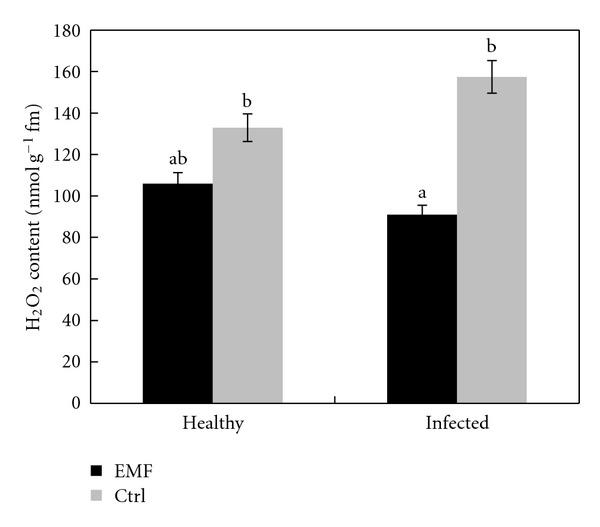
Exposure to electromagnetic fields (EMF) has become an issue of concern for a great many people and is an active area of research. Phytoplasmas, also known as mycoplasma-like organisms, are wall-less prokaryotes that are pathogens of many plant species throughout the world. Effects of electromagnetic fields on the changes of lipid peroxidation, content of H(2)O(2), proline, protein, and carbohydrates were investigated in leaves of two-year-old trees of lime (Citrus aurantifolia) infected by the Candidatus Phytoplasma aurantifoliae. The healthy and infected plants were discontinuously exposed to a 10 KHz quadratic EMF with maximum power of 9 W for 5 days, each 5 h, at 25 °C. Fresh and dry weight of leaves, content of MDA, proline, and protein increased in both healthy and infected plants under electromagnetic fields, compared with those of the control plants. Electromagnetic fields decreased hydrogen peroxide and carbohydrates content in both healthy and infected plants compared to those of the controls.
暴露于电磁场(EMF)已成为许多人关注的问题,并且是一个活跃的研究领域。植原体,也被称为类支原体生物,是无细胞壁的原核生物,是全世界许多植物物种的病原体。研究了电磁场对感染了韧皮部杆菌的两年生酸橙(Citrus aurantifolia)叶片中脂质过氧化、H₂O₂含量、脯氨酸、蛋白质和碳水化合物变化的影响。健康和受感染的植株在25℃下,以最大功率9W的10kHz二次电磁场间断暴露5天,每天5小时。与对照植株相比,在电磁场作用下,健康和受感染植株的叶片鲜重和干重、丙二醛、脯氨酸和蛋白质含量均增加。与对照相比,电磁场降低了健康和受感染植株中的过氧化氢和碳水化合物含量。


 Zotero 插件