Howard Hughes Medical Institute, Stanford University School of Medicine, Stanford, CA 94305, USA.
Science. 2012 Jul 6;337(6090):59-64. doi: 10.1126/science.1222879. Epub 2012 May 31.
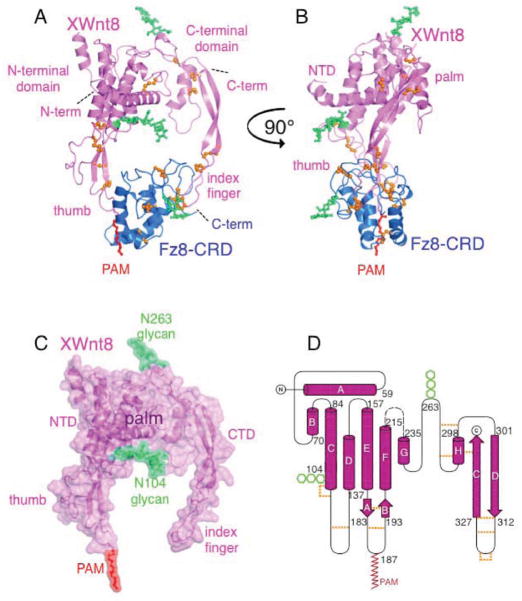
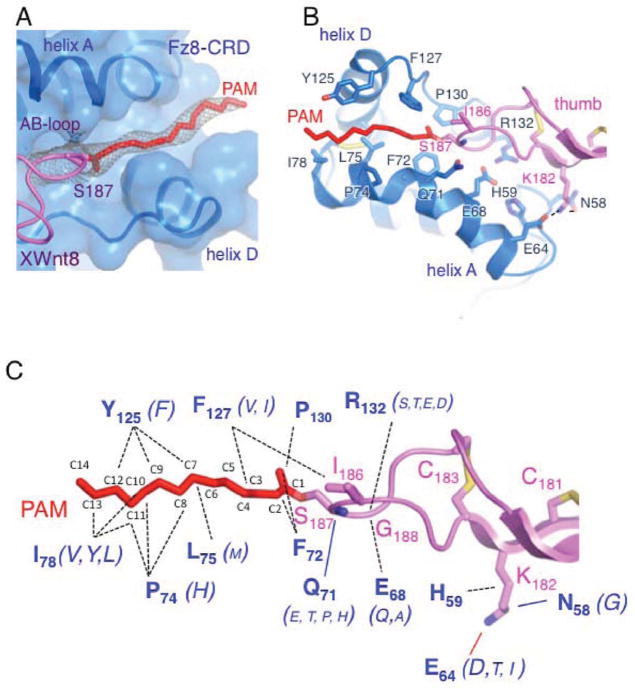
Wnts are lipid-modified morphogens that play critical roles in development principally through engagement of Frizzled receptors. The 3.25 angstrom structure of Xenopus Wnt8 (XWnt8) in complex with mouse Frizzled-8 (Fz8) cysteine-rich domain (CRD) reveals an unusual two-domain Wnt structure, not obviously related to known protein folds, resembling a "hand" with "thumb" and "index" fingers extended to grasp the Fz8-CRD at two distinct binding sites. One site is dominated by a palmitoleic acid lipid group projecting from serine 187 at the tip of Wnt's thumb into a deep groove in the Fz8-CRD. In the second binding site, the conserved tip of Wnt's "index finger" forms hydrophobic amino acid contacts with a depression on the opposite side of the Fz8-CRD. The conservation of amino acids in both interfaces appears to facilitate ligand-receptor cross-reactivity, which has important implications for understanding Wnt's functional pleiotropy and for developing Wnt-based drugs for cancer and regenerative medicine.
Wnts 是一种脂质修饰的形态发生素,主要通过与 Frizzled 受体的结合在发育中发挥关键作用。爪蟾 Wnt8(XWnt8)与小鼠 Frizzled-8(Fz8)富含半胱氨酸结构域(CRD)复合物的 3.25 埃结构揭示了一种不常见的双结构域 Wnt 结构,与已知的蛋白质折叠没有明显的关系,类似于“手”,其中“拇指”和“食指”伸展以在两个不同的结合位点抓住 Fz8-CRD。一个位点主要由棕榈油酸脂基团主导,该基团从 Wnt 拇指的 187 位丝氨酸伸出,进入 Fz8-CRD 的一个深槽中。在第二个结合位点中,Wnt 的“食指”的保守尖端与 Fz8-CRD 相对侧的凹陷形成疏水性氨基酸接触。两个界面中氨基酸的保守性似乎促进了配体-受体的交叉反应性,这对于理解 Wnt 的功能多效性以及开发用于癌症和再生医学的基于 Wnt 的药物具有重要意义。