Hagemann Anja I H, Scholpp Steffen
Karlsruhe Institute of Technology, Institute of Toxicology and Genetics Karlsruhe, Germany.
Front Neurosci. 2012 May 28;6:76. doi: 10.3389/fnins.2012.00076. eCollection 2012.
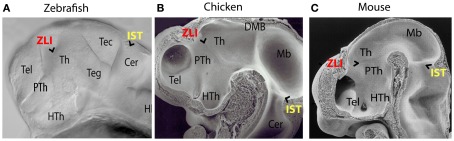
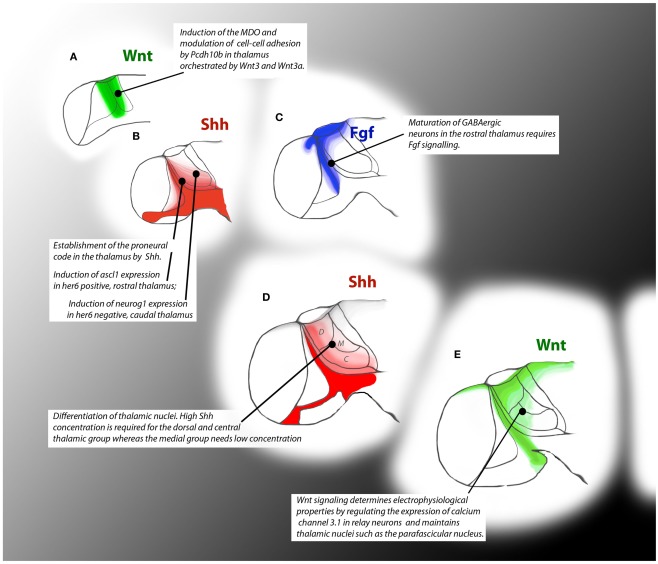
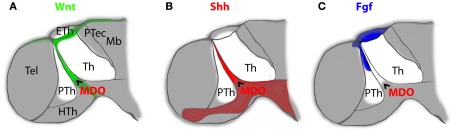
The thalamic complex is an essential part of the brain that requires a combination of specialized activities to attain its final complexity. In the following review we will describe the induction process of the mid-diencephalic organizer (MDO) where three different signaling pathways merge: Wnt, Shh, and Fgf. Here, we dissect the function of each signaling pathway in the thalamus in chronological order of their appearance. First we describe the Wnt mediated induction of the MDO and compartition of the caudal forebrain, then the Shh mediated determination of proneural gene expression before discussing recent progress in characterizing Fgf function during thalamus development. Then, we focus on transcription factors, which are regulated by these pathways and which play a pivotal role in neurogenesis in the thalamus. The three signaling pathways act together in a strictly regulated chronology to orchestrate the development of the entire thalamus.
丘脑复合体是大脑的重要组成部分,需要一系列特定活动的组合才能达到其最终的复杂性。在以下综述中,我们将描述中脑间脑组织者(MDO)的诱导过程,其中三种不同的信号通路相互融合:Wnt、Shh和Fgf。在此,我们按照各信号通路出现的时间顺序剖析其在丘脑中的功能。首先,我们描述Wnt介导的MDO诱导和前脑尾部的分隔,接着是Shh介导的神经前体基因表达的确定,然后再讨论丘脑发育过程中Fgf功能特征的最新进展。之后,我们将重点关注受这些信号通路调控且在丘脑神经发生中起关键作用的转录因子。这三种信号通路按照严格调控的时间顺序协同作用,精心编排整个丘脑的发育过程。