Department of Biology, Massachusetts Institute of Technology, Cambridge, Massachusetts, United States of America.
PLoS One. 2012;7(5):e37256. doi: 10.1371/journal.pone.0037256. Epub 2012 May 24.
The transparency of the eye lens depends upon maintenance of the native state of the γ- and β-crystallins, which is aided by the abundant chaperones αA- and αB-crystallin. Mature onset cataract, the leading cause of blindness worldwide, involves the polymerization of covalently damaged or partially unfolded crystallins into light-scattering aggregates. A number of single amino acid substitutions and truncations of γ-crystallins result in congenital cataract in both humans and mice, though in many cases the coupling between the protein alterations and the accumulation of aggregates is poorly defined.
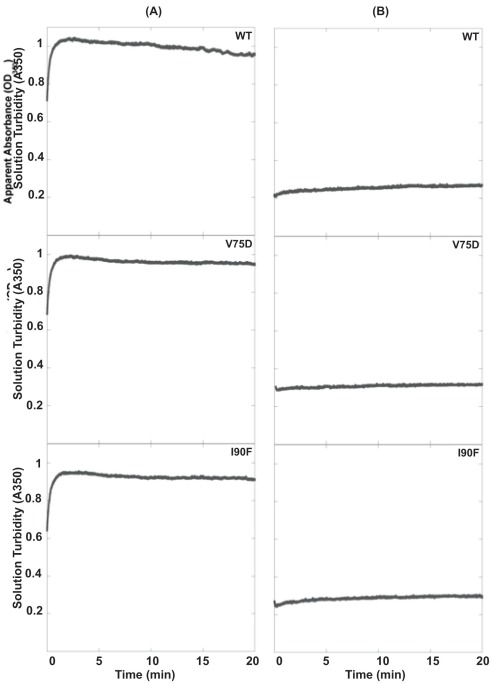
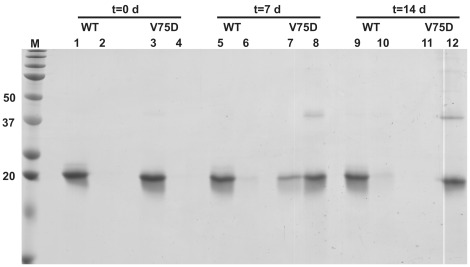
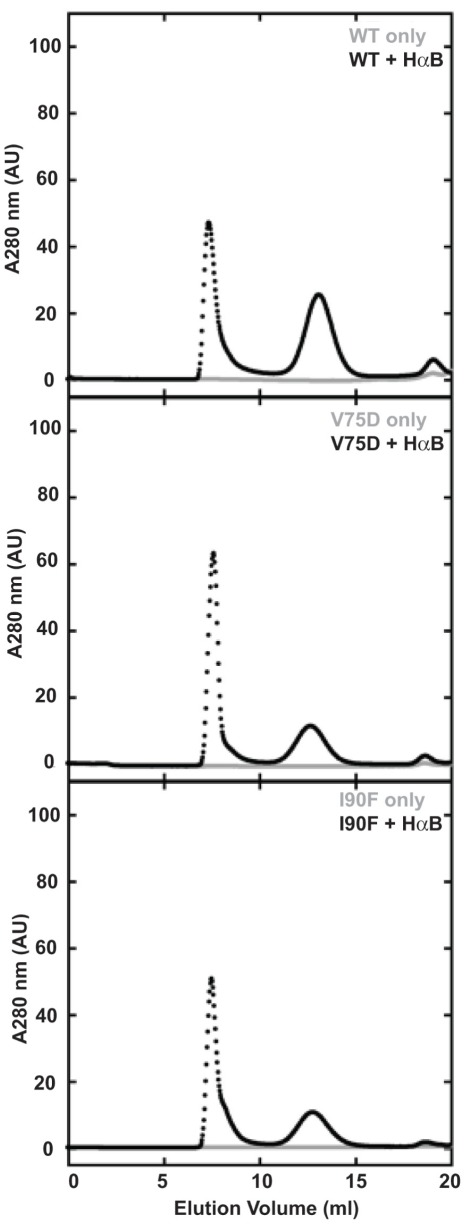
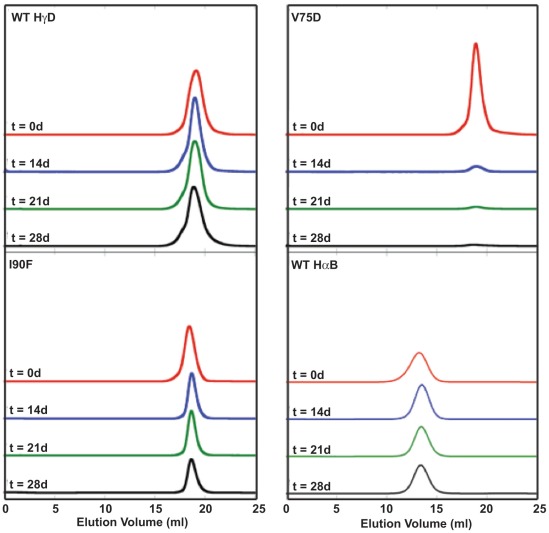
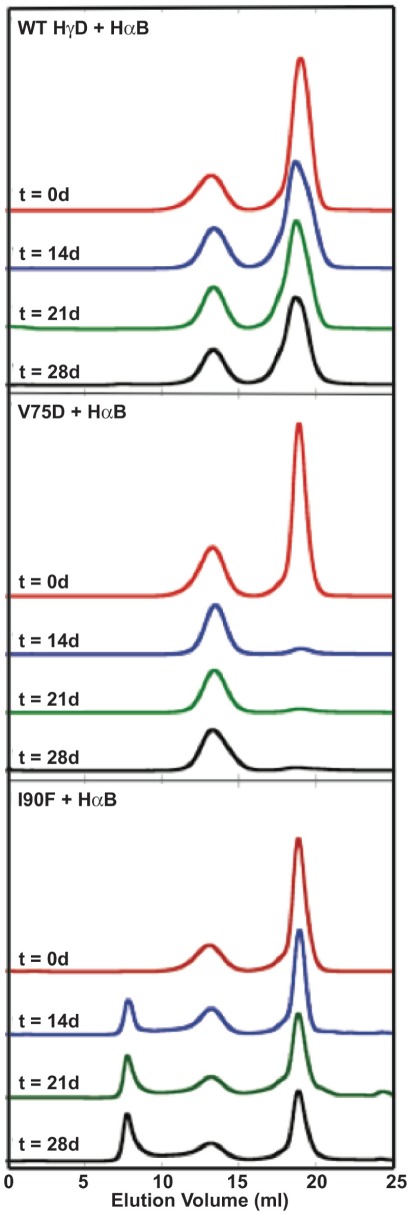
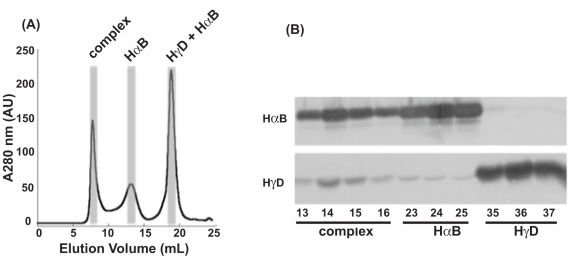
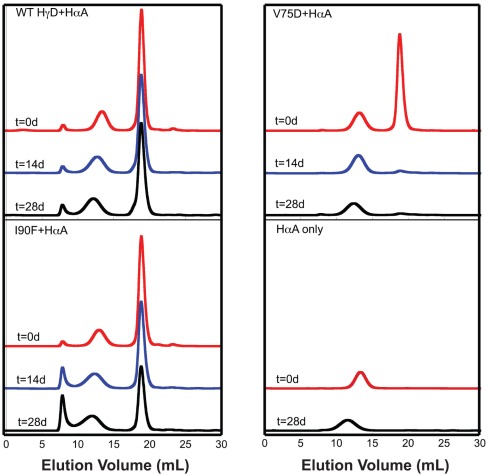
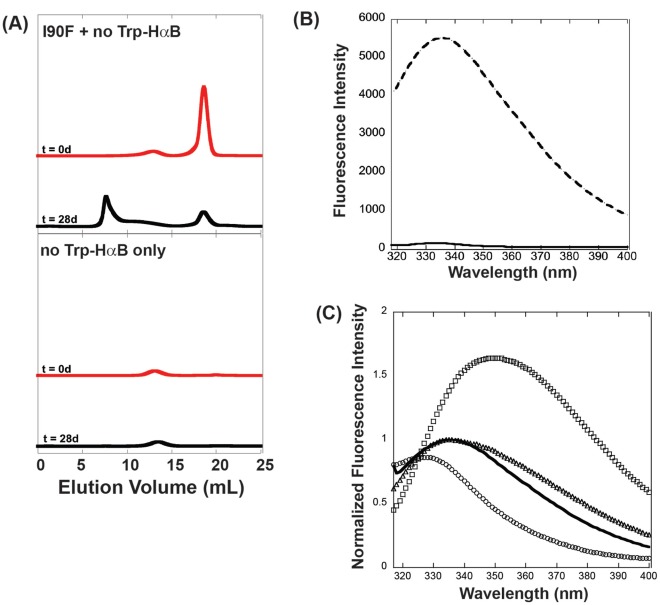
METHODOLOGY/PRINCIPAL FINDINGS: We have studied the aggregation properties and chaperone interactions of human γD-crystallin carrying substitutions of two buried core mutants, I90F and V75D, which cause congenital cataract in mice. The in vitro aggregation pathway competing with productive refolding was not altered by either substitution. Furthermore, this aggregation pathway for both mutant proteins--originating from a partially folded intermediate--was efficiently suppressed by αB-crystallin. Thus the cataract pathology was unlikely to be associated with a direct folding defect. The native state of wild-type human γD-crystallin exhibited no tendency to aggregate under physiological conditions. However both I90F and V75D native-like proteins exhibited slow (days) aggregation to high molecular weight aggregates under physiological conditions. The perturbed conformation of I90F was recognized and bound by both αA and αB chaperones. In contrast, the aggregation derived from the perturbed state of V75D was not suppressed by either chaperone, and the aggregating species were not bound by the chaperone.
CONCLUSIONS/SIGNIFICANCE: The cataract phenotype of I90F in mice may be due to premature saturation of the finite α- crystallin pool. The V75D aggregation pathway and its escape from chaperone surveillance and aggregation suppression can account for the congenital cataract pathology of this mutant. Failure of chaperone recognition may be an important source of pathology for many other protein folding defects.
晶状体的透明度依赖于γ-和β-晶体蛋白的天然状态的维持,这得益于丰富的伴侣蛋白αA-和αB-晶体蛋白的辅助。年龄相关性白内障是全球致盲的主要原因,涉及到共价损伤或部分展开的晶体蛋白聚合成光散射聚集体。许多γ-晶体蛋白的单个氨基酸取代和截短导致人类和小鼠发生先天性白内障,尽管在许多情况下,蛋白质改变与聚集体积累之间的偶联关系定义不明确。
方法/主要发现:我们研究了携带两个埋藏核心突变(I90F 和 V75D)的人γD-晶体蛋白的聚集特性和伴侣蛋白相互作用,这些突变导致小鼠发生先天性白内障。这两种突变蛋白的体外聚集途径与有活性的重折叠竞争,没有被任何取代改变。此外,这种聚集途径(来源于部分折叠的中间体)被αB-晶体蛋白有效抑制。因此,白内障病理不太可能与直接折叠缺陷有关。野生型人γD-晶体蛋白的天然状态在生理条件下没有聚集的趋势。然而,I90F 和 V75D 的天然样蛋白在生理条件下表现出缓慢(数天)聚集至高相对分子质量的聚集体。I90F 的扰动构象被αA 和αB 伴侣蛋白识别和结合。相比之下,V75D 扰动状态衍生的聚集不能被任何伴侣蛋白抑制,聚集的物质也不能被伴侣蛋白结合。
结论/意义:I90F 突变导致的小鼠白内障表型可能是由于有限的α-晶体蛋白池的过早饱和。V75D 的聚集途径及其逃避伴侣蛋白监控和聚集抑制可以解释该突变的先天性白内障病理。伴侣蛋白识别的失败可能是许多其他蛋白质折叠缺陷的重要病理来源。