IBMC-Instituto de Biologia Molecular e Celular, Universidade do Porto, Porto, Portugal.
PLoS One. 2012;7(5):e37836. doi: 10.1371/journal.pone.0037836. Epub 2012 May 24.
Bacterial spot-causing xanthomonads (BSX) are quarantine phytopathogenic bacteria responsible for heavy losses in tomato and pepper production. Despite the research on improved plant spraying methods and resistant cultivars, the use of healthy plant material is still considered as the most effective bacterial spot control measure. Therefore, rapid and efficient detection methods are crucial for an early detection of these phytopathogens.
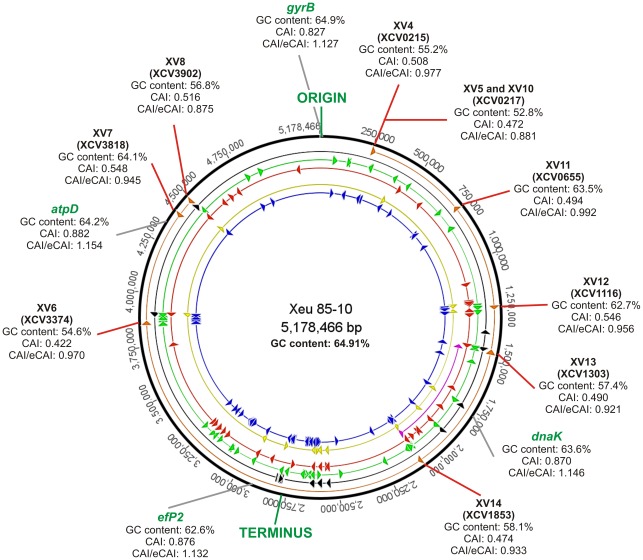
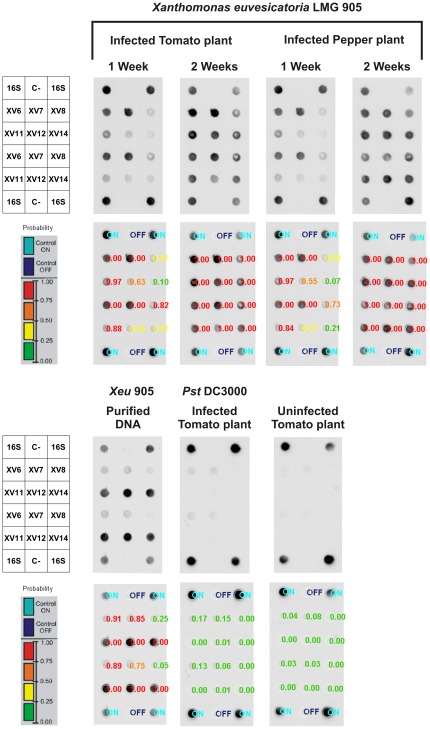
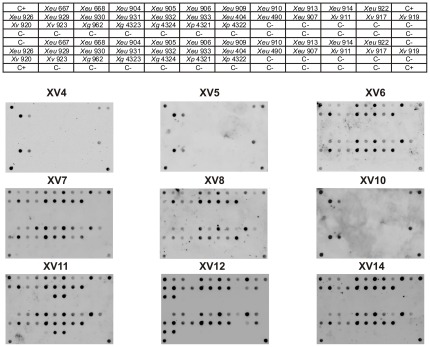
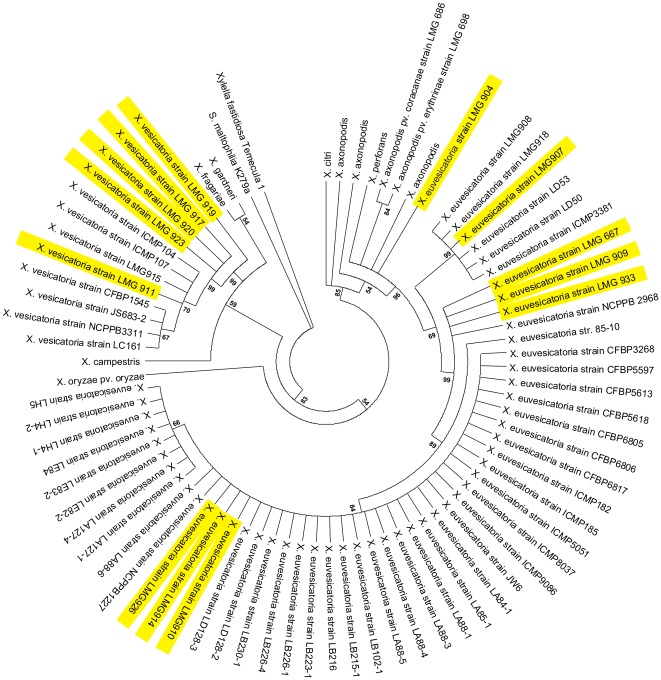
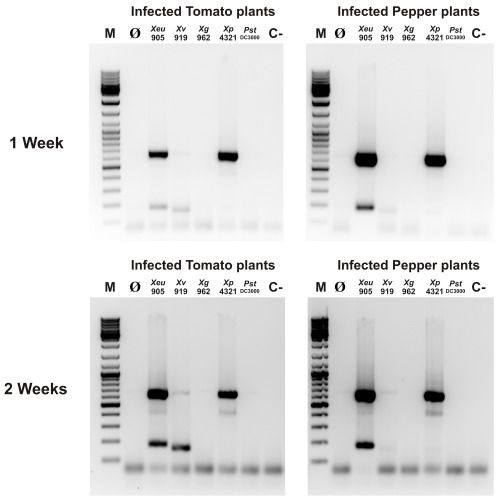
In this work, we selected and validated novel DNA markers for reliable detection of the BSX Xanthomonas euvesicatoria (Xeu). Xeu-specific DNA regions were selected using two online applications, CUPID and Insignia. Furthermore, to facilitate the selection of putative DNA markers, a customized C program was designed to retrieve the regions outputted by both databases. The in silico validation was further extended in order to provide an insight on the origin of these Xeu-specific regions by assessing chromosomal location, GC content, codon usage and synteny analyses. Primer-pairs were designed for amplification of those regions and the PCR validation assays showed that most primers allowed for positive amplification with different Xeu strains. The obtained amplicons were labeled and used as probes in dot blot assays, which allowed testing the probes against a collection of 12 non-BSX Xanthomonas and 23 other phytopathogenic bacteria. These assays confirmed the specificity of the selected DNA markers. Finally, we designed and tested a duplex PCR assay and an inverted dot blot platform for culture-independent detection of Xeu in infected plants.
This study details a selection strategy able to provide a large number of Xeu-specific DNA markers. As demonstrated, the selected markers can detect Xeu in infected plants both by PCR and by hybridization-based assays coupled with automatic data analysis. Furthermore, this work is a contribution to implement more efficient DNA-based methods of bacterial diagnostics.
引起细菌性斑点病的黄单胞菌(BSX)是检疫性植物病原细菌,会导致番茄和辣椒生产的重大损失。尽管研究了改进的植物喷雾方法和抗性品种,但使用健康的植物材料仍然被认为是控制细菌性斑点病的最有效措施。因此,快速有效的检测方法对于早期检测这些植物病原至关重要。
在这项工作中,我们选择并验证了用于可靠检测 BSX Xanthomonas euvesicatoria(Xeu)的新型 DNA 标记物。使用两个在线应用程序 CUPID 和 Insignia 选择了 Xeu 特异性 DNA 区域。此外,为了便于选择可能的 DNA 标记物,设计了一个定制的 C 程序来检索两个数据库输出的区域。进一步扩展了计算机模拟验证,以便通过评估染色体位置、GC 含量、密码子使用和同线性分析,深入了解这些 Xeu 特异性区域的起源。为扩增这些区域设计了引物对,PCR 验证实验表明,大多数引物可以与不同的 Xeu 菌株进行阳性扩增。获得的扩增子被标记,并用于点印迹分析中的探针,该分析允许用 12 种非 BSX 黄单胞菌和 23 种其他植物病原菌测试探针。这些分析证实了所选 DNA 标记物的特异性。最后,我们设计并测试了一种用于非培养检测感染植物中 Xeu 的双重 PCR 检测和倒置点印迹平台。
本研究详细介绍了一种能够提供大量 Xeu 特异性 DNA 标记物的选择策略。如所证明的,所选标记物可以通过 PCR 和基于杂交的检测与自动数据分析相结合来检测感染植物中的 Xeu。此外,这项工作为实施更有效的基于 DNA 的细菌诊断方法做出了贡献。