Department of Oncology, Lombardi Comprehensive Cancer Center, Georgetown University, 3970 Reservoir Road NW, Washington, DC 20057, USA.
Eur J Cancer. 2012 Dec;48(18):3488-98. doi: 10.1016/j.ejca.2012.04.020. Epub 2012 Jun 2.
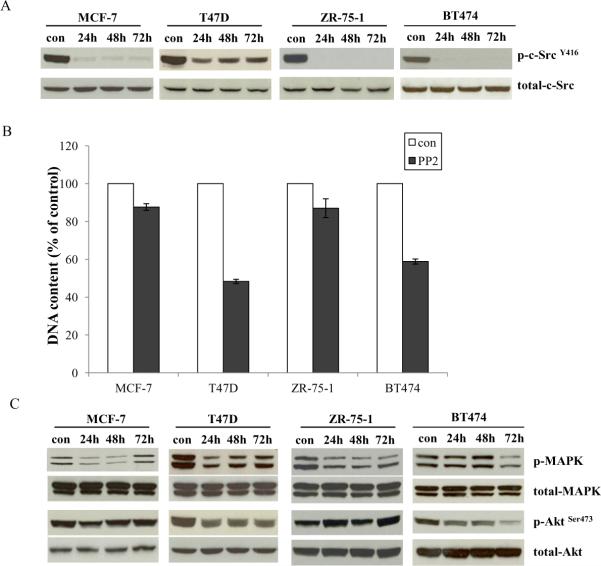
c-Src is an important adapter protein with oestrogen receptor (ER) and human epidermal growth factor receptor 2 (HER2), which validates it as an attractive target for the treatment of breast cancer. A specific c-Src inhibitor, 4-amino-5-(4-chlorophenyl)-7(t-butyl)pyrazolo[3,4-d]pyrinidine (PP2), was utilised to block c-Src activity to identify targeted vulnerabilities affected by ER and HER2 in a panel of breast cancer cell lines.
ER, growth factor receptors and signalling pathways were detected by Western-blot. The DNA content of the cells was determined by using a DNA fluorescence quantitation kit. Cell cycles were analysed by flow cytometry.
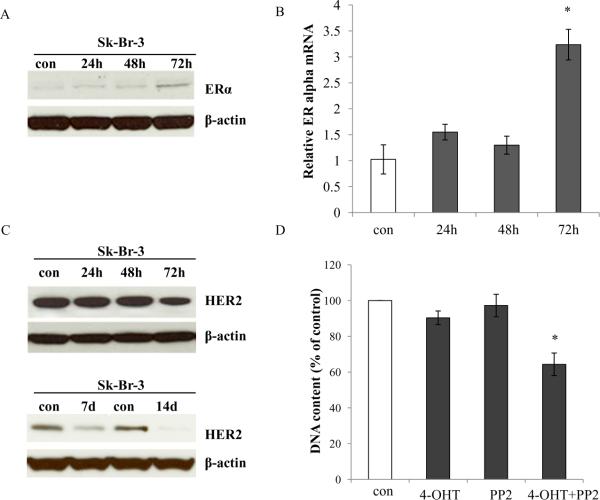
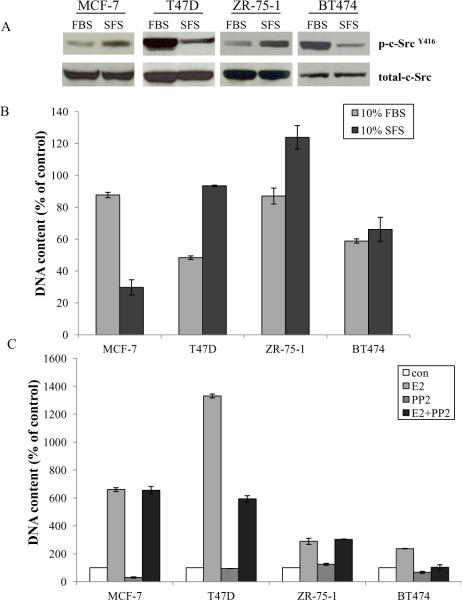
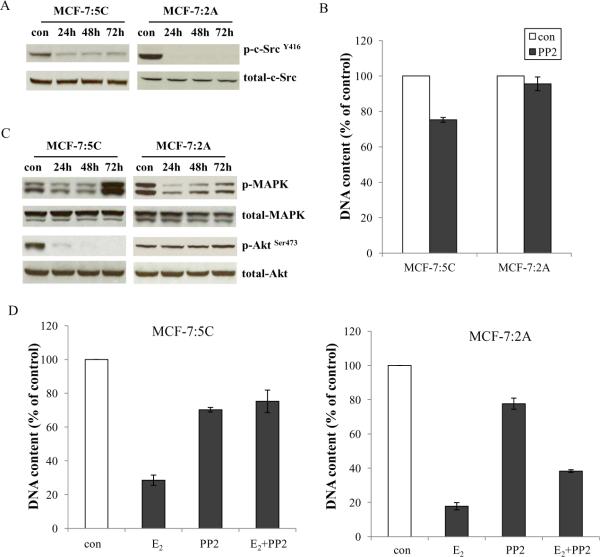
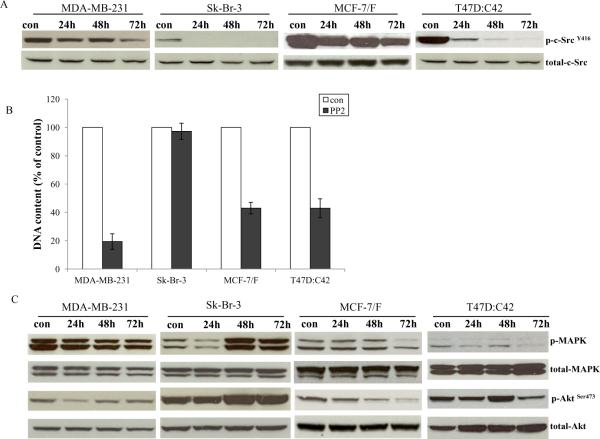
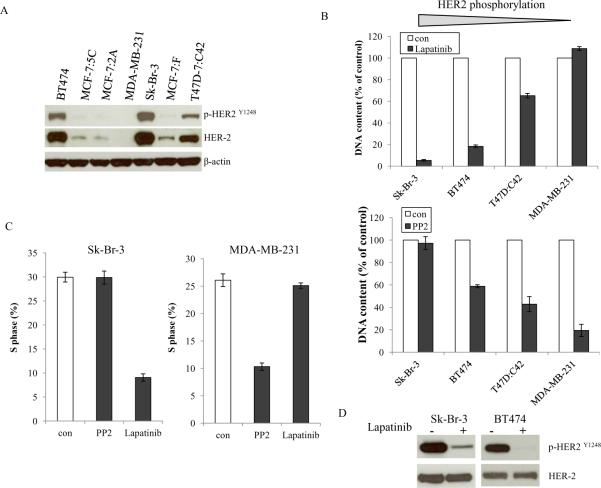
The antiproliferative effect of PP2 closely correlated with the inhibition of c-Src mediated extracellular signal-regulated kinase/mitogen-activated protein kinase (ERK/MAPK) and/or phosphoinositide 3-kinase (PI3K)/Akt growth pathways. Inhibition of c-Src tyrosine kinase predominantly blocked ER negative breast cancer cell growth, particularly the triple (i.e. ER, progesterone receptor (PR), and HER2) negative cells. In contrast, ER negative Sk-Br-3 cells with highest HER2 phosphorylation were resistant to PP2, in which hyper-activated HER2 directly regulated growth pathways. However, blocking c-Src recovered ER expression and down-regulated HER2 which made Sk-Br-3 cells regain responsiveness to 4-hydroxytamoxifen. The majority of ER positive cells were not sensitive to PP2 regardless of wild-type or endocrine resistant cell lines.
c-Src mediates the essential role of growth pathways in ER negative breast cancer cells. The ER positive and HER2 over-activation are two important predictive biomarkers for the resistance to a c-Src inhibitor. These data provided an important therapeutic rationale for patient selection in clinical trials with c-Src inhibitors in breast cancer.
c-Src 是一种重要的衔接蛋白,与雌激素受体 (ER) 和人表皮生长因子受体 2 (HER2) 相互作用,这使其成为治疗乳腺癌的有吸引力的靶标。一种特异性 c-Src 抑制剂,4-氨基-5-(4-氯苯基)-7(t-丁基)吡唑并[3,4-d]嘧啶 (PP2),被用于阻断 c-Src 活性,以鉴定 ER 和 HER2 影响的乳腺癌细胞系中的靶向脆弱性。
通过 Western blot 检测 ER、生长因子受体和信号通路。使用 DNA 荧光定量试剂盒测定细胞的 DNA 含量。通过流式细胞术分析细胞周期。
PP2 的抗增殖作用与 c-Src 介导的细胞外信号调节激酶/丝裂原激活蛋白激酶 (ERK/MAPK) 和/或磷酸肌醇 3-激酶 (PI3K)/Akt 生长途径的抑制密切相关。c-Src 酪氨酸激酶的抑制主要阻断 ER 阴性乳腺癌细胞的生长,特别是三阴性 (即 ER、孕激素受体 (PR) 和 HER2) 阴性细胞。相比之下,HER2 磷酸化最高的 ER 阴性 Sk-Br-3 细胞对 PP2 有抗性,其中过度激活的 HER2 直接调节生长途径。然而,阻断 c-Src 恢复了 ER 表达并下调了 HER2,使 Sk-Br-3 细胞重新对 4-羟基他莫昔芬敏感。大多数 ER 阳性细胞对 PP2 不敏感,无论其是否为野生型或内分泌耐药细胞系。
c-Src 介导了 ER 阴性乳腺癌细胞中生长途径的重要作用。ER 阳性和 HER2 过度激活是对 c-Src 抑制剂产生抗性的两个重要预测生物标志物。这些数据为临床试验中使用 c-Src 抑制剂治疗乳腺癌患者的选择提供了重要的治疗依据。