Geriatric Unit and Rare Disease Center, University Hospital of Bari, Bari, Italy.
Orphanet J Rare Dis. 2012 Jun 7;7:33. doi: 10.1186/1750-1172-7-33.
The difficulty in establishing a timely correct diagnosis is a relevant matter of concern for several rare diseases. Many rare-disease-affected patients suffer from considerable diagnostic delay, mainly due to their poor knowledge among healthcare professionals, insufficient disease awareness among patients' families, and lack of promptly available diagnostic tools. Hereditary Haemorrhagic Telangiectasia (HHT) is an autosomal-dominantly inherited vascular dysplasia, affecting 1:5,000-10,000 patients. HHT is characterized by high variability of clinical manifestations, which show remarkable overlapping with several common diseases.
To perform a detailed analysis concerning the diagnostic time lag occurring in patients with HHT, defined as the time period spanning from the first clinical manifestation to the attainment of a definite, correct diagnosis.
A questionnaire was administered to the HHT patients previously recruited from 2000 and 2009. Clinical onset, first referral to a physician for disease manifestations, and first correct diagnosis of definite HHT were collected. Eventual misdiagnosis at first referral and serious complications occurring throughout the time elapsing between disease onset and definite diagnosis were also addressed.
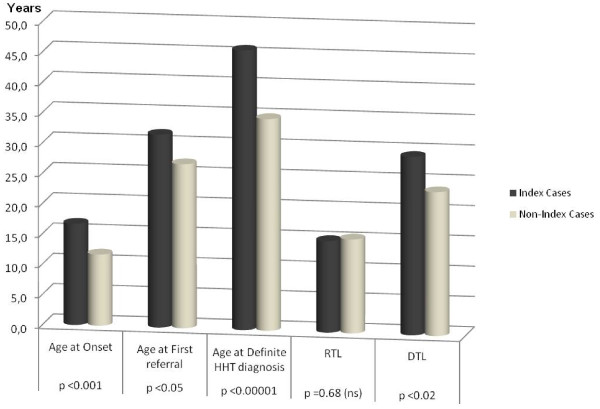
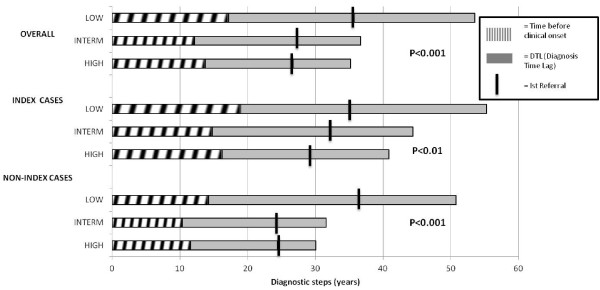
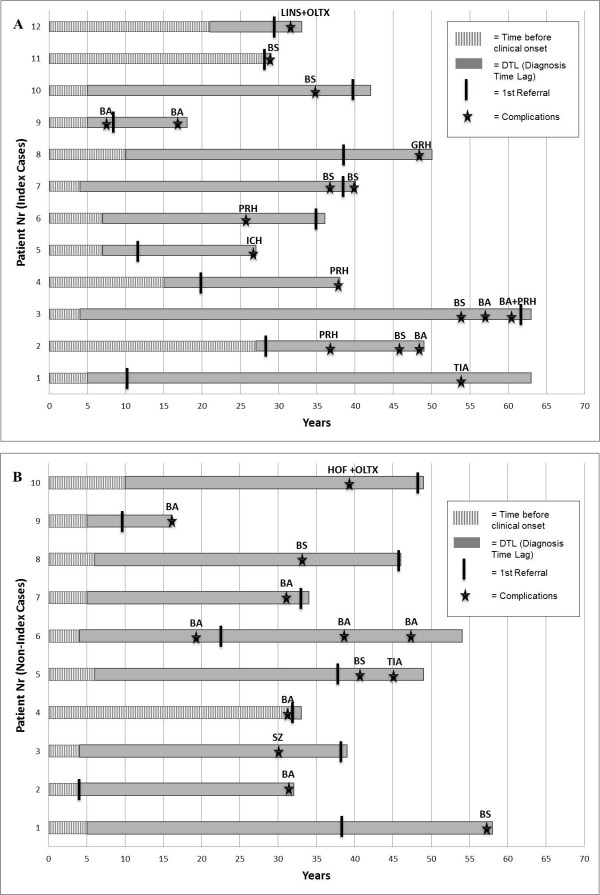
In the 233 respondents, the clinical onset of disease occurred at an age of 14.1 yrs, while the age of first referral and the age of first definite diagnosis of HHT were 29.2 yrs and 40.1 yrs, respectively. Only 88/233 patients received a correct diagnosis at first counseling. Thus, the diagnostic time lag, represented by the time elapsing from disease onset and first definite diagnosis of HHT, proved to be 25.7 yrs. Twenty-two patients suffered from severe complications during this time interval. The diagnostic delay was significantly longer (p < 0.001) in index patients (first patients who attained definite HHT diagnosis in a given family) than in non-index patients (relative of index patients). The diagnostic time lag was also significantly associated with education grade (p < 0.001).
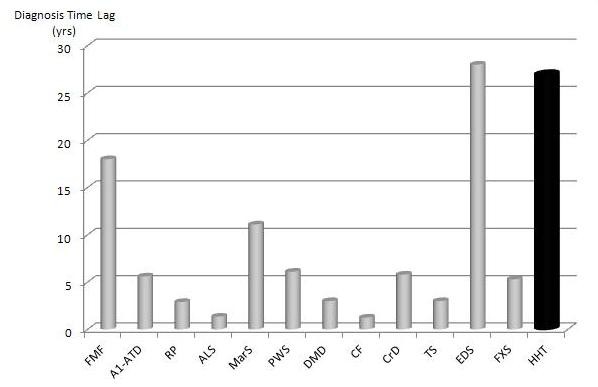
Our data report for the first time a systematic inquiry of diagnostic delay in HHT showing that patients receive a definite diagnosis only after nearly three decades from disease onset. Concerted efforts are still to be made to increase awareness of this disease among both families and physicians.
对于许多罕见病来说,难以及时做出正确诊断是一个令人关注的问题。许多受罕见病影响的患者都经历了相当长的诊断延迟,这主要是由于医疗保健专业人员对此病的了解不足,患者家属对此病的认识不足,以及缺乏及时可用的诊断工具。遗传性出血性毛细血管扩张症(HHT)是一种常染色体显性遗传性血管发育不良,影响每 5000-10000 人中的 1 人。HHT 的临床表现具有高度可变性,与几种常见疾病有显著重叠。
对 HHT 患者的诊断时间延迟进行详细分析,将其定义为从首次临床表现到获得明确、正确诊断的时间段。
对 2000 年和 2009 年以前招募的 HHT 患者进行问卷调查。收集疾病发作时的临床起病、首次因疾病表现就诊于医生、首次明确诊断为 HHT 的时间。还记录了首次就诊时的误诊情况以及从发病到明确诊断期间发生的严重并发症。
在 233 名应答者中,疾病的临床起病年龄为 14.1 岁,而首次就诊年龄和首次明确诊断为 HHT 的年龄分别为 29.2 岁和 40.1 岁。只有 88/233 例患者在首次咨询时得到了正确的诊断。因此,从疾病发作到首次明确诊断为 HHT 的诊断时间延迟为 25.7 年。在此期间,22 例患者发生严重并发症。指数患者(在一个家族中首次获得明确 HHT 诊断的患者)的诊断延迟明显长于非指数患者(指数患者的亲属)(p<0.001)。诊断时间延迟与教育程度显著相关(p<0.001)。
我们首次报告了一项关于 HHT 诊断延迟的系统研究,表明患者在发病近 30 年后才得到明确诊断。仍需做出一致努力,提高家庭和医生对该病的认识。